Archive for the
‘Mental Health Resources’ Category

Authored by the Clinical Team at Lucent Recovery and Wellness
Reviewed by Chris Hudson, MA, LPC, LCDC

A woman called us last spring after making, by her count, eleven phone calls. Two practices had closed. Four never called back. Three didn’t take her insurance despite being listed as in network. Two had waits into the following season. By the time she reached us she opened with an apology, as though the difficulty had been something she’d caused.

We hear that apology a lot, and it’s the part of this we’d most like to correct. The difficulty is structural. It has a federal dataset behind it. And in Texas it’s worse than in almost anywhere else in the country.

The Health Resources and Services Administration, part of the U.S. Department of Health and Human Services, publishes a quarterly count of designated health professional shortage areas. In the summary published February 15, 2026, with data as of December 31, 2025, there were 6,807 designated mental health professional shortage areas nationally, covering a population of 137,133,953 people. HRSA estimates it would take 6,800 additional practitioners to lift all of those designations.

One hundred thirty-seven million people. Roughly four in ten Americans live somewhere the federal government has formally recorded that there aren’t enough mental health providers.

Texas sits at the top of that list on absolute practitioner need. This article explains what’s driving that, what it does to wait times, and what actually shortens a search. Some of the advice runs counter to what people usually try first.

What a shortage area designation means, and what it doesn’t

The term gets used loosely, so it’s worth being precise.

A Mental Health Professional Shortage Area is a federal designation applied to a geographic area, a specific population group, or a facility, based on the ratio of population to available mental health providers alongside factors like poverty rate and travel time to the nearest source of care. Designations feed into federal programs including loan repayment and placement incentives designed to move clinicians toward underserved areas.

What the designation tells you is that provider supply is thin relative to population.

What it does not tell you is anything about the providers who are there. It doesn’t indicate whether they take your insurance, whether they’re accepting new patients, or whether their rates are affordable. Those are separate failures, and they compound the first one. An area can technically have providers present while remaining functionally inaccessible to most people who live there.

This gap between “provider exists” and “care reachable” explains why states sometimes rank differently on workforce supply than on actual access. Texas performs badly on both.

Why Texas is at the top of the list

Four factors stack here.

Population size and growth. Texas is the second most populous state and among the fastest growing. Provider supply hasn’t tracked population growth, and a growing denominator worsens the ratio even when the number of clinicians increases.

Geography. Texas covers roughly 268,000 square miles across 254 counties. A provider in one county does nothing for a resident three counties over. HRSA’s data shows 4,212 of the nation’s mental health shortage areas are rural, covering more than 30 million people, and Texas contributes heavily to that figure. The overwhelming majority of Texas counties are wholly or partially designated.

Provider concentration. The clinicians who are here cluster in the major metros. Austin, Houston, Dallas, and San Antonio hold a disproportionate share of the state’s licensed behavioral health workforce relative to their share of the population.

Reimbursement and retention. Mental Health America identifies low reimbursement rates as a primary barrier to recruiting and retaining behavioral health clinicians. When Medicaid, Medicare, and commercial insurers pay poorly for mental health services, providers stop accepting insurance or leave the field. Both outcomes reduce accessible supply without changing the raw headcount.

The result: Mental Health America puts Texas mental health workforce availability at roughly one provider per 640 residents, against a national ratio near 320 to 1. Texas ranks 50th of 51 on that measure.

The pipeline problem nobody sees

There’s a bottleneck upstream of all this that rarely gets discussed outside the profession, and it’s worth understanding because it explains why the shortage is persistent rather than temporary.

Becoming an independently licensed mental health clinician in Texas requires a master’s degree followed by a substantial period of supervised practice. An LPC-Associate, LMSW, or LMFT-Associate cannot practice independently. They must work under the clinical supervision of a licensed supervisor who takes formal responsibility for their work.

Supervisors are themselves scarce, and supervision is time that isn’t billable at full rate. Which means the rate at which new clinicians can enter independent practice is capped by the availability of experienced clinicians willing to supervise them. You can graduate more students. You cannot easily manufacture more supervisors.

You can see this structure on any clinical team, including ours. Several of our associate-level clinicians practice under named supervisors, which is both a licensure requirement and a genuine layer of clinical oversight. Our team page lists those relationships openly.

Texas established a Mental Health Professional Pipeline Program in 2025 aimed at building pathways from public junior colleges into behavioral health degrees and licensure. That’s a real step. It’s also a program whose effects arrive in five to eight years, not this quarter.

What the shortage does to your wait

The mechanics are straightforward. Fewer providers per person means longer books.

But the way waits distribute is less obvious, and it’s where most people lose time.

Individual therapy with a specific clinician is usually the longest wait. One person’s calendar has a fixed number of slots. When a therapist is full, they’re full, and the queue extends.

Specialty care waits longer than general counseling. Trauma-specialized clinicians, prescribers, child and adolescent psychiatry, and programs equipped for co-occurring mental health and substance use conditions all have thinner supply than generalist talk therapy.

Prescribers wait longer than therapists. Psychiatric providers are scarcer, and child psychiatry is the scarcest subspecialty in the country.

Structured programs frequently wait less. This is the finding that surprises people, and it’s the most useful thing in this article.

Why higher levels of care can have shorter waits

If you’ve spent six weeks trying to book a weekly therapy appointment, being told that a more intensive program might see you sooner sounds backwards. Here’s why it isn’t.

Individual therapy runs on one clinician’s calendar. An intensive outpatient program runs on a cohort schedule. Groups have a defined size and a defined rotation, and when someone completes the program a slot opens. The program isn’t gated by a single person’s availability, it’s gated by census, and census turns over.

Programs like these also typically employ their own psychiatric providers, which means psychiatric evaluation and medication management are bundled rather than requiring a separate search and a separate wait. For someone who needs both therapy and a medication evaluation, that consolidation can compress a months-long process into weeks.

The important caveat: level of care should be a clinical decision, not a scheduling workaround. Nobody should enter a structured program because it was available. But a lot of people who’ve been waiting for weekly therapy are, on assessment, appropriate for more structure than weekly therapy provides. Their symptoms were interfering with functioning the whole time. They just assumed weekly was the entry point because it’s the option they’d heard of.

If you want to see how the levels differ, our page on mental health treatment options in Austin, TX breaks down partial hospitalization, intensive outpatient, and outpatient counseling and what each asks of your week. Our intensive outpatient program page covers the middle tier in more detail.

Seven things that shorten a search in Texas

After years of doing this here, these are the moves that actually help.

1. Lead with the clinical question. Instead of “do you have openings,” ask “what level of care would you recommend for what I’m describing, and how soon could someone assess me?” You’ll get a clinical answer, a timeline, and often a referral you wouldn’t have found alone.

2. Ask if they’re accepting new patients. Not whether they’re in network. Directories are unreliable on the first and silent on the second. This one question eliminates most dead-end calls.

3. Get assessed somewhere, even if it isn’t your final answer. A clinical assessment tells you what intensity of care you need. That single piece of information makes every subsequent call dramatically more efficient, because you stop searching for the wrong thing.

4. Don’t restrict yourself to individual therapists. Look at programs. See the section above.

5. Say out loud how long you’ve been searching. If you’ve called nine places, tell the tenth. Programs triage, and duration of unsuccessful search is relevant clinical information about your situation, not a complaint.

6. Ask about cancellation lists. Many practices maintain one and few advertise it. In a market this tight, cancellations are a meaningful channel.

7. Consider virtual care for individual therapy. It genuinely widens the pool. We provide individual mental health counseling virtually to people located anywhere in Texas. Broadband and privacy at home are real limitations, but where they aren’t obstacles, telehealth removes geography from the equation.

If you’re waiting right now

Waiting is not neutral. It’s the period during which people give up, and given how much effort it took to start, that’s worth naming.

A few things to hold onto:

Being on a waitlist is not the same as having no options. Crisis resources are available 24 hours a day and don’t require established care or insurance. 988 handles crises broadly, not only suicidal thoughts, and it’s staffed around the clock.

Continue making calls after you’ve been given a wait. People often stop searching once they’ve secured a distant appointment, and then wait months for a slot they might have beaten elsewhere.

Tell somebody in your life what’s happening. Not as a substitute for treatment, but because isolation makes waiting harder and because the people around you generally want to be useful and don’t know how.

And if things get worse while you wait, call back and say so. Deterioration changes the clinical picture and can change your priority. Programs would rather know.

Frequently asked questions

How many mental health shortage areas does Texas have? HRSA publishes these counts quarterly and they shift with each release, which is why you’ll see different figures in different articles depending on which snapshot they used. Rather than quote a number that may be stale, we’d point you to HRSA’s shortage area data directly, where you can pull the current designation count and practitioner shortfall for Texas with the data-as-of date attached. What’s consistent across releases is that Texas leads the nation in absolute practitioner need.

Does the shortage mean the therapists who are available are lower quality? No, and we’d push back on that inference. High demand and long waits are a supply condition, not a quality signal. Texas has excellent clinicians. There simply aren’t enough of them relative to the number of people who need care, which is a different problem than a quality problem.

Why do so many good therapists not take insurance? Reimbursement. Mental Health America identifies low payment rates as a primary barrier to retaining behavioral health providers. When insurance pays substantially less than a clinician’s sustainable rate, and requires administrative work on top of it, some providers conclude the arrangement isn’t viable. That’s an economics problem in the payment system rather than a character problem in the profession.

Is it worth getting on multiple waitlists at once? Yes, and we’d encourage it. Be straightforward with each program that you’re pursuing several options, which nobody will hold against you. Then tell the others when you land somewhere, so the slot frees up for the next person.

Will the shortage improve? Not quickly. Federal workforce projections show demand growing considerably faster than supply across behavioral health disciplines over the next decade. State pipeline programs and telehealth expansion help at the margin. Anyone promising near-term resolution is not reading the same data.

Does this affect people with more serious conditions differently? Yes, and often in the opposite direction from what you’d assume. Coordinated care for serious mental illness requires psychiatric management, therapy, and case management working together, and assembling those pieces independently in a shortage market is very difficult. Programs that provide them under one roof can be substantially easier to access than the equivalent set of separate providers. Our case management services exist partly to handle that coordination on the client’s behalf.

What if I’m calling on behalf of a family member who won’t call themselves? That’s common and it’s fine. We talk to family members regularly. There are limits on what we can share about an adult who hasn’t authorized it, but there’s no limit on what we can explain to you about levels of care, what an assessment involves, and how to have the conversation. Our what to expect for families page covers how family involvement works once someone is in treatment.

The part we’d underline

The reason it’s hard to get a mental health appointment in Texas is that there are roughly half as many providers per resident as the national average, in a large state where they’re concentrated in four metros, inside a payment system that pushes clinicians out of insurance networks and out of the profession.

That’s not your fault and it isn’t a reflection of how much your situation warrants attention.

What it means practically is that the search rewards a specific kind of persistence: asking clinical questions instead of scheduling questions, getting assessed early so you know what you’re actually looking for, and considering structured programs rather than defaulting to weekly therapy because it’s the familiar option.

If you’re in Central Texas and stuck in this process, we’re happy to be one of your calls. We’ll tell you what level of care we’d recommend and how quickly we could assess you, and if we’re not the right fit we’ll say so and point you elsewhere. Reach us at 512-588-3899 or through our contact page.


If you need support right now

If you’re in crisis or having thoughts of harming yourself, you don’t need to wait for an appointment. Call or text 988 to reach the 988 Suicide & Crisis Lifeline, available 24 hours a day. For treatment referrals and information, SAMHSA’s National Helpline is free and confidential at 1-800-662-4357. If this is a medical emergency, call 911.

Healing and recovery at Lucent Recovery and Wellness

Reviewed by Chris Hudson, LPC

Founder & Executive Director – Lucent Recovery and Wellness, Austin, TX (2020–Present)
Leads clinical programs and develops innovative therapeutic approaches integrating experiential and creative therapies.

Board Member – Reklaimed, Austin, TX
Supports recovery-focused nonprofit initiatives fostering community and creative skill-building.

Clinical Leadership Roles – South Meadows Recovery, Inc.
Held leadership positions overseeing program development, clinical operations, and organizational management.

EDUCATION & CREDENTIALS

  • M.A., Clinical Mental Health Counseling – Seminary of the Southwest (2021)
  • B.A., Studio Art – Lewis & Clark College (2004)
  • Licensed Professional Counselor (LPC), Texas
  • Licensed Chemical Dependency Counselor (LCDC), Texas

Authored by the Clinical Team at Lucent Recovery and Wellness
Reviewed by Chris Hudson, MA, LPC, LCDC

One of the more disorienting parts of looking for eating disorder help is discovering that treatment is not one thing. It is a ladder. And nobody hands you a map of the ladder before asking you to pick a rung.

Families call us having spent an evening on treatment center websites, and they usually arrive with the same confusion. Some programs describe residential care. Some describe partial hospitalization. Some describe intensive outpatient. The language across all of them sounds reassuring, professional, and hard to tell apart. Meanwhile the question underneath is much simpler: how much structure does this person need right now, and what happens if we guess wrong?

Here is what the levels actually mean, how clinicians decide between them, and why the answer changes over time.

Why level of care is the first clinical decision

Before anyone discusses therapy modalities, someone has to work out how much containment a person needs in order to be safe and to make progress. Get this wrong in one direction and you place someone in a setting that cannot keep them medically safe. Get it wrong in the other and you pull someone out of their life unnecessarily, which carries its own costs.

This decision is not primarily about diagnosis. Two people with the same diagnosis can need very different levels of support depending on medical stability, how often symptoms are occurring, whether those symptoms can be interrupted between sessions, what the home environment looks like, and what else is going on psychiatrically.

That last factor matters more than most people expect. National Institute of Mental Health data shows that eating disorders overwhelmingly co-occur with other psychiatric conditions. More than half of adults with anorexia nervosa, nearly 95 percent of those with bulimia nervosa, and roughly 79 percent of those with binge eating disorder met criteria for at least one other core disorder, with anxiety disorders the most common across all three. Someone managing an eating disorder alongside panic attacks and a trauma history often needs more support than the eating disorder symptoms alone would suggest.

The levels, from most to least structured

Inpatient medical stabilization

This is a hospital setting, and it exists for one purpose: medical safety. Eating disorders can produce cardiac, electrolyte, and other complications that require monitoring no outpatient program can provide. Admission here is driven by physical status, not by how distressing the symptoms feel.

Inpatient stays are usually short and narrowly focused. Stabilize, then step down. Meaningful psychological work generally happens at the next rung, once the body is out of danger.

Residential treatment

Residential programs provide 24-hour supervision in a non-hospital setting. People live on site, meals are supported, and the day is structured around programming. This level suits people who are medically stable enough to be out of hospital but who cannot yet interrupt symptoms without constant structure around them.

The tradeoff is significant. Residential means stepping out of work, school, and daily life entirely, sometimes for weeks or months, often far from home.

Partial hospitalization, sometimes called day treatment

People attend programming for a substantial portion of the day, most days of the week, then go home at night. It offers much of the structure of residential care while allowing someone to sleep in their own bed and stay connected to their support system.

For eating disorders specifically, partial hospitalization usually includes supported meals and dietetic input, because the eating itself is part of what needs structure. That is a different thing from a general mental health day program, and the distinction matters when you are comparing options.

Intensive outpatient

Intensive outpatient typically involves several hours of programming several days per week, scheduled so people can keep working or studying around it. Group therapy tends to be the backbone, supplemented by individual sessions.

The argument for this level is not that it is easier or cheaper, though it is often both. It is that recovery practiced inside your actual life tends to be recovery that holds. You encounter real triggers in real settings and bring them back to the group that week, rather than meeting them for the first time after discharge from a controlled environment.

Standard outpatient

Weekly or twice-weekly therapy, often alongside appointments with a dietitian and a medical provider. This suits people whose symptoms are relatively contained, people in maintenance after more intensive treatment, and people whose symptoms are emerging but not yet entrenched.

How clinicians actually decide

There is no formula. Clinical judgment weighs several factors together.

Medical status. Vital signs, labs, and physical findings, assessed by a medical provider. This can override every other consideration.

Symptom frequency and interruptibility. How often are symptoms occurring, and can the person interrupt them with support but without constant supervision?

Co-occurring conditions. Active suicidality, substance use, or severe anxiety can each push toward more structure.

Environment. Whether home is a place where recovery is possible. This is not about whether a family is loving. It is about practical realities: who is present during high-risk hours, what the living situation looks like, whether there is stability.

Previous treatment history. Someone who has completed a program twice without durable change may need something different. As we note below, that is usually a signal about fit rather than about capacity for recovery.

Motivation and insight. Ambivalence is normal and expected in eating disorder treatment. It is not disqualifying. But it does inform how much external structure is useful.

Where we fit

We should be direct about our own place on this ladder, because vague answers here waste people’s time.

Lucent is a clinician-owned outpatient mental health practice in Austin. We work at two of the rungs described above. Our partial hospitalization program provides structure most days of the week for people who need frequent clinical contact while things stabilize, and our intensive outpatient program provides real structure around work, school, and ordinary life. Ongoing mental health counseling and master’s level case management run alongside both.

What we treat is the part of this picture that most often goes unaddressed. Many people arrive at eating disorder treatment with an untreated anxiety disorder, depression, or trauma history running underneath, and those conditions are frequently what determines whether progress holds. Every therapist on our outpatient team holds a master’s degree and clinical licensure, and a board-certified psychiatrist serves as our Medical Director for evaluation and medication management.

If you are already working with a physician, a dietitian, or another provider, we coordinate with them rather than asking you to start over. Our case management team handles that communication so you are not the one relaying messages between people.

Movement between levels is normal

The most common misconception we encounter is that level of care is a single decision made once. It is not. It is a working hypothesis that gets revised.

Most treatment trajectories involve stepping down as someone stabilizes. Some involve stepping back up, and that is not failure. Recovery from an eating disorder is rarely linear, and needing more support at some point is a clinical event, not a moral one.

A May 2026 meta-analysis in JAMA Psychiatry examining 36 randomized trials of digitally delivered eating disorder interventions found moderate improvements in core symptoms, with weaker but still statistically significant gains sustained at follow-up. Digital tools are becoming a genuine part of this landscape, particularly for lower-intensity support and for people who cannot access in-person care. What that research does not suggest is that an app substitutes for structured treatment when someone needs structured treatment. The most useful way to think about it is as another rung, and as a way to extend support between the others.

The bigger problem: most people never enter the ladder at all

For all the complexity of choosing a level of care, the more pressing issue is how many people never get to that decision.

NIMH data indicates that roughly a third of adults with anorexia nervosa and just over 43 percent of those with bulimia nervosa or binge eating disorder have ever sought treatment specifically for their eating disorder. Those figures come from the National Comorbidity Survey Replication, the most recent nationally representative diagnostic-interview data NIMH publishes, though the survey itself was fielded in the early 2000s.

A report from Deloitte Access Economics, produced for Harvard’s Strategic Training Initiative for the Prevention of Eating Disorders and the Academy for Eating Disorders, estimated that 28.8 million Americans will experience an eating disorder during their lifetime, and that people of color are roughly half as likely to be diagnosed or receive treatment.

Those gaps are not explained by a shortage of motivation. They reflect stigma, cost, the persistent and false belief that eating disorders have a recognizable appearance, and the experience of being dismissed by a provider who did not think the person looked sick.

If you have been told you are not sick enough, or told it indirectly by the absence of anyone taking your concerns seriously, that assessment was about the limits of the person making it.

Frequently asked questions

Do I need to know which level I need before I call? No. Working that out is what an assessment is for. A good assessment will tell you plainly if what you need is something a given program does not provide.

Can I move down a level before I feel ready? Step-downs are planned rather than sudden, and readiness is part of the clinical conversation. If a step-down happens and turns out to be premature, stepping back up is a normal adjustment.

What if my insurance will only cover a lower level than recommended? This happens, and it is frustrating. Programs can often help with appeals and documentation. It is worth asking directly what a program’s experience is with your specific insurer.

Is intensive outpatient enough for a serious eating disorder? Sometimes, and sometimes not. It depends on medical stability, whether symptoms can be interrupted between sessions, and what support exists at home. Severity alone does not determine the answer.

What if I have already been through treatment more than once? Previous treatment that did not hold can mean the level of care was not right, the approach was not matched to the presentation, co-occurring conditions were not addressed, or the timing was wrong. It is information for planning the next attempt, not a verdict on whether recovery is possible.

What if I am already working with other providers? That is common and it works well. If you already have a physician, a psychiatrist, a dietitian, or a therapist you want to keep, we coordinate with them rather than asking you to start over. Our case management team handles that communication so you are not the one relaying messages between people.

Where to begin

You do not need to determine your own level of care before reaching out. Working that out is the assessment’s job.

If you want to talk with someone before contacting a program, the National Alliance for Eating Disorders operates a free helpline staffed by licensed therapists who specialize in eating disorders at 1-866-662-1235, Monday through Friday, 9:00 a.m. to 7:00 p.m. Eastern, along with a free national referral database at findEDhelp.com. If you or someone you love is in crisis, the 988 Suicide and Crisis Lifeline is available 24 hours a day by call or text at 988.

And if you are weighing options for eating disorder care in Austin, TX, we are glad to talk through where you are and what level of care would actually fit. You can contact our team or call 512-588-3899.

Healing and recovery at Lucent Recovery and Wellness

Reviewed by Chris Hudson, LPC

Founder & Executive Director – Lucent Recovery and Wellness, Austin, TX (2020–Present)
Leads clinical programs and develops innovative therapeutic approaches integrating experiential and creative therapies.

Board Member – Reklaimed, Austin, TX
Supports recovery-focused nonprofit initiatives fostering community and creative skill-building.

Clinical Leadership Roles – South Meadows Recovery, Inc.
Held leadership positions overseeing program development, clinical operations, and organizational management.

EDUCATION & CREDENTIALS

  • M.A., Clinical Mental Health Counseling – Seminary of the Southwest (2021)
  • B.A., Studio Art – Lewis & Clark College (2004)
  • Licensed Professional Counselor (LPC), Texas
  • Licensed Chemical Dependency Counselor (LCDC), Texas

Authored by the Clinical Team at Lucent Recovery and Wellness
Reviewed by Chris Hudson, MA, LPC, LCDC

Most people arrive at this question already tired. They’ve done something already, and it wasn’t enough, and now they’re trying to figure out what “more” looks like without much guidance about what the options even are.

That confusion is reasonable. Mental health care in this country is organized into levels of care that clinicians talk about fluently and almost nobody explains to the public. People know about therapy and they know about hospitals. Between those two there’s a whole range of treatment intensity that most people don’t discover until someone tells them, which is usually years after it would have helped.

The 2025 National Survey on Drug Use and Health, released by SAMHSA on July 27, 2026, found that 21.6% of U.S. adults, about 57.3 million people, received mental health treatment in the past year. That’s a lot of people in care. And yet Mental Health America’s State of Mental Health in America data still shows one in four adults with a mental illness reporting an unmet need for treatment.

Part of that gap isn’t about access at all. It’s about intensity. People receiving weekly therapy when their situation calls for considerably more structure, and concluding from the lack of progress that treatment doesn’t work for them.

This is a plain-language guide to the levels of care available in Austin, what each one asks of your week, how clinicians actually decide between them, and what to ask any program before you enroll.

Why “getting help” isn’t one thing

Level of care describes how much treatment you receive and how much structure surrounds it. It’s not a measure of how serious your problems are, and it’s not a ranking of how much you’re struggling.

We labor this point because people hear “higher level of care” and interpret it as a verdict. It isn’t. It’s closer to a dosage question. Two people with the same diagnosis can need completely different intensities depending on how much the symptoms are interfering with daily function, what support they have at home, whether substances are involved, and what they’ve already tried.

The levels, from least to most intensive: weekly outpatient therapy, intensive outpatient programming, partial hospitalization, and inpatient or residential care. Each has a role. The skill is in matching.

Weekly outpatient therapy

What it is: typically one 50-minute session per week with a licensed clinician, sometimes alongside medication management from a separate psychiatric provider.

What it’s genuinely good at: focused work on a defined issue, maintenance after a higher level of care, processing life transitions, and the slow relational work that only happens across a long stretch of time with one person. Most therapeutic change in the world happens at this level.

Where it runs out: when symptoms are interfering with your ability to function day to day, one hour a week is not enough contact to interrupt the pattern. Six days pass between sessions. If you’re having trouble getting out of bed, or the anxiety is running the whole schedule, or you’re using substances to manage either, weekly therapy tends to become a place to report on the week rather than a mechanism for changing it.

We see a specific version of this often. Someone has been in weekly therapy for a year or two, likes their therapist, and hasn’t gotten meaningfully better. They’ve concluded they’re treatment-resistant. Frequently they’ve just been under-dosed.

Our individual mental health counseling is available in person in Austin and virtually across Texas.

Intensive outpatient programs

What it is: structured group and individual therapy several days per week, typically in three-hour blocks scheduled around work and school. Individual sessions, case management, and psychiatric support are woven in as clinically indicated.

What it’s good at: this is the level of care built specifically for people who need significant treatment and can’t stop their lives to get it. Group therapy does most of the work, supported by individual sessions. The frequency means a bad week gets caught in days rather than a month.

What it asks of you: real time, several days a week, on a fixed schedule. That’s a genuine imposition and worth planning around honestly.

Group is the part people most often dread and most often end up valuing. The common fear is having to perform vulnerability in front of strangers. What actually tends to happen is more ordinary: somebody describes an experience you thought was yours alone, in language you hadn’t found yet, and something loosens.

Our outpatient mental health treatment program in Austin runs on this model, with small groups and a current clinician-to-client ratio in programming of 1:4.

Who it tends to fit: people whose symptoms are interfering with functioning but who are safe at home, people stepping down from a higher level of care, people for whom weekly therapy hasn’t been enough, and people managing co-occurring mental health and substance use conditions.

Partial hospitalization programs

What it is: the most structured care available to someone who still sleeps at home. Days are full: individual therapy, multiple group sessions, psychiatric evaluation and medication management, and case management, on a near-daily schedule.

What it’s good at: stabilizing an acute period without hospitalization. It provides most of the clinical intensity of inpatient care while keeping you in your own bed, in your own life, practicing what you’re learning in the environment where you actually have to use it.

What it asks of you: most of your weekday. For many people that means arranging leave from work or a reduced course load. That’s a significant ask, and if a partial hospitalization program is the right clinical fit, we’d rather talk through leave options and how to have that conversation with an employer than pretend the scheduling isn’t a real obstacle.

Who it tends to fit: people whose symptoms are substantially impairing daily function, people recently discharged from inpatient care who need a bridge, and people for whom intensive outpatient has proven insufficient.

Our partial hospitalization program page covers the schedule and structure in more detail.

Inpatient and crisis care

What it is: 24-hour care in a hospital or residential facility.

When it’s the right call: when someone isn’t safe outside a monitored setting, when acute psychiatric symptoms require medical stabilization, or when withdrawal management needs medical supervision.

We’re an outpatient provider and we don’t offer inpatient care. What we do is recognize when someone needs it and help them get there rather than admitting them to a program that can’t hold what they’re carrying. That happens, and it isn’t a failure of the assessment. It’s the assessment working.

If you’re in immediate crisis, don’t wait for an appointment. Call or text 988, or call 911 for a medical emergency.

Step-down and continuing care, the part most people skip

Here’s where we’d focus if we could change one thing about how mental health treatment is generally structured.

Programs end. Symptoms improve, insurance authorization runs out, the cohort completes, and someone goes from twelve hours of clinical contact a week to zero. That transition is where a lot of progress gets lost, and it’s rarely planned with the same care as admission.

Continuing care can mean stepping down from partial hospitalization to intensive outpatient, then to weekly therapy. It can mean recovery coaching or ongoing case management. For some people it means transitional services, which combine supportive living with continued clinical contact while routines, work, and relationships get rebuilt.

The same question matters most right after a hospital stay. Our guide to what families can plan for after a psychiatric hospital stay in Austin walks through the discharge week, from the first appointment to the shape of the first days home.

The point isn’t that everyone needs all of these. It’s that the question “what happens when this ends” should be asked at the beginning, not in the final week. Ask any program you’re considering what their step-down process looks like. The answer tells you a lot.

How clinicians actually decide

An assessment isn’t a test you pass or fail, and there’s no severity score that maps to a level of care. What a clinician is weighing is roughly this:

Functioning. What has this stopped you from doing? Work, school, parenting, leaving the house, maintaining a household, sleeping. This is the single most informative question, and it’s more useful than trying to rate how bad you feel.

Safety. Are you safe where you are right now? This determines whether outpatient care is appropriate at all.

Support. Who’s around you, and what can they realistically hold? Someone living alone and someone living with an involved partner may need different intensities for identical symptoms.

Substance use. Whether it’s part of the picture, and whether withdrawal needs medical management. Co-occurring conditions treated in sequence usually don’t resolve. They need to be in the same treatment plan.

Treatment history. What you’ve tried, at what intensity, and what happened. “Therapy didn’t work” and “weekly therapy for eight months with a generalist while drinking every night” are very different pieces of information.

Practical constraints. Your job, your kids, your transportation, your insurance. A clinically ideal recommendation you can’t actually attend helps nobody.

That last item is the one that gets undervalued. The best level of care is the most appropriate one you can actually sustain.

What each level costs you in hours

A rough sense of the weekly commitment, which is often the deciding practical factor:

Level of care Typical weekly clinical hours Can you keep working?
Weekly outpatient therapy 1 hour Yes
Intensive outpatient program Roughly 9 to 12 hours across several days Usually, with scheduling
Partial hospitalization program Most of the weekday, several days a week Often requires leave or reduced hours
Inpatient or residential 24-hour care No

Specific schedules vary by program. Ask for the actual hours before enrolling rather than assuming.

Nine questions to ask any Austin program before you enroll

We’d ask these of ourselves, and we’d expect a straight answer from anyone.

  1. What level of care are you recommending for me, and why that one?
  2. How soon could I be assessed, and how soon could I start?
  3. What are the actual days and hours?
  4. Who would my clinician be, and what are their credentials and licensure?
  5. Is there a psychiatric provider on staff, or would I need to find one separately?
  6. Will you verify my benefits and give me an out-of-pocket estimate before I commit?
  7. What does your step-down or continuing care process look like?
  8. How is my family involved, and to what extent is that my choice?
  9. If I’m not a good fit here, will you refer me elsewhere?

A program that answers all nine plainly is telling you something about how it operates. So is one that deflects on cost or credentials.

Frequently asked questions

Can I start at a higher level of care without having tried therapy first? Yes. There’s no requirement to fail at a lower level before accessing a more intensive one, and the idea that you have to work your way up is a misconception that costs people time. If an assessment indicates intensive outpatient or partial hospitalization is appropriate, that’s where you should start.

What if I’m recommended a level of care I can’t attend? Say so immediately, and be specific about the constraint. Sometimes there’s scheduling flexibility. Sometimes a different program is a better logistical fit. Sometimes the honest answer is that the next level down is imperfect but sustainable, and that’s a real conversation to have with a clinician rather than a reason to walk away entirely.

Do I have to do group therapy? In intensive outpatient and partial hospitalization, group is a core component rather than an optional add-on, because the format is doing specific therapeutic work that individual sessions don’t replicate. If group is genuinely intolerable for you, that’s worth raising at assessment, because it may point toward a different treatment plan. It’s also worth knowing that most people who dread group beforehand describe it differently after two weeks.

How is this different from rehab? “Rehab” colloquially refers to residential substance use treatment. The levels of care described here are outpatient mental health programs, which means you live at home and treat conditions like depression, anxiety, trauma, and bipolar disorder, often alongside substance use when both are present. Different setting, different structure, and no requirement to leave your life.

Will my insurance cover an intensive outpatient or partial hospitalization program? Many commercial plans cover both, often subject to authorization requirements and clinical criteria. Coverage varies substantially by plan, so the only reliable answer comes from a benefits verification. Ask for that before enrolling and ask specifically about deductible, coinsurance, and estimated out-of-pocket cost for the recommended level of care.

How long do these programs last? Weeks rather than months in most cases, with the specific length depending on the condition, the level of care, and progress. Any program that quotes you a confident duration before assessing you is guessing. What we’d want you to hear is that the goal is a planned step down, not indefinite enrollment.

What if I live outside Austin? Our Spicewood Springs Road location serves the greater Austin area including Cedar Park, Georgetown, Lakeway, Bee Cave, Kyle, San Marcos, and Bastrop. For structured programs the commute is a real consideration and worth discussing honestly. For individual counseling, we provide virtual care to people located anywhere in Texas, which matters in a state where most counties are federally designated mental health shortage areas.

Can I be treated for both a mental health condition and substance use in the same program? Yes, and in our view that’s the only approach that reliably works when both are present. Several clinicians on our outpatient team hold both mental health and chemical dependency licensure specifically so one treatment plan can address both rather than handing you off between two systems.

Where to start

If you take one thing from this, let it be that “getting help” isn’t a single decision. It’s a question of which intensity fits your situation, and that question has a real answer that a clinical assessment can give you in a single conversation.

A lot of people we work with spent years cycling through under-dosed care and concluding they were beyond treatment. They weren’t. They just hadn’t been offered the right level of it.

Recovery from mental health conditions is common. SAMHSA’s 2025 survey found 44.1 million American adults who describe themselves as in recovery from a mental health issue. That’s not an exceptional outcome, it’s an ordinary one, and it usually starts with someone getting matched to the right intensity of care.

If you’re in Austin and trying to work out what you need, we’re glad to talk it through. Our team will tell you what level of care we’d recommend, what it would cost, and whether we’re the right place for it. If we’re not, we’ll point you somewhere better suited. You can read more about our full range of mental health treatment in Austin, TX, or reach us at 512-588-3899 or through our contact page. Our what to expect for clients page covers what the first days actually look like.


If you need support right now

If you’re in crisis or having thoughts of harming yourself, you don’t need to wait for an appointment. Call or text 988 to reach the 988 Suicide & Crisis Lifeline, available 24 hours a day. For treatment referrals and information, SAMHSA’s National Helpline is free and confidential at 1-800-662-4357. If this is a medical emergency, call 911.

Healing and recovery at Lucent Recovery and Wellness

Reviewed by Chris Hudson, LPC

Founder & Executive Director – Lucent Recovery and Wellness, Austin, TX (2020–Present)
Leads clinical programs and develops innovative therapeutic approaches integrating experiential and creative therapies.

Board Member – Reklaimed, Austin, TX
Supports recovery-focused nonprofit initiatives fostering community and creative skill-building.

Clinical Leadership Roles – South Meadows Recovery, Inc.
Held leadership positions overseeing program development, clinical operations, and organizational management.

EDUCATION & CREDENTIALS

  • M.A., Clinical Mental Health Counseling – Seminary of the Southwest (2021)
  • B.A., Studio Art – Lewis & Clark College (2004)
  • Licensed Professional Counselor (LPC), Texas
  • Licensed Chemical Dependency Counselor (LCDC), Texas

Authored by the Clinical Team at Lucent Recovery and Wellness
Reviewed by Chris Hudson, MA, LPC, LCDC

Nobody warns you about the parking lot.

That’s the detail people mention to us months later. Not the assessment, not the first group. The ten minutes sitting in the car outside the building on day one, engine off, wondering whether to go in. Almost everyone has that moment. Very few people expect it, because nothing anyone tells you about starting treatment prepares you for how ordinary and how hard the last hundred feet are.

We wrote this because the first two weeks of an outpatient program are the least documented and most decisive part of treatment. SAMHSA’s newest National Survey on Drug Use and Health, released July 27, 2026, found that 21.6% of U.S. adults received mental health treatment in the past year. What that figure doesn’t capture is how many of them started and left, and how much of that attrition happens early.

The research that exists on this is limited and mostly focused on younger populations, but it’s consistent about the shape of the problem. A 2023 quality improvement analysis published in JMIR Formative Research, examining 1,487 patients in a nationwide remote intensive outpatient program for youth and young adults, opens by noting that early treatment dropout in that population has been documented across a wide range, from 28% to 75%, and that dropping out early is associated with poorer outcomes. The same analysis found that family participation in treatment was associated with better engagement and retention.

We’d be careful about generalizing figures from a youth telehealth program to adults in an in-person Austin program. What we can say from our own practice is that the first two weeks are where people decide, mostly without articulating it, whether this is going to be something they do.

A note on what follows. Every program runs its own schedule, and specific days, hours, and session lengths vary by level of care and by provider. We’ve written this about the shape of the experience rather than a timetable, and we’ve listed the specific questions worth asking us or any other program at the end. Anyone who gives you exact hours before assessing you is guessing at your level of care.

Day one: the assessment

Before you attend any programming, you sit down with a licensed clinician for a full clinical assessment.

People consistently underestimate this appointment. It isn’t paperwork. It’s a structured conversation covering your history, your current symptoms, what you’ve already tried, your safety, substance use, medical history, medications, your living situation, and what you’re actually hoping changes.

Two things about it are worth knowing in advance.

First, it will probably surface things you didn’t plan to talk about. Someone comes in to discuss anxiety and ends up describing a period from twelve years ago they haven’t mentioned to anyone. That’s normal and it’s useful. You’re not obligated to go anywhere you’re not ready to go, and a good clinician will tell you that explicitly.

Second, the questions about safety are asked of everyone. If you’re asked directly about thoughts of harming yourself, that’s not a suspicion about you specifically. It’s standard, it’s asked because not asking is worse, and honest answers get you appropriate care rather than getting you in trouble. Outpatient treatment is voluntary. Being truthful in an assessment does not result in involuntary hospitalization.

At the end, the clinician recommends a level of care. Sometimes that’s the program you called about. Sometimes it’s something less intensive, and sometimes it’s something more. If we’re not the right fit, we say so and point you elsewhere, which happens regularly and isn’t a rejection.

The first group

This is the part almost everyone dreads.

The fear is fairly universal: that you’ll be expected to perform vulnerability in front of strangers, on demand, immediately. That isn’t how it goes. You will not be made to disclose anything on your first day. New members are typically invited to introduce themselves and then given room to listen, and listening is legitimate participation.

What tends to happen instead is more disorienting in a different way. Someone else in the room describes something you thought was yours alone, in language you hadn’t found, and you feel simultaneously exposed and enormously relieved. People frequently describe the first useful moment of treatment as hearing rather than speaking.

The other thing worth naming: groups are made up of people at different stages. Someone six weeks in knows how this works and is doing recognizable work. You’re on day one. That gap can feel demoralizing on Tuesday and reassuring by Friday, because the people further along are visible proof the process goes somewhere.

Our groups run small. Our current clinician-to-client ratio in programming is 1:4, which matters practically. In a small group you can’t disappear, which is uncomfortable at first and is most of the reason it works.

Meeting the psychiatric provider

If a psychiatric evaluation is part of your plan, you’ll meet with a prescriber. At Lucent, medical oversight is provided by our Medical Director, Dr. Yahya Saeed, who completed an addiction psychiatry fellowship at Yale School of Medicine and is board certified by the American Board of Psychiatry and Neurology, or Reggie Graves, MSN, PMHNP-BC, FNP-C.

Three things people find useful going in:

Bring a list of everything you take, including doses, supplements, and anything you’ve tried before that didn’t work or caused side effects you couldn’t tolerate. That history is genuinely valuable and hard to reconstruct from memory in the appointment.

Medication is a recommendation, not a requirement. You can ask questions, ask for time, and decline. A prescriber who won’t discuss the reasoning, the alternatives, or the side effect profile isn’t doing the job properly.

If medication is started, most psychiatric medications take weeks to show their full effect. Week two is too early to judge. Plan for that so the interval doesn’t read as failure.

Week one: the disorientation is normal

Here’s the thing we most wish people knew before starting: a lot of people feel worse in the first week.

Not everyone, but enough that it’s worth saying plainly. There are reasonable explanations. You’ve dismantled your routine and replaced it with an unfamiliar one. You’re talking about things you’ve spent significant energy not talking about, which is tiring in a way that’s hard to describe to anyone who hasn’t done it. Sleep often gets disrupted before it gets better. And you’re surrounded by other people’s difficulty in a way you weren’t the week before.

This is the single most common point at which people quit, and they quit for a logical reason: they came here to feel better, they feel worse, and the obvious inference is that it isn’t working.

We’d ask you to hold that inference loosely for two weeks. The early discomfort is more often the cost of engagement than a sign of mismatch. And if you’re feeling worse, say so out loud to your clinician rather than quietly deciding. That’s information they need and can act on, including by adjusting the plan.

When your family gets involved

Family involvement at Lucent starts early rather than at discharge. We staff dedicated family support therapists, and what they offer includes family sessions, virtual family groups, and monthly Family Weekends here in Austin.

How much your family participates is your call. For adults, nothing is shared without your written authorization. Some people want their family fully involved. Some want them educated but at arm’s length. Some have good reasons for wanting no contact at all, and that’s a legitimate choice we’ll respect.

What we’d offer for consideration: the people around you are usually exhausted and frequently have been told almost nothing, and often behave badly out of fear rather than indifference. The research here is limited but points one direction. The JMIR Formative Research analysis cited above found family therapy participation associated with better treatment engagement and retention, though in a youth and young adult telehealth population rather than an adult in-person one.

Our what to expect for families page is written for them rather than for you, and it’s a reasonable thing to forward.

Week two: the part where it starts to click, or doesn’t

Something usually shifts in the second week, and it’s rarely dramatic.

The schedule stops being an event and becomes a routine. You know where to park. You know who’s in the room. You’ve said something in group and survived it. A skill you learned on Monday turns out to be relevant on Thursday, in traffic, and you use it without deciding to.

That last one is the actual mechanism. Not insight. Insight is available in books. What structured programs provide is enough repetition, closely enough spaced, that something moves from a concept into a reflex.

For some people week two is when it stops clicking instead, and that’s also real information. Sometimes the level of care is wrong. Sometimes the therapeutic approach isn’t landing. Sometimes it’s a mismatch with a particular clinician, which happens, is common, and reflects badly on nobody. All three are addressable, and all three require you to say something.

Things people tell us they wish they’d known

Collected from clients over several years.

Bring water and something to eat. Programming blocks run longer than they sound and you’ll be more depleted than you expect.

Wear whatever you’d wear on a Saturday. There’s no dress standard. People who show up in work clothes on day one generally stop by day three.

Tell your job less than you think you have to. “I’m managing a health matter and need a schedule adjustment” is a complete sentence. You’re not obligated to disclose a diagnosis.

Write things down. Groups generate more than you’ll retain, especially in a week when your concentration isn’t at its best.

Expect to be tired. Genuinely, unexpectedly tired. Therapeutic work is work. Plan lighter evenings for the first week if you can.

Don’t try to fix your whole life in week one. People arrive determined to overhaul sleep, diet, exercise, relationships, and career simultaneously. It doesn’t hold. Pick one thing.

Talk to the person in week six. They were where you are and they’ll tell you the truth about it.

The questions worth asking before you start

Because the specifics vary by program and by level of care, ask us or anyone else you’re considering:

  1. What days and hours would my schedule be, and how many weeks is the typical course?
  2. Who would my primary clinician be, and what’s their licensure?
  3. When does the psychiatric evaluation happen, and is it automatic or by clinical indication?
  4. What’s the attendance policy, and what happens if I have to miss a day?
  5. When does family outreach begin, and is it opt-in?
  6. What should I bring, and is there anything I can’t bring on site?
  7. What does step-down look like when the program ends?

A program that answers all seven plainly is telling you something about how it operates. So is one that deflects.

If you’re thinking about quitting in week one

We’d rather address this directly than pretend it doesn’t happen.

If you’re in the first week and considering leaving, notice which reason you’re giving yourself. “This isn’t helping” after four days is a prediction, not an observation. “I feel worse” is often the cost of starting. “I can’t afford the time” is a real constraint that may be solvable with a schedule change. “I don’t think I belong here” is worth saying out loud to your clinician, because it’s usually about something specific that can be named and worked with.

Then do one thing before deciding: tell someone on the clinical team exactly what you just told yourself. Not a polite version. The actual thought.

People who leave in week one almost always leave silently. The ones who say it out loud frequently stay, not because anyone talked them out of it, but because saying it made the thing addressable.

Frequently asked questions

What should I bring on the first day? A list of your current medications with doses, your insurance card and photo ID, water and a snack, something to write with, and anything you find useful for regulating yourself in an unfamiliar setting. Ask in advance whether there’s anything the program doesn’t allow on site, since policies differ.

Will I have to tell my employer? Not what you’re being treated for. You may need to request a schedule accommodation, which can be done without disclosing a diagnosis. Your treatment information isn’t shared with an employer without your written authorization. If you work in a licensed profession with specific reporting obligations, raise that at intake so you get guidance for your actual situation rather than general reassurance.

What if I don’t like my assigned clinician? Say so. It’s a more common request than people assume and it isn’t taken personally by anyone who’s been doing this a while. Therapeutic fit is a real variable that affects outcomes, and a mismatch is worth correcting early rather than tolerating for six weeks.

Can I miss a day? Attendance matters more in structured programs than in weekly therapy, because the schedule and the group are part of the treatment rather than the container for it. That said, life happens, and policies differ between programs. Ask about it up front, and tell the team in advance rather than not appearing.

Will I be in group with people whose problems are much worse than mine? You’ll be in group with people whose problems are different from yours, and you will almost certainly, at some point, decide that everyone else’s situation is more serious and that you don’t belong. So will they, about you. Groups are clinically composed rather than randomly assembled, and if the fit is genuinely wrong that’s an adjustment your clinician can make.

How soon will I feel better? We won’t give you a number, because anyone who does is guessing and because the honest answer varies enormously by condition, level of care, and whether medication is part of the plan. What we’d say is that most people report the routine getting easier in the second week, which is different from symptoms improving, and that psychiatric medication typically needs several weeks before its effect can be fairly judged.

What happens when the program ends? That gets planned during treatment, not in the final week. Depending on your situation it might mean stepping down to a less intensive level of care, continuing with individual counseling, recovery coaching, ongoing case management, or transitional services. Ask about step-down early. It’s one of the better questions you can ask any program.

Is what I say in group confidential? Your clinical information is protected by law and confidentiality applies. Group members also agree to confidentiality as a condition of participation, though that’s an agreement between people rather than a legal protection, and it’s worth understanding the distinction. The narrow legal exceptions to clinician confidentiality involve imminent danger and the abuse or neglect of a child or vulnerable adult, and your clinician should walk through exactly what those mean at intake.

Two weeks from now

The first two weeks of treatment are mostly unglamorous. You learn where to park, you get tired, you say one true thing in a room with other people, and somewhere in there the schedule stops feeling like an intrusion and starts feeling like a structure.

That’s the whole mechanism, and it’s much less dramatic than the version in films. It also works, often, for ordinary people who arrived convinced it wouldn’t work for them. SAMHSA’s newest survey counted 44.1 million American adults who describe themselves as in recovery or recovered from a mental health issue. Almost every one of them had a first week.

If you’re thinking about starting, or you’ve already started and you’re in the hard part, we’d rather you talk to us than decide alone. Our mental health treatment program in Austin page covers the levels of care and how our clinicians decide between them, and our what to expect for clients page goes into more detail on the practicalities. You can also just call us at 512-588-3899 or reach out through our contact page. No pressure, no obligation, and an honest answer about whether we’re the right place.


If you need support right now

If you’re in crisis or having thoughts of harming yourself, you don’t need to wait for an appointment. Call or text 988 to reach the 988 Suicide & Crisis Lifeline, available 24 hours a day. For treatment referrals and information, SAMHSA’s National Helpline is free and confidential at 1-800-662-4357. If this is a medical emergency, call 911.

Healing and recovery at Lucent Recovery and Wellness

Reviewed by Chris Hudson, LPC

Founder & Executive Director – Lucent Recovery and Wellness, Austin, TX (2020–Present)
Leads clinical programs and develops innovative therapeutic approaches integrating experiential and creative therapies.

Board Member – Reklaimed, Austin, TX
Supports recovery-focused nonprofit initiatives fostering community and creative skill-building.

Clinical Leadership Roles – South Meadows Recovery, Inc.
Held leadership positions overseeing program development, clinical operations, and organizational management.

EDUCATION & CREDENTIALS

  • M.A., Clinical Mental Health Counseling – Seminary of the Southwest (2021)
  • B.A., Studio Art – Lewis & Clark College (2004)
  • Licensed Professional Counselor (LPC), Texas
  • Licensed Chemical Dependency Counselor (LCDC), Texas

Authored by the Clinical Team at Lucent Recovery and Wellness
Reviewed by Chris Hudson, MA, LPC, LCDC

Most of the people we work with at Lucent didn’t come to us because of food. They came because of the worry that wouldn’t turn off. The racing thoughts before a meal, the dread of being judged, the need to control something, anything, when life felt unmanageable. Somewhere along the way, that anxiety found an outlet in eating, or in not eating, and what started as a way to cope became its own problem. When we gently ask about the timeline, the story is remarkably consistent. The anxiety was there first.

That pattern isn’t a coincidence, and it isn’t rare. Anxiety and eating disorders are deeply intertwined, and understanding how they feed each other changes what effective treatment looks like. If you’re worried about yourself or someone you love, this article walks through what the research shows, why these two struggles so often travel together, and what genuine, whole-person recovery involves.

What the research shows about anxiety and eating disorders

Anxiety is the single most common mental health condition to co-occur with an eating disorder. According to the National Institute of Mental Health, when researchers looked at people with anorexia, bulimia, and binge eating disorder, all three had their highest comorbidity with anxiety disorders. A large 2022 review in the Journal of Eating Disorders, which synthesized more than 200 studies, put the number in perspective: up to 62 percent of people with an eating disorder also live with an anxiety disorder. That’s not a footnote. That’s a majority.

What’s just as striking is the order in which these conditions tend to appear. In a study of women presenting for eating disorder treatment, about two-thirds also met criteria for an anxiety disorder, and among those, roughly seven in ten reported that the anxiety came first. Social anxiety was the most common form. This lines up with what we see clinically. For many people, anxiety is the soil the eating disorder grows in, not the other way around.

More recent work reinforces the connection and adds nuance. A 2024 systematic review and meta-analysis in European Child & Adolescent Psychiatry pooled 54 studies and found that anxiety symptoms in adolescence predicted later eating disorder symptoms and higher odds of developing an eating disorder. The researchers were careful to note the effects were modest and called for more study, but the pattern was consistent, and importantly, the relationship ran in both directions, meaning anxiety can fuel disordered eating and disordered eating can deepen anxiety. It becomes a loop.

We’ll add one honest caveat, because we think trustworthy information matters more than tidy answers. A 2025 systematic review examining medications for anxiety in people with eating disorders found the evidence was still mixed and called for more rigorous research. There’s no quick pharmaceutical fix here. Medication can play a supporting role for some people, but therapy and skilled, individualized care remain at the center of recovery.

Why anxiety and eating disorders feed each other

If anxiety so often comes first, the natural question is why it so frequently leads to disordered eating. In our experience, it usually comes down to control and relief.

Anxiety is, at its core, a feeling of threat and uncertainty. For someone whose inner world feels chaotic or unsafe, food is one of the few things that seems controllable. Restricting can create a temporary sense of order and accomplishment. Bingeing can numb or quiet unbearable feelings for a little while. Rigid rules around eating can make an unpredictable world feel more predictable. None of this is a character flaw or a choice. It’s the mind reaching for whatever lowers the distress in the moment, even when the long-term cost is high.

Social anxiety deserves special mention, since it shows up so often in this population. Fear of being judged can attach itself to appearance, eating in front of others, or body image, and that fear can drive both avoidance and disordered behaviors. Perfectionism, another close cousin of anxiety, adds fuel by setting impossible standards. Over time, the eating disorder and the anxiety start reinforcing each other. Anxiety drives the behavior, the behavior offers brief relief, and then guilt and physical depletion crank the anxiety back up. Breaking that cycle usually takes more than willpower.

What it can look like

Because anxiety and eating concerns overlap so much, the signs can blur together. Someone might describe intense worry around mealtimes, a need for strict routines or rules about food, or avoidance of social situations that involve eating. There may be constant mental checking, reassurance seeking, or a preoccupation with body and food that crowds out other parts of life. Physical signs of anxiety, like restlessness, trouble sleeping, or difficulty concentrating, often sit right alongside changes in eating.

We want to be careful and gentle here, because every person’s experience is different, and a list of signs is never a diagnosis. A trauma history, depression, or obsessive-compulsive patterns can also be part of the picture. What matters most is not fitting a checklist but noticing when worry and eating have started to shrink someone’s world. That’s the moment to reach out, well before things reach a crisis.

Why treating the eating disorder without the anxiety often falls short

Here’s something we’ve learned the hard way, alongside the wider field. When treatment focuses only on the eating behaviors and ignores the anxiety underneath, progress tends to be fragile. Someone might stabilize their eating in a structured setting, then relapse once they return to the same anxious thoughts and the same triggers that started the cycle. The eating disorder was doing a job. If the anxiety that hired it is still running the show, the symptoms often come back.

This is why we believe in treating the whole person rather than a single diagnosis. Evidence-based therapies like cognitive behavioral therapy, dialectical behavior therapy, and acceptance and commitment therapy give people concrete skills to manage anxiety, tolerate distress, and respond to difficult thoughts without turning to disordered behaviors. When the anxiety becomes more manageable, the pull toward those behaviors tends to ease. The two have to be addressed together.

How we approach anxiety and co-occurring concerns at Lucent

At Lucent Recovery and Wellness, we’re a clinician-owned mental health practice in Austin, and individualized care is the whole point of how we’re built. We know that no two people arrive with the same story, so we don’t run anyone through a one-size-fits-all protocol.

Our licensed, master’s-level therapists draw on evidence-based approaches, including CBT, DBT, ACT, mindfulness-based interventions, and trauma-informed care, and we match the approach to the person. For many clients, group therapy is a turning point, because anxiety thrives in isolation and shame, and sitting with others who understand can be profoundly relieving. Depending on what someone needs, care might take the form of our Intensive Outpatient Program, our Partial Hospitalization Program, or ongoing mental health counseling. Because anxiety and disordered eating affect families too, we also involve loved ones through our family support work.

We also believe in being honest about scope. When someone’s primary struggle is an eating disorder, dedicated eating disorder treatment matters, and it should address the anxiety and other conditions that come with it rather than treating food in isolation. Specialized programs like ViaMar Health, which treats eating disorders alongside co-occurring anxiety, depression, and trauma, reflect the kind of integrated, whole-person model the research points toward. Getting someone to the right level and type of care is part of doing this well, and we’d always rather make a thoughtful referral than stretch beyond what serves a person best.

Supporting a loved one

If you’re watching someone you love struggle with anxiety and eating, you probably feel some mix of worry, confusion, and helplessness. A few things tend to help more than others.

Try to lead with curiosity and warmth rather than fixing or controlling. Comments about food, weight, or appearance usually backfire, even when they come from love. What helps is a steady, nonjudgmental presence and a willingness to listen without rushing to solutions. It also helps to understand that the eating behaviors may be serving an anxious mind in ways that aren’t obvious from the outside, so patience matters. And take care of your own wellbeing too, because supporting someone through recovery is a marathon. Bringing the family into treatment, when it’s appropriate, gives everyone a shared language and a plan.

When to reach out for professional help

There’s no bar a person has to clear to deserve support. If anxiety and eating have started taking up more and more space, interfering with relationships, work or school, or peace of mind, that’s reason enough to talk to a professional. You don’t have to wait for a crisis or for things to get “bad enough.”

If you or someone you know is in immediate danger or having thoughts of suicide, please call or text 988, the Suicide and Crisis Lifeline, right away. For eating disorder support and referrals, the National Alliance for Eating Disorders runs a clinician-staffed helpline. And if you’re ready to explore treatment for anxiety or a co-occurring concern, reaching out to a program is a strong next step.

Common myths that get in the way

“It’s just anxiety, it’ll pass.” Anxiety disorders are real, treatable medical conditions, and when they go unaddressed they can drive other problems, including disordered eating. Getting help early tends to make recovery easier.

“The eating is the whole problem.” For many people, the eating disorder is the visible tip of an anxious iceberg. Treating only the behaviors, without the anxiety underneath, often leads to relapse.

“You have to look a certain way to have an eating disorder.” Eating disorders affect people of every body size, gender, age, and background, and most people with one are not underweight. The same is true of anxiety. It doesn’t have a “look.”

“Needing help is a weakness.” Reaching out takes courage, not weakness. The people we admire most are the ones who were willing to ask.

Frequently asked questions

Does anxiety cause eating disorders? Anxiety doesn’t cause eating disorders in a simple, direct way, and not everyone with anxiety develops one. But research consistently shows that anxiety often precedes eating disorders and raises the risk of developing one, and that the two reinforce each other. For many people, disordered eating begins partly as a way to manage overwhelming anxiety.

If I treat my anxiety, will the eating disorder go away on its own? Not necessarily, and we’d be cautious about promising that. Once an eating disorder takes hold, it usually needs direct attention alongside the anxiety. The good news is that addressing the anxiety tends to remove fuel from the fire and makes eating disorder recovery more durable. The two are best treated together.

What kind of therapy helps with both anxiety and disordered eating? Approaches with strong evidence include cognitive behavioral therapy, dialectical behavior therapy, and acceptance and commitment therapy. These help people manage anxious thoughts, build distress tolerance, and respond differently to triggers. The right mix depends on the individual, which is why an assessment matters.

Should I consider medication? Medication can help some people, often as part of a broader plan rather than a stand-alone solution. A 2025 review found the evidence for medications targeting anxiety in eating disorders is still mixed, so this is a decision to make carefully with a qualified prescriber, alongside therapy.

Can anxiety and eating concerns be treated at the same time? Yes, and in most cases they should be. Integrated, whole-person care that addresses both is more effective than treating one and ignoring the other. The specifics, including the level of care, depend on each person’s needs and safety.

My anxiety feels manageable most days. Is it still worth getting help? Absolutely. You don’t have to be in crisis to benefit from support. Working on anxiety earlier, before it drives other patterns, is often easier and can prevent bigger struggles down the road.

A hopeful path forward

We opened with a pattern we see again and again: the anxiety was there first, and the eating disorder grew out of it. We want to close with the hopeful side of that same truth. When we understand anxiety as part of the story rather than a side issue, we can treat what’s actually driving the struggle. And when the anxiety becomes more manageable, people so often find that their relationship with food, with their bodies, and with themselves can heal too.

Recovery isn’t a straight line, and we’d never promise a quick fix. But with individualized, evidence-based care and real support, meaningful and lasting change is possible. You are not your anxiety, and you are not your eating disorder. Both can be treated, and you don’t have to face them alone.

Ready to talk to someone?

If anxiety, disordered eating, or both have started to weigh on you or someone you love, we’re here to help. Our team is glad to answer your questions, talk through what care could look like, and help you figure out the right next step, with no pressure and no judgment. You can reach out to us or call 512-588-3899 whenever you’re ready.

Healing and recovery at Lucent Recovery and Wellness

Reviewed by Chris Hudson, LPC

Founder & Executive Director – Lucent Recovery and Wellness, Austin, TX (2020–Present)
Leads clinical programs and develops innovative therapeutic approaches integrating experiential and creative therapies.

Board Member – Reklaimed, Austin, TX
Supports recovery-focused nonprofit initiatives fostering community and creative skill-building.

Clinical Leadership Roles – South Meadows Recovery, Inc.
Held leadership positions overseeing program development, clinical operations, and organizational management.

EDUCATION & CREDENTIALS

  • M.A., Clinical Mental Health Counseling – Seminary of the Southwest (2021)
  • B.A., Studio Art – Lewis & Clark College (2004)
  • Licensed Professional Counselor (LPC), Texas
  • Licensed Chemical Dependency Counselor (LCDC), Texas
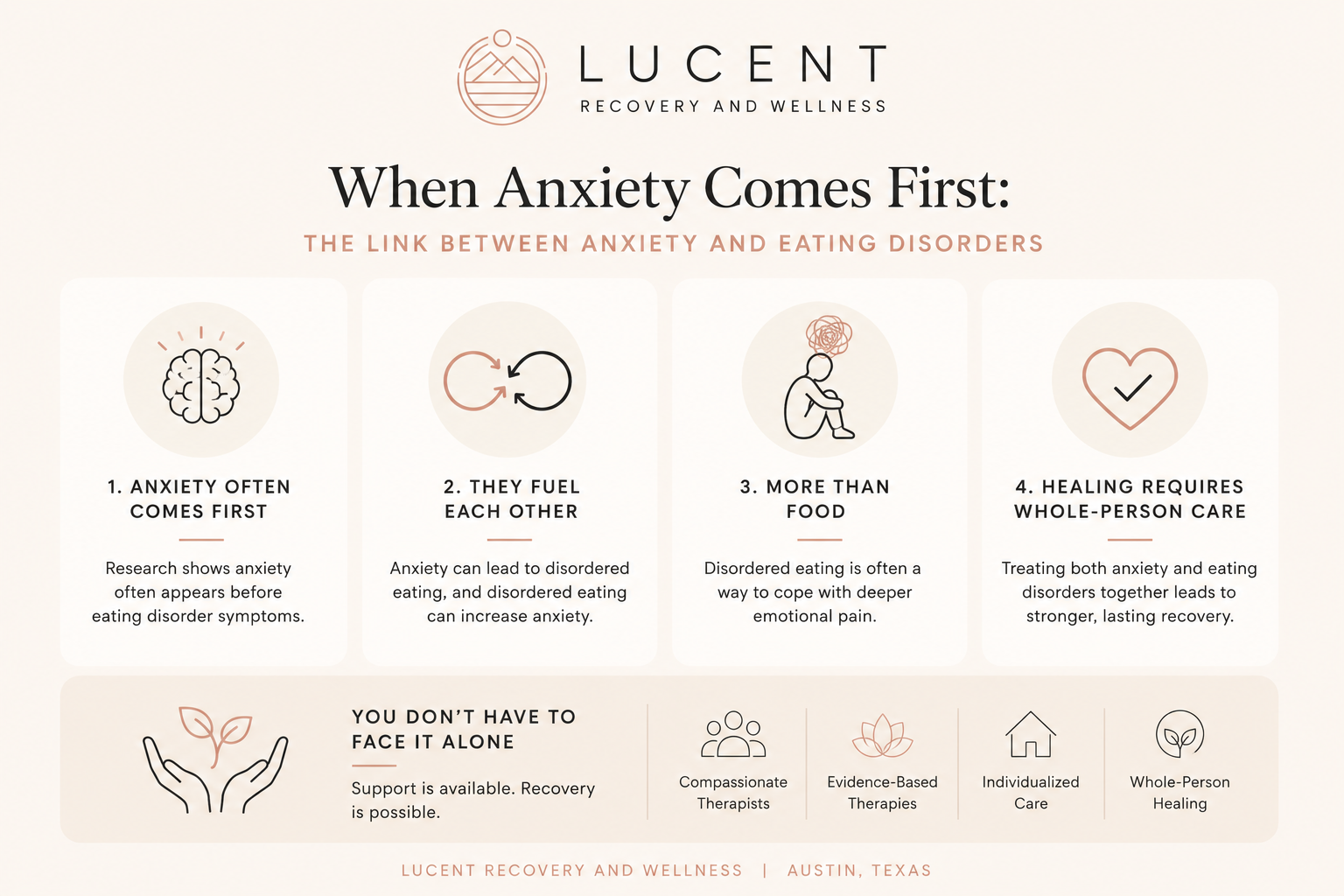
Authored by the Clinical Team at Lucent Recovery and Wellness
Reviewed by Chris Hudson, MA, LPC, LCDC

Searching for mental health treatment in Austin, TX brings up a long list of options. Hospitals, private practices, outpatient programs, online platforms, group practices, and boutique clinics all appear in the same search results, making broadly similar claims. Sorting through them when you’re already struggling can feel like a full-time job.

At Lucent Recovery and Wellness, we’re asked regularly how people should evaluate their options. The questions below are the ones that actually matter when you’re trying to find mental health care in Austin that will work for your specific situation.

1. What Level of Care Do You Actually Need?

This is the most important question, and the one most people skip. Choosing the wrong level of care is one of the most common reasons people invest time and money in treatment that doesn’t produce the change they’re looking for.

The main levels of outpatient mental health care in Austin are:

Standard outpatient therapy (one to two sessions per week). Appropriate for mild to moderate mental health concerns where daily functioning is mostly intact — specific life stressors, relationship challenges, grief, or ongoing maintenance after more intensive treatment.

Intensive Outpatient Program (IOP) (three to five days per week, two to three hours per session). Appropriate for moderate to severe mental health conditions where weekly therapy hasn’t been sufficient, or where symptoms significantly affect daily life. Our Austin IOP is designed for exactly this population.

Partial Hospitalization Program (PHP) (five days per week, five to six hours per session). Appropriate for people stepping down from inpatient care or who need full-day clinical structure. Our post comparing IOP and PHP explains the distinction clearly and helps you identify where your current level of functioning puts you.

If you’re still uncertain which level fits, our explainer on what to expect from outpatient mental health treatment can help orient you.

2. Who Is Actually Delivering Your Care?

Mental health programs are not all staffed the same way. The credentials of the people actually running your treatment have a significant effect on outcomes.

Some programs employ licensed master’s-level clinicians — LCSWs, LPCs, LMFTs — for all therapeutic services. Others use a mix of credentialed clinicians and paraprofessionals. All of these models have a place in the care continuum, but they’re not clinically equivalent for people dealing with complex presentations.

At Lucent, all therapeutic services are delivered by master’s-level clinicians. Our program is clinician-owned, which means clinical judgment — not administrative pressure — drives every treatment decision.

Questions worth asking any program:

  • What credentials do the people leading my group sessions hold?
  • Will I have an individual therapist assigned to me?
  • Who develops my treatment plan and how often is it reviewed?

3. What Therapeutic Approaches Are Used?

Not all therapy is the same. A reputable program should be able to explain which modalities they use and why they fit your diagnosis.

Evidence-based approaches with strong research backing include:

CBT (Cognitive Behavioral Therapy): Effective for anxiety, depression, OCD, and many other conditions. Focuses on the relationship between thoughts, feelings, and behaviors.

DBT (Dialectical Behavior Therapy): Developed for emotional dysregulation and borderline personality disorder, and well-supported for mood disorders and self-harm.

EMDR and trauma-focused therapies: Well-supported for PTSD and complex trauma. Addresses the physiological dimensions of trauma that talk-based approaches alone may not reach.

IFS (Internal Family Systems): Increasingly used for trauma, anxiety, and personality-based presentations. Particularly useful for people with complex histories.

ACT (Acceptance and Commitment Therapy): Effective for anxiety and depression. Focuses on psychological flexibility rather than symptom elimination as the primary goal.

The National Institute of Mental Health maintains detailed information on evidence-based treatments by condition. Use it.

4. Is Treatment Individualized or Generic?

Some programs run all clients through the same curriculum regardless of their diagnosis or history. This works for straightforward presentations. For people with complex trauma, co-occurring conditions, or treatment-resistant symptoms, individualized care produces meaningfully better outcomes.

Ask directly: how do you individualize treatment? What happens if the standard approach isn’t working? If answers are vague, that’s useful clinical information.

5. Does the Program Fit Your Life?

Even the best program won’t work if you can’t realistically attend or afford it.

  • Schedule: Morning, afternoon, or evening tracks?
  • Insurance: Can they verify benefits before you start?
  • Location: Is it accessible from where you live or work?
  • Housing: For out-of-area clients, is transitional housing available?

Lucent serves clients from across Texas. For clients coming from Round Rock, Georgetown, or Kyle, our Round Rock IOP page and Georgetown IOP page have information about commuting or transitional options.

6. What Happens After the Program Ends?

Discharge planning determines in large part whether the gains made in an IOP are maintained over time. Programs that don’t have clear, individualized transition plans leave clients in a precarious position.

At Lucent, we build transition planning in from the beginning. Clients move into an ongoing transitional support phase after completing the IOP, which bridges the gap before returning to standard outpatient care.

When evaluating any program, ask directly: what is the discharge plan? What happens after IOP ends?


If you’re evaluating options in Austin and want to talk through whether Lucent’s program makes sense for your situation, reach out to our team. We’ll answer every question honestly — including the ones that might lead us to recommend a different provider if that’s what’s actually right for you.

You might also find our broader overview of the Austin mental health landscape useful context before making your decision.

Healing and recovery at Lucent Recovery and Wellness

Reviewed by Chris Hudson, LPC

Founder & Executive Director – Lucent Recovery and Wellness, Austin, TX (2020–Present)
Leads clinical programs and develops innovative therapeutic approaches integrating experiential and creative therapies.

Board Member – Reklaimed, Austin, TX
Supports recovery-focused nonprofit initiatives fostering community and creative skill-building.

Clinical Leadership Roles – South Meadows Recovery, Inc.
Held leadership positions overseeing program development, clinical operations, and organizational management.

EDUCATION & CREDENTIALS

  • M.A., Clinical Mental Health Counseling – Seminary of the Southwest (2021)
  • B.A., Studio Art – Lewis & Clark College (2004)
  • Licensed Professional Counselor (LPC), Texas
  • Licensed Chemical Dependency Counselor (LCDC), Texas

Authored by the Clinical Team at Lucent Recovery and Wellness
Reviewed by Chris Hudson, MA, LPC, LCDC

A 2024 report from the Kaiser Family Foundation found that among Texas adults who reported symptoms of anxiety or depression, 30% said they needed counseling or therapy but hadn’t received it. That’s not a small number. In a city the size of Austin, that gap represents tens of thousands of people managing real distress without professional support — going to work, maintaining relationships, and keeping up appearances while quietly struggling.

We see this pattern at Lucent Recovery and Wellness all the time. Someone calls us after months, sometimes years, of struggling quietly. They knew something was wrong. They kept waiting for the right moment, the right reason, or the right amount of courage to pick up the phone. And when they finally do call, one of the first things they say is: “I should have done this a long time ago.”

This post is for anyone still in that waiting room.

The Austin Mental Health Landscape Is More Complicated Than It Looks

Austin has a reputation as a progressive, health-forward city. There are yoga studios on every corner, wellness apps downloaded by millions, and a cultural conversation about mental health that’s more open than it was a decade ago. But the on-the-ground reality of accessing mental health care in Austin is a lot messier than the brand image suggests.

Austin has grown faster than its mental health infrastructure. According to NAMI Texas, as of 2024, more than 15 million Texans live in communities without enough mental health professionals to meet demand. Statewide, 839,000 adults who needed treatment for mental illness couldn’t access it, primarily due to cost and provider shortages. And in the NAMI Texas 2025-2026 Public Policy Platform, Texas was ranked dead last in the nation for mental health care and workforce capacity.

Travis County has more resources than rural Texas — but waitlists for individual therapy can stretch weeks or months. Insurance coverage for behavioral health services remains inconsistent. And for people already dealing with anxiety, depression, or trauma, the process of finding help can itself feel like an obstacle course.

That’s the cruel irony of mental health barriers: the illness makes it harder to fight the illness. Anxiety makes initiating contact scary. Depression makes the research feel pointless. Trauma can make reaching out feel unsafe. So people wait.

Why People Delay Seeking Counseling: The Real Reasons

Over the years, we’ve heard just about every reason someone gives for waiting. Most of them come back to a handful of common threads worth naming directly.

“I didn’t think it was bad enough.” Mental health symptoms often develop gradually. People adapt, adjust, and rationalize. The anxiety that started as occasional nervousness becomes a baseline hum of dread. The low mood that came and went starts to feel permanent. By the time daily functioning is genuinely affected, the idea that things aren’t that serious has become a deeply held belief.

The truth is that you don’t have to hit rock bottom to deserve support. You don’t need a crisis to justify counseling. If your quality of life is consistently lower than it should be, that’s enough of a reason. Our post on when outpatient mental health treatment is the right fit can help you think through where you fall on that spectrum.

“I didn’t know what kind of help to look for.” Therapy, psychiatry, IOP, PHP, counseling, coaching, support groups — the distinctions aren’t always clear, and most people don’t know where they fit. A lot of people spend so much energy trying to figure out the right first step that they don’t take any step at all.

For a structured breakdown of how IOP compares to standard weekly counseling, that’s a good place to start clarifying where you might fit. And if you’re not sure whether you need standard therapy or something more intensive, our overview of IOP versus PHP can also help orient you.

“I was worried about what it would mean.” Stigma around mental health care persists, even in a city like Austin. Seeking counseling can still feel like an admission of weakness or failure. What the research consistently shows, though, is that people who engage in mental health treatment tend to perform better — not worse — in every domain of their lives.

“I couldn’t afford it or didn’t have time.” These are legitimate barriers. What we can say is that intensive outpatient programs are often covered by insurance more comprehensively than people expect, and are specifically designed to fit around work and family schedules. Mental health parity laws require most plans to cover behavioral health at the same level as medical care.

“I kept hoping it would get better on its own.” Chronic depression, anxiety disorders, trauma responses, and mood dysregulation rarely improve on their own over time. More often they deepen and widen, affecting more areas of life the longer they go unaddressed.

What Counseling in Austin Actually Looks Like Today

The word “counseling” covers a wide range of services, and it’s worth understanding what’s available.

Weekly outpatient therapy is what most people picture — a 50-minute session with a licensed therapist, once or twice a week. Appropriate for mild to moderate concerns, specific life stressors, or ongoing maintenance.

Intensive Outpatient Programs (IOP) provide a higher level of structured clinical care — typically three to five days per week — for people whose symptoms require more support than weekly therapy can deliver. At Lucent’s IOP in Austin, this includes individual therapy, structured group sessions, skills-based workshops, and specialty modalities. All sessions are led by master’s-level clinicians.

We treat adults navigating depression, anxiety, complex trauma, PTSD, bipolar disorder, borderline personality disorder, and ADHD. For people coming from outside Austin, transitional housing is available so that geography doesn’t have to be a barrier.

Partial Hospitalization Programs (PHP) sit above IOP — full-day programming five days per week for people who need more intensive support without inpatient hospitalization. Our post comparing IOP and PHP in detail explains the difference clearly.

Crisis care is available through the 988 Suicide and Crisis Lifeline (call or text 988) and Austin’s Integral Care, which operates 24/7 crisis lines and mobile response teams.

The Pattern We See at Lucent

People who call us often describe the same progression. Things started manageable. They tried to handle it themselves. They maybe saw a therapist for a while with mixed results. Then something shifted — a relationship broke down, work became untenable, a coping mechanism stopped working — and they realized the support they’d been accessing wasn’t enough.

What we find is that people almost universally wish they’d reached out sooner. Not because waiting made things catastrophically worse, but because the time spent managing alone was costly in ways that are hard to articulate — opportunities missed, relationships strained, years spent at a lower quality of life than necessary.

The SAMHSA 2024 National Survey on Drug Use and Health found that of 61.5 million U.S. adults with a mental health condition in 2024, nearly 29.5 million received no treatment at all. The most common reasons cited weren’t that people didn’t want help — they were that people didn’t know where to start, thought they could handle it on their own, or worried about cost.

What to Do If You’ve Been Waiting

If you’re in Austin and you’ve been thinking about counseling, the most important thing is to take one concrete action today. That might be calling a provider, filling out a contact form, or talking to your primary care doctor. Any one of those moves.

You might also find it useful to read our companion pieces on how to choose the right mental health program in Austin and how IOP compares to traditional counseling before making a decision. Both can help you arrive at a conversation with a provider already oriented to what you need.

At Lucent, we offer confidential consultations where we can help you figure out whether our level of care is the right fit, or whether a different kind of support might serve you better.

Learn more about our Austin IOP program or reach out to our team to start that conversation.

Healing and recovery at Lucent Recovery and Wellness

Reviewed by Chris Hudson, LPC

Founder & Executive Director – Lucent Recovery and Wellness, Austin, TX (2020–Present)
Leads clinical programs and develops innovative therapeutic approaches integrating experiential and creative therapies.

Board Member – Reklaimed, Austin, TX
Supports recovery-focused nonprofit initiatives fostering community and creative skill-building.

Clinical Leadership Roles – South Meadows Recovery, Inc.
Held leadership positions overseeing program development, clinical operations, and organizational management.

EDUCATION & CREDENTIALS

  • M.A., Clinical Mental Health Counseling – Seminary of the Southwest (2021)
  • B.A., Studio Art – Lewis & Clark College (2004)
  • Licensed Professional Counselor (LPC), Texas
  • Licensed Chemical Dependency Counselor (LCDC), Texas

Authored by the Clinical Team at Lucent Recovery and Wellness
Reviewed by Chris Hudson, MA, LPC, LCDC

A lot of the people who come to Lucent Recovery and Wellness for anxiety treatment have been managing their anxiety for a long time. Not avoiding it — actively managing it. They’ve read the books. They know the cognitive distortions by name. They’ve been in therapy on and off. Some have tried medication. They’ve developed real coping strategies that have genuinely helped.

And then, somewhere along the line, the managing stops being enough.

This is a specific and important moment. It doesn’t mean the strategies failed or that the person did something wrong. It means the underlying condition has accumulated more weight than the coping layer can hold. The difference between managing anxiety and actually treating it is real — and that distinction often only becomes fully visible when the management starts to break down.

Why Coping Strategies Have Real Limits

Coping strategies work by helping you tolerate anxiety in the moment or reduce its intensity after it arises. Breathing techniques reduce physiological arousal. Cognitive reframes interrupt catastrophic thinking. Exercise manages the neurochemistry of anxiety in meaningful ways. These are genuine tools.

What they don’t do is change the underlying patterns that generate the distress in the first place — the learned neural associations, the neurological hypervigilance that’s become a default mode, the cognitive distortions running on autopilot, the interpersonal dynamics that perpetuate the cycle.

NIMH-supported research published in 2024 found that effective anxiety treatment — particularly CBT-based approaches — produces measurable changes in brain activity, not just behavioral changes. Clinically significant reductions in anxiety symptoms corresponded to improved neurological functioning. Coping strategies, even well-developed ones, don’t produce that kind of neurological shift. Structured clinical treatment does.

This is why people who’ve been coping effectively for years sometimes plateau. Coping manages the expression of anxiety without addressing its architecture.

What “Functioning With Anxiety” Costs Over Time

There’s a version of functioning with anxiety that looks successful and sustainable from the outside while quietly accumulating a cost that doesn’t become visible until something tips the system.

People who cope well often do so by structuring their lives around their anxiety in ways they may not fully recognize as adaptations. The career that stayed narrower than it might have been because expansion felt too threatening. The relationship that never deepened past a certain point because real vulnerability felt too risky. The social circle that stayed small because managing interactions beyond it felt too effortful.

The coping works, in the sense that the anxiety stays contained. But the container gets smaller over time if the anxiety isn’t actually being addressed.

According to the 2024 SAMHSA National Survey on Drug Use and Health, 7.4% of U.S. adults experienced moderate to severe generalized anxiety disorder symptoms in 2024. Many of those people are functioning. Many are also exhausted by it in ways that are hard to name and harder to explain to people who don’t experience it.

The exhaustion isn’t from the anxiety itself. It’s from the management. And management, unlike treatment, doesn’t have an endpoint.

What Specifically Changes in Structured Treatment

The shift from coping to treatment is a shift in what’s being addressed. Treatment — particularly anxiety disorder group therapy within an IOP structure — works on the patterns themselves, not just their expression.

The relational dimension becomes workable. Most anxiety, particularly the kinds that persist despite effective individual coping, has a strong relational component. It shows up in how you relate to other people — the avoidance, the reassurance-seeking, the hypervigilance to social cues, the difficulty with vulnerability. These patterns show up in the group room in real time. With skilled clinical facilitation, they become visible and workable as they happen — something that no amount of individual coping practice or even individual therapy can fully replicate.

The neurological architecture actually changes. Coping strategies redirect the traffic without changing the road. Evidence-based treatment — particularly exposure-based work within a CBT framework, embedded in the intensity of an IOP — actually reroutes the architecture. The change is neurological, not just behavioral.

The isolation and shame break down. Years of managing anxiety privately creates significant isolation. The experience of being in a room with other people who understand your internal experience precisely, who aren’t surprised by it — this creates a fundamental shift in how the anxiety is held. It stops being a disqualifying secret and becomes a shared human condition that’s treatable.

For a side-by-side breakdown of how group and individual therapy compare for anxiety, our post on group therapy vs. individual therapy is worth reading before your consultation.

What to Expect When You Enter an IOP After Years of Independent Management

People who’ve been managing their anxiety effectively for a long time sometimes find the initial experience of structured treatment disorienting — not because the treatment is too hard, but because the shift from managing to genuinely engaging with the underlying experience is different from what they’re used to.

The anxiety that surfaces in the group room is not a sign that group therapy isn’t working. It’s the material of the work. Years of effective coping often means years of keeping that material at a distance. Structured treatment asks you to work with it directly.

People who’ve been coping well also typically arrive with real insight and genuine self-awareness. What they often lack is a structured clinical context in which to act on that insight, practice new responses with clinical support, and build the neurological change that coping alone hasn’t been able to produce.

What We Offer at Lucent

At Lucent, we work with adults who’ve been managing anxiety for years and are ready for something more substantive. Our anxiety treatment program includes structured group therapy led by master’s-level clinicians, individual sessions, and evidence-based modalities including CBT, DBT, IFS, and somatic approaches — selected based on each client’s individual clinical picture.

We treat anxiety as it actually presents — not in isolation, but often alongside depression, trauma, PTSD, ADHD, or mood dysregulation. We address the full clinical picture.

We’re LGBTQIA+ affirming and clinician-owned. For people coming from outside Austin, transitional housing makes accessing treatment practical. For clients in the broader Texas area, our how intensive outpatient programs support long-term recovery post explains the IOP model and its outcomes in more detail.

If you’ve been managing your anxiety for years and the management isn’t holding the way it used to, that’s worth paying attention to. It’s not a failure. It’s information.

Talk to our team and let’s figure out what’s next.

Healing and recovery at Lucent Recovery and Wellness

Reviewed by Chris Hudson, LPC

Founder & Executive Director – Lucent Recovery and Wellness, Austin, TX (2020–Present)
Leads clinical programs and develops innovative therapeutic approaches integrating experiential and creative therapies.

Board Member – Reklaimed, Austin, TX
Supports recovery-focused nonprofit initiatives fostering community and creative skill-building.

Clinical Leadership Roles – South Meadows Recovery, Inc.
Held leadership positions overseeing program development, clinical operations, and organizational management.

EDUCATION & CREDENTIALS

  • M.A., Clinical Mental Health Counseling – Seminary of the Southwest (2021)
  • B.A., Studio Art – Lewis & Clark College (2004)
  • Licensed Professional Counselor (LPC), Texas
  • Licensed Chemical Dependency Counselor (LCDC), Texas

Authored by the Clinical Team at Lucent Recovery and Wellness
Reviewed by Chris Hudson, MA, LPC, LCDC

One of the questions we get most often from people exploring the Lucent IOP is some version of: “Do I really have to do group therapy? Can’t I just do individual sessions?”

It’s a fair question. For someone managing anxiety, the idea of sitting in a room with strangers and talking about their internal experience can feel like the last thing they’d choose. The impulse to avoid group settings is, for many people with anxiety disorders, a direct symptom of the condition itself.

The honest answer involves a few moving parts. Both individual and group therapy have strong evidence. They work through different mechanisms, address different dimensions of anxiety, and produce different kinds of change. And for most people dealing with moderate to severe anxiety disorders, the combination isn’t just more effective — it’s often what the clinical picture actually requires.

Here’s how to think through it clearly.

What Individual Therapy Does Well

Individual therapy creates a private, contained space for exploration and skill development. You can move at your own pace, address material that feels too sensitive for group disclosure, and build a therapeutic relationship with a single clinician who comes to know your history and patterns in depth over time.

The therapeutic alliance — the quality of the relationship between therapist and client — is one of the most robust predictors of positive outcomes in therapy, according to the American Psychological Association. That relational element is real, meaningful, and genuinely therapeutic in its own right.

For mild to moderate anxiety where symptoms aren’t severely disrupting daily function, weekly individual therapy is often the right primary treatment. It’s also the appropriate format when you’re processing a defined life event or maintaining gains after a more intensive treatment phase.

What individual therapy can’t provide, by design, is a real social environment. And for most anxiety disorders, the social environment is precisely where the condition lives.

What Group Therapy Offers That Individual Therapy Simply Cannot

Group therapy’s advantages for people with anxiety go beyond cost-efficiency. There are specific therapeutic mechanisms only accessible in a group context — mechanisms that are particularly powerful given how anxiety actually works.

Social exposure in a safe, structured environment. Most anxiety disorders have a significant interpersonal dimension. Social anxiety, generalized anxiety, panic disorder, and anxiety co-occurring with trauma all involve distress that surfaces in relational contexts — in being seen, in being vulnerable, in the unpredictability of other people. Individual therapy removes most of that relational uncertainty. Group therapy reintroduces it in a controlled, clinically supported way. The group room is itself a form of graduated exposure.

Universality and reduced shame. Anxiety is commonly accompanied by a belief that one’s experience is uniquely broken. Sitting in a group and hearing other people describe your internal experience in their own words creates relief that’s more powerful than any therapist’s reassurance. The psychologist Irvin Yalom identified universality as one of the primary curative elements of group therapy — it’s only accessible in a group.

Vicarious learning. Watching other group members practice skills and make progress creates learning pathways that verbal instruction doesn’t activate. You’re not just processing information about what’s possible — you’re watching it happen, which engages different cognitive and emotional systems.

Real-time feedback on relational patterns. Anxiety maintains itself through interpersonal patterns that are difficult to see clearly from inside them — reassurance-seeking, avoidance of conflict, hypervigilance to social cues. These patterns show up in the group room, in real time, in interactions that skilled clinicians can name and help you work with directly.

What the Research Supports

A meta-analysis published in the Journal of Anxiety Disorders found that group CBT produces outcomes comparable to individual therapy for social anxiety disorder, and several studies have found group formats produce more durable maintenance of gains over time.

NIMH-supported research published in 2024 found that CBT-based treatment produces measurable neurological changes alongside symptom improvement — clinically significant reductions in brain overactivation. Research published in European Psychiatry in 2022 validated transdiagnostic group CBT in community-based clinical settings.

The American Psychological Association recognizes group therapy as a primary, evidence-based treatment for anxiety disorders.

Presentations That Respond Especially Well to Group Work

Social anxiety disorder. By definition, social anxiety disorder involves fear and avoidance of social situations. The group room is, almost by definition, the most directly relevant therapeutic context. Individual therapy prepares you cognitively. Group therapy provides the exposure.

Generalized anxiety disorder. The worrying, reassurance-seeking, and avoidance patterns characteristic of GAD often show up in the group in real time — worry about what others think, reassurance-seeking from the clinician, avoidance of certain topics. Skilled group facilitation can address these patterns directly as they emerge.

Anxiety co-occurring with depression, trauma, or mood dysregulation. When anxiety exists alongside depression, PTSD, bipolar disorder, or complex trauma, the group setting provides a normalizing, containing environment that helps regulate the overall emotional load.

What If Group Therapy Feels Impossible Right Now?

If the thought of group therapy feels genuinely paralyzing, that’s worth naming directly with the clinical team during intake. It doesn’t disqualify you from an IOP — it’s clinical information.

At Lucent, we assess each client’s anxiety about the group format during intake and structure initial participation accordingly. For some clients, that means starting with psychoeducational groups before moving into process work. The discomfort with group therapy is part of what the program addresses — not a barrier to participation.

For a deeper dive into what group therapy for anxiety actually involves in practice, see our post on what to expect from anxiety disorder group therapy. And if you’re wondering whether an IOP is the right level of care at all versus standard weekly counseling, our overview of how IOP compares to traditional therapy can help you orient.

Reach out to our team for a confidential consultation, or learn more about our anxiety treatment program.

Healing and recovery at Lucent Recovery and Wellness

Reviewed by Chris Hudson, LPC

Founder & Executive Director – Lucent Recovery and Wellness, Austin, TX (2020–Present)
Leads clinical programs and develops innovative therapeutic approaches integrating experiential and creative therapies.

Board Member – Reklaimed, Austin, TX
Supports recovery-focused nonprofit initiatives fostering community and creative skill-building.

Clinical Leadership Roles – South Meadows Recovery, Inc.
Held leadership positions overseeing program development, clinical operations, and organizational management.

EDUCATION & CREDENTIALS

  • M.A., Clinical Mental Health Counseling – Seminary of the Southwest (2021)
  • B.A., Studio Art – Lewis & Clark College (2004)
  • Licensed Professional Counselor (LPC), Texas
  • Licensed Chemical Dependency Counselor (LCDC), Texas

Authored by the Clinical Team at Lucent Recovery and Wellness
Reviewed by Chris Hudson, MA, LPC, LCDC

There’s a particular irony at the center of anxiety disorder treatment that we see play out regularly at Lucent Recovery and Wellness. One of the most effective interventions available for anxiety is also the one that anxious people are most likely to want to avoid.

Group therapy.

The idea of sitting in a room with other people, talking about your inner experience, being witnessed in your vulnerability — these can feel genuinely threatening to someone managing anxiety. The fear of judgment, the unpredictability of what other people might say, the exposure of sitting with emotions in a social context — these are exactly the conditions that anxiety tends to make difficult.

We understand that response completely. And we also know from the clinical evidence and from years of working with clients in exactly this situation that the group room, despite how it feels going in, is often where the most meaningful shifts happen.

What the Research Actually Shows

The evidence base for group-based anxiety treatment is consistently strong and has been replicated across different conditions, populations, and clinical settings.

A meta-analysis of randomized controlled trials published in the Journal of Anxiety Disorders found that group CBT produces outcomes comparable to individual therapy for social anxiety disorder. Research published in European Psychiatry in 2022 validated transdiagnostic group CBT approaches — those addressing shared features of anxiety across different diagnostic presentations — in community-based clinical settings.

NIMH-supported research published in 2024 found that CBT-based treatment produces measurable changes in brain activity alongside symptom improvement — clinically significant drops in anxiety alongside improved neurological functioning. The group context doesn’t diminish these effects. For many anxiety disorders with a strong interpersonal component, it enhances them.

The American Psychological Association recognizes group therapy as a well-established, evidence-based primary treatment modality for anxiety disorders — not a supplementary option.

What Anxiety Disorder Group Therapy Actually Is

“Group therapy” covers a wide range of formats that are not equivalent. It’s worth being clear about the distinction before we get into why it works.

Support groups are peer-led gatherings where people share experiences and offer mutual support. Valuable, but not clinical group therapy.

Clinical group therapy is led by licensed clinicians, follows an evidence-based structure, and is designed to produce measurable therapeutic outcomes. It’s a clinical intervention.

In a well-structured intensive outpatient program like Lucent’s, anxiety disorder group therapy typically includes:

Psychoeducation groups that teach the neuroscience of anxiety in accessible language — what’s happening in the brain and body during an anxiety response, how specific therapeutic interventions work at a neurological level.

Skills-based groups focused on CBT techniques, DBT skills like distress tolerance and emotion regulation, and mindfulness-based approaches. These are structured and practice-oriented.

Process groups where clients explore their patterns and emotional responses in a facilitated setting. This is where the relational dimensions of anxiety become workable — where the experience of being vulnerable in a group, and finding it survivable, directly challenges core cognitive distortions.

All groups at Lucent are led by master’s-level clinicians trained in group dynamics and evidence-based modalities. Our anxiety treatment program integrates group work as a central — not supplementary — element of care.

The Specific Mechanisms That Make Group Effective for Anxiety

Understanding why group therapy works helps reduce the resistance that’s natural going in.

Universality. One of the most therapeutically potent experiences in group is the early discovery that other people feel the exact same things you feel. The isolation and shame that anxiety creates — the sense that your internal experience is uniquely broken — begins to dissolve when you hear someone else describe it accurately. This factor, which the psychologist Irvin Yalom identified as central to group therapy’s effectiveness, is only available in a group context.

In vivo social exposure. For people with social anxiety or anxiety that manifests in interpersonal contexts, the group room is itself a therapeutic intervention. Individual therapy can help you understand your anxiety conceptually. Group therapy provides the actual practice environment — a real social situation with real social stakes, navigated with clinical support in real time.

Vicarious learning. Watching other group members practice skills, navigate difficult emotions, and make progress creates learning pathways that verbal instruction alone doesn’t activate. You’re not just hearing what’s possible — you’re watching it happen.

Real-time interpersonal feedback. Anxiety often maintains itself through interpersonal patterns — reassurance-seeking, avoidance of conflict, hypervigilance to others’ reactions. These patterns show up in the group room, in real time, in interactions that skilled clinicians can name and help the client work with directly.

Peer connection and accountability. The connections formed between group members are part of the treatment. Anxiety tends to narrow and isolate. The experience of genuine connection in a group context directly challenges that contraction, and the accountability of showing up for others is itself a therapeutic force.

What to Expect in Your First Few Sessions

For people who haven’t been in clinical group therapy before, the first session or two can feel awkward. That’s normal and expected.

You don’t have to share if you’re not ready. Observation is a legitimate mode of engagement, particularly early on.

Confidentiality is established explicitly at the outset and enforced throughout. What’s shared in group stays in group.

Each session has a clinical structure and purpose. This isn’t a free-form sharing circle.

The discomfort that comes up in the group is not a reason to leave. It’s the material of the work. The anxiety that surfaces in the room is exactly the anxiety that needs to be worked with.

Most people who are initially resistant find, by the third or fourth session, that group is the part of the program they’re getting the most from. We see this regularly enough that it’s essentially a pattern.

How Lucent Integrates Group into Anxiety Treatment

At Lucent, group therapy is central to our IOP, not supplementary. We work with adults managing generalized anxiety, panic disorder, social anxiety, OCD-spectrum presentations, PTSD, and anxiety co-occurring with depression, bipolar disorder, or complex trauma.

Our groups are small, led by master’s-level clinicians, and structured to move at a pace that’s challenging without overwhelming. We’re LGBTQIA+ affirming and sensory-safe. Treatment plans are individualized — the group curriculum informs but doesn’t override each client’s specific clinical plan.

If you’re not yet sure whether group therapy or individual therapy is the better starting point for your situation, our post on group vs. individual therapy for anxiety addresses that question directly.

Learn more about our anxiety treatment program or reach out to talk through whether our IOP is a good fit.

Healing and recovery at Lucent Recovery and Wellness

Reviewed by Chris Hudson, LPC

Founder & Executive Director – Lucent Recovery and Wellness, Austin, TX (2020–Present)
Leads clinical programs and develops innovative therapeutic approaches integrating experiential and creative therapies.

Board Member – Reklaimed, Austin, TX
Supports recovery-focused nonprofit initiatives fostering community and creative skill-building.

Clinical Leadership Roles – South Meadows Recovery, Inc.
Held leadership positions overseeing program development, clinical operations, and organizational management.

EDUCATION & CREDENTIALS

  • M.A., Clinical Mental Health Counseling – Seminary of the Southwest (2021)
  • B.A., Studio Art – Lewis & Clark College (2004)
  • Licensed Professional Counselor (LPC), Texas
  • Licensed Chemical Dependency Counselor (LCDC), Texas