
Types of Interventions: What Families Should Know When Mental Health Is Part of the Picture
Authored by the Clinical Team at Lucent Recovery and Wellness
Reviewed by Chris Hudson, MA, LPC, LCDC
On July 27, 2026, the Substance Abuse and Mental Health Services Administration (SAMHSA) released the 2025 National Survey on Drug Use and Health, a national snapshot built from the self-reported responses of more than 60,000 people. One finding stands out for anyone who works in mental health care. Of the 54.6 million U.S. adults who had a mental illness in the past year, 33.9 percent, or 18.5 million people, also had a substance use disorder. Among the 18.2 million adults with a serious mental illness, the overlap was higher still: 42.9 percent, or 7.8 million people.
As a mental health treatment provider in Austin, we hear the stories behind those numbers from the families who contact us. A parent can’t tell whether a son’s sleepless, racing weeks are about stimulant use or the start of a mood disorder. A spouse is trying to understand whether a partner’s withdrawal is depression, drinking, or both. A family is watching a teenager disappear into a screen while their mood gets darker every month.
Many of these families eventually ask about an intervention. Most people picture a single scene from television: a living room, a circle of chairs, and a tearful confrontation. In reality, there are several types of interventions, and the one that fits depends a great deal on what your loved one is experiencing, especially their mental health.
We aren’t an intervention service. Our work begins when someone enters mental health treatment. But because mental health symptoms so often shape how an intervention should be planned, we want families to understand their options before they reach that point. In this guide, we’ll cover the main types of interventions, how mental health symptoms can change which approach makes sense, what the research says about different models, and where mental health treatment fits once a person is ready for care.
What an Intervention Is (and What It Isn’t)
An intervention is a planned, structured effort by the people who care about someone to help that person accept professional help. It doesn’t have to be an ambush, and in many cases it shouldn’t be.
Families usually encounter three broad models:
- Invitational models (such as ARISE) bring the loved one into the process early. Nothing is planned behind their back.
- Direct or confrontational models (often associated with the Johnson model) involve a prepared meeting where family members share how the person’s behavior has affected them and present a plan for treatment.
- Family training models (such as CRAFT, the Community Reinforcement and Family Training approach) teach family members new ways to communicate, reinforce healthy behavior, and set boundaries over time, without one high-stakes meeting.
The research on these models is worth knowing. A randomized pilot study published in the Journal of Substance Abuse Treatment and archived by the National Institutes of Health summarized years of trials: family members using CRAFT engaged between 55 and 86 percent of treatment-refusing loved ones in care, while Al-Anon referral and the Johnson Institute intervention, the two approaches that historically dominated the field, showed lower engagement rates. Most of that research focused on substance use, but the underlying lesson carries over to mental health: preparation, respect, and ongoing family involvement tend to matter more than the intensity of a single conversation.
How Mental Health Symptoms Shape the Type of Intervention a Family Needs
This is the part of the conversation that often gets overlooked. An intervention isn’t only about getting someone to say yes. It’s about approaching them in a way their mind can actually take in at that moment. Mental health symptoms can change that dramatically.
Insight may be limited. In conditions like psychosis, mania, and some eating disorders, a person may not recognize that anything is wrong. Clinicians sometimes call this reduced insight. It isn’t stubbornness or denial in the usual sense. It’s part of the illness. Pressuring someone to “admit” a problem they can’t perceive usually backfires.
Fear and paranoia can escalate quickly. For someone who is already feeling watched or threatened, a surprise meeting with a room full of people can feel like confirmation of their fears. That’s one reason confrontational approaches are generally a poor fit when psychotic symptoms are present.
Depression affects energy, hope, and thinking. A person with severe depression may agree to help and then be unable to follow through on phone calls, forms, or appointments. The plan needs to account for that, with someone ready to help with the practical steps.
Suicide risk changes the priority. If a loved one is talking about not wanting to be alive, has made a plan, or has attempted before, safety comes before any other goal. That may mean an emergency evaluation rather than a family meeting.
Trauma can shape reactions. People with a trauma history may respond to confrontation, raised voices, or a sense of being cornered with shutdown, anger, or panic. Calm, predictable, and choice-based approaches tend to work better.
Substances can mask or mimic mental illness. Stimulants can look like mania. Alcohol withdrawal can look like an anxiety disorder. Cannabis can intensify psychotic symptoms in people who are vulnerable. When substance use and mental health overlap, it’s often impossible to know what’s driving what until a person is assessed in a stable setting.
Keeping these factors in mind can help families choose a safer, more realistic approach, and it’s a big part of why a mental health assessment is so often an early step.
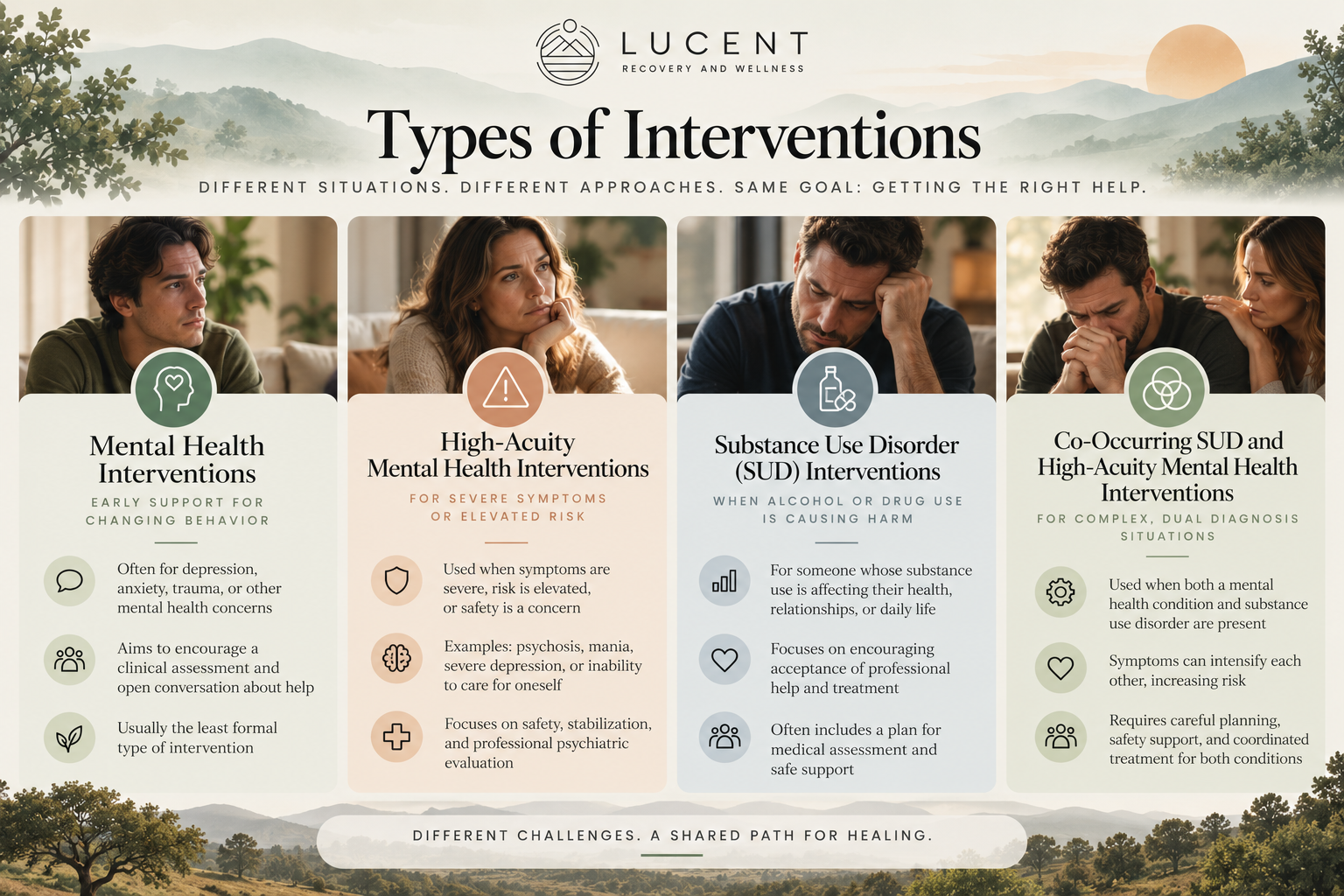
Types of Interventions
Mental Health Interventions
A mental health intervention is often the least formal type. It’s usually for someone living with depression, anxiety, trauma-related symptoms, or another condition that’s slowly wearing down their work, school, relationships, or sense of self, but who isn’t in immediate danger.
The goal is rarely a dramatic commitment. More often, it’s an agreement to get a clinical assessment and an honest conversation about what level of support fits. Many families start with one trusted person saying something simple: “You haven’t seemed like yourself, and I’m worried about you. Would you be willing to talk to someone with me?”
SAMHSA offers practical guidance on how to talk to someone about getting help. For some people, the right next step is outpatient mental health counseling. For others whose symptoms are affecting daily functioning, a structured program such as a mental health intensive outpatient program (IOP) offers more support while they continue living at home.
High-Acuity Mental Health Interventions
High acuity means symptoms are severe, risk is elevated, or both. Examples include:
- A first episode of psychosis, with hearing voices, beliefs that don’t match reality, or paranoia
- Mania, with days of little sleep, reckless spending, or risky behavior
- Severe depression with suicidal thoughts
- A person who has stopped eating, sleeping, or caring for themselves
These situations put safety first. If someone is in immediate danger, call 911 or go to the nearest emergency room. For urgent emotional distress or suicidal thoughts, the 988 Suicide and Crisis Lifeline is available by call or text, 24 hours a day.
When the situation is serious but not an emergency, a high-acuity intervention usually calls for more planning than families expect. Calm, simple language, a trusted person in the room, and a care option that’s already identified tend to help far more than confrontation. Psychiatric evaluation is often an important part of stabilization, since medication may be part of treatment.
From the treatment side, people coming out of a crisis or hospital stay often need a step-down level of care rather than a sudden return to normal life. A partial hospitalization program (PHP) provides structured daily treatment, with a gradual step down to IOP as symptoms stabilize. At Lucent, psychiatric care is led by our Medical Director, Dr. Yahya Saeed, and you can learn more about our clinical team.
Substance Use Disorder (SUD) Interventions
SUD interventions are the type most people have heard of. They’re for someone whose alcohol or drug use is causing real harm and who has resisted or refused help.
The biggest change in this area over the past few decades has been a move away from shame. Families used to be told to wait for a loved one to “hit bottom.” The research on CRAFT and invitational models suggests families can influence change without waiting for a crisis.
SUD interventions also carry medical considerations. Stopping some substances abruptly, including alcohol and benzodiazepines, can be medically dangerous, so a plan often starts with an assessment for medically supervised withdrawal. It also needs a clear answer to the question, “Where does this person go if they say yes?”
From a mental health perspective, it’s worth asking what the substance may be doing for the person. Many people use alcohol or drugs to quiet anxiety, numb trauma, sleep, or escape depression. When that’s true, stopping the substance can bring those symptoms to the surface quickly, which is why mental health screening belongs in the plan from the start.
Co-Occurring SUD and High-Acuity Mental Health Interventions
This is where the 2025 NSDUH findings are most relevant. According to SAMHSA, among the 42.7 million adults with a past-year substance use disorder, 43.3 percent had a mental illness and 18.3 percent had a serious mental illness. For many families, the real question isn’t “Is this addiction or mental illness?” It’s “How do we get help for both?”
These are often the most complex situations to plan for. Psychiatric symptoms and substance use can intensify each other, and a person may be at higher risk during withdrawal or in the early days of treatment. Safety planning, medical assessment, and an understanding of both conditions all matter before anyone sits down to talk.
When a family needs structured, professional guidance through that process, organizations that specialize in SUD and high-acuity mental health interventions can help with preparation, choosing an intervention approach, and coordinating the transition into treatment. Intervention providers and treatment programs play different roles. Once a person is ready for care, a mental health treatment provider such as Lucent focuses on assessment, diagnosis, and ongoing treatment, with a plan that accounts for how the person’s mental health and substance use affect each other. Case management can help coordinate care across providers so that important details aren’t lost between one step and the next.
SAMHSA’s overview of co-occurring disorders explains why treating both conditions together matters.
Technology and Gaming Concerns
Technology concerns are one of the newer reasons families seek help, and they can be hard to read. Where is the line between a teenager who loves video games and one who is struggling? Between heavy social media use and something closer to dependence?
Clinicians generally focus on impact rather than hours alone. Warning signs include losing control over use, giving up activities and friendships, disrupted sleep, falling grades or work performance, intense irritability when devices are limited, and continuing despite clear consequences.
The mental health angle is especially important here. Problematic technology use frequently occurs alongside depression, anxiety, ADHD, and social isolation. For some young people, gaming or scrolling becomes the main way they manage feelings they don’t have words for yet. Taking the device away without addressing that can leave them with the distress and none of the coping.
Treatment appears to help. A systematic review and meta-analysis published October 21, 2025, in the International Journal of Environmental Research and Public Health examined psychological treatments for problematic use of the internet, video games, social media, and instant messaging among young people ages 10 to 21. Across nine studies with 744 participants, researchers found significant symptom reductions, with the strongest support for cognitive behavioral therapy (CBT), family therapy, and executive function training. The authors noted variation across studies and possible publication bias, so the findings are encouraging rather than conclusive.
For most families, the most useful “intervention” here is a family-level plan: agreed-upon limits, a curious conversation about what the technology is doing for the person emotionally, and a clinical evaluation for any mental health condition that may be underneath.
Gambling Interventions
Gambling disorder is a recognized mental health condition. It was reclassified alongside substance use disorders in the DSM-5 in 2013. Since the Supreme Court cleared the way for state-legalized sports betting in 2018, access has changed dramatically, with betting available on a phone at any hour.
Recent data suggests the change is showing up in clinical care. In June 2026, Epic Research published an analysis of electronic health records from more than 197 million U.S. adults between 2018 and early 2026. In states that legalized sports betting, the quarterly rate of diagnosed gambling disorder rose from 3.0 to 4.8 per 100,000 patients, roughly a 61 percent increase. In states without legal sports betting, the rate fell by about 29 percent. The largest proportional increase was among adults ages 18 to 29, whose rate more than doubled. The researchers noted the data shows an association, not proof of cause.
Gambling often overlaps with other concerns. A two-year study of more than 4,300 American adults, led by Joshua Grubbs at the University of New Mexico with researchers at Toronto Metropolitan University, found a meaningful link between sports betting and alcohol use: when one increased, the other tended to increase too.
Gambling interventions tend to involve a few distinct considerations:
- Financial safety comes early. Protecting joint accounts, credit, and household finances is part of the plan.
- Shame runs deep. Many people hide gambling debt for a long time. Confrontation can deepen the secrecy.
- Emotional risk can rise quickly. Financial crisis and hopelessness can feed each other, so screening for depression and suicidal thoughts is important.
- Other conditions need attention. Anxiety, depression, ADHD, and alcohol use often appear alongside problem gambling.
Eating Disorder Interventions
Eating disorders are among the most medically serious mental health conditions, and interventions here follow their own rules. Medical stability comes first, because restriction, bingeing, and purging can affect the heart, electrolytes, and other body systems. As with psychosis, a person may not recognize the seriousness of their illness, because the condition itself distorts how they see their body and behavior.
Families should avoid centering the conversation on weight, food, or appearance. Focus on what you’ve noticed about their health, mood, energy, and daily life, and on your care for them. A medical evaluation and a specialized eating disorder assessment are usually the first steps. You can read more about our approach on our eating disorder treatment page.
Questions That Can Help Clarify Where to Start
It’s normal to feel unsure, especially when more than one concern is present. These questions can help:
- Is anyone in immediate danger? If so, call 911 or go to an emergency room.
- Are there signs of psychosis, mania, severe depression, or suicidal thinking? These point toward a safety-focused, psychiatrically informed approach.
- Is substance use involved, and could stopping be medically risky? Medical assessment belongs in the plan.
- Does your loved one seem able to recognize the problem? Limited insight often calls for a gentler, more patient approach.
- Has your loved one refused help repeatedly? That may be a sign the family would benefit from professional guidance, whether that’s family training, family therapy, or a professionally guided intervention.
- How is the family holding up? Exhausted or divided families often need support of their own.
Where Mental Health Treatment Fits
An intervention can open the door, but the longer work happens in treatment. For people whose symptoms are primarily or significantly related to mental health, that usually starts with a thorough assessment, followed by care matched to the level of need.
Depending on the person, that might mean outpatient counseling, an intensive outpatient program, or a partial hospitalization program for more structured daily support. Some people also benefit from practical supports during treatment, such as coaching or a structured living environment like transitional housing. The right combination depends on symptoms, safety, and the person’s goals.
Families are part of this, too. It helps to know what treatment involves and how to stay supportive without taking on the role of clinician. Our pages on what to expect for families and what to expect for clients walk through the early stages of care.
Practical Ways Families Can Prepare
Whatever type of intervention you’re considering, a few things consistently help:
- Write down specific observations. “You haven’t left your room most days this month” lands differently than “You’re always shut away.”
- Agree on one message. Mixed messages from family members make it easier for a struggling person to avoid the conversation.
- Identify a next step in advance. Know where an assessment or appointment could happen before you talk.
- Choose boundaries you’ll actually keep. Only state a boundary you’re prepared to follow through on.
- Care for yourselves. Family members often carry anxiety, grief, and exhaustion. Their own support matters.
Common Myths About Interventions
Myth: A person has to want help for treatment to work. Many people start treatment with mixed feelings. Motivation often grows once someone feels safe and begins to feel better.
Myth: Interventions are always confrontational. Invitational and family training approaches are widely used, and research suggests they often engage loved ones as well as or better than confrontational ones.
Myth: If they say no, it failed. A no is often the beginning of a longer process. Families who keep communicating with care and consistency often see a loved one accept help later.
Myth: Mental health symptoms are just an excuse. Symptoms like reduced insight, paranoia, or depression-related exhaustion are real parts of an illness, and they affect how a person can respond to a hard conversation.
Frequently Asked Questions
How do I know if my loved one needs an intervention or just a conversation?
Start with a caring, private conversation if it’s safe. If you’ve tried several times without progress, the problem is getting worse, or there are safety concerns, it may be time to seek professional guidance on a more structured approach.
Does Lucent provide intervention services?
No. Lucent Recovery and Wellness is a mental health treatment provider. We can talk with families about treatment options and what care might look like, but we don’t provide professional interventionist services. Families who need help planning an intervention can work with a dedicated intervention provider, and treatment can begin once the person is ready.
Can an intervention be done for an adult who doesn’t live at home?
Yes, and most interventions involve adults. With adults, treatment participation is generally voluntary unless there is an imminent safety risk, which is why preparation and a respectful approach matter so much.
Should children or teens be included?
It depends on their age, maturity, and relationship with the person. Younger children usually shouldn’t be present for a difficult conversation. Older teens can sometimes share a meaningful perspective, but only with preparation and support.
What if my loved one has both a gaming problem and depression?
That combination is common. Addressing the technology use alone often misses what’s underneath. A clinical assessment can clarify whether depression, anxiety, ADHD, or another condition is involved so both can be treated together.
Is a surprise intervention ever appropriate?
Some families choose a direct approach when other efforts haven’t worked and the risks are serious. It should be carefully planned and led by someone experienced. It’s generally not a good fit for someone experiencing psychosis or paranoia, because surprise can heighten fear.
What should we do if the person gets angry and leaves?
Stay calm and don’t chase them. Let them know you love them and the offer of help still stands. Anger during a hard conversation is common, and many people return to it once the initial shock fades.
Do interventions work for gambling problems?
The same principles that help with substance use, including preparation, compassion, clear boundaries, and an identified next step, also apply to gambling. Gambling-related plans often add steps to protect household finances and screen for emotional crisis.
Conclusion
The 2025 NSDUH is a reminder of how often mental illness and substance use overlap: 18.5 million adults lived with both in the past year, and nearly 43 percent of adults with a serious mental illness also had a substance use disorder. Add rising gambling disorder diagnoses and growing concern about technology use, and it’s clear that families need more than one picture of what an intervention can look like.
The right type of intervention depends on the person, and mental health symptoms are often what tip the balance. Limited insight, paranoia, suicidal thinking, trauma, and depression can all change what’s safe and what’s realistic. A thoughtful approach takes those symptoms seriously, puts safety first, and connects the person with care that can address everything that’s going on.
Recovery rarely follows a straight line, and no single conversation solves everything. But with the right support, evidence-based treatment, and a family that’s cared for along the way, meaningful improvement in symptoms, relationships, and quality of life is possible.
When You’re Ready to Talk
If you’re concerned about the mental health of someone you love, or your own, you’re welcome to reach out. Our team can answer questions about mental health treatment, explain levels of care, and help you think through next steps. You can contact Lucent Recovery and Wellness or call 512-588-3899.
If you or someone you love is in immediate danger, call 911. For emotional distress or suicidal thoughts, call or text 988 to reach the 988 Suicide and Crisis Lifeline.

Reviewed by Chris Hudson, LPC
Founder & Executive Director – Lucent Recovery and Wellness, Austin, TX (2020–Present)
Leads clinical programs and develops innovative therapeutic approaches integrating experiential and creative therapies.
Board Member – Reklaimed, Austin, TX
Supports recovery-focused nonprofit initiatives fostering community and creative skill-building.
Clinical Leadership Roles – South Meadows Recovery, Inc.
Held leadership positions overseeing program development, clinical operations, and organizational management.
EDUCATION & CREDENTIALS
- M.A., Clinical Mental Health Counseling – Seminary of the Southwest (2021)
- B.A., Studio Art – Lewis & Clark College (2004)
- Licensed Professional Counselor (LPC), Texas
- Licensed Chemical Dependency Counselor (LCDC), Texas