
When You Need Two Kinds of Treatment at Once
Authored by the Clinical Team at Lucent Recovery and Wellness
Reviewed by Chris Hudson, MA, LPC, LCDC
Almost nobody wants group therapy at first.
People will agree to individual sessions, to psychiatry, to family work, to almost anything before they will agree to sit in a circle and say out loud what they have spent years not saying. The objection is nearly always some version of the same thing: I do not want strangers knowing this.
We understand the objection. We also see what happens about three weeks later, when the same person tells us group is the part they would not give up.
This article is about why that shift happens, what group work actually involves, and why it matters particularly when the thing you have been carrying involves food, your body, or the enormous private effort of managing both.
The thing that keeps this going is not really the food
Start with what the data says about company.
National Institute of Mental Health figures show that eating disorders almost never arrive alone. More than half of adults with anorexia nervosa, nearly 95 percent of those with bulimia nervosa, and roughly 79 percent of those with binge eating disorder met criteria for at least one other core psychiatric disorder. Anxiety disorders were the most common companion across all three.
Anxiety and shame are social conditions in a way that is easy to miss. They are made worse by concealment and they get better in the presence of people who do not flinch. That is not a slogan. It is the mechanism, and it is the reason a room full of other people is a strange but effective place to put someone who has been managing something in private.
The same NIMH data shows how much concealment is going on. Roughly a third of adults with anorexia nervosa and just over 43 percent of those with bulimia nervosa or binge eating disorder have ever sought treatment specifically for their eating disorder. Those figures come from the National Comorbidity Survey Replication, the most recent nationally representative diagnostic-interview data NIMH publishes, though the survey itself was fielded in the early 2000s.
Most people, in other words, never say it out loud to anyone at all.
What secrecy costs
We want to be careful here, because “just open up” is unhelpful advice and we are not offering it.
What we see clinically is that concealment has a compounding effect. The behaviour itself takes effort. Hiding the behaviour takes more. Managing the story you tell people about why you left dinner early, or why you cannot come to that thing, or why you have been tired, takes more again. By the time someone reaches us, a meaningful share of their available energy is going into maintenance rather than into living.
There is also the specific loneliness of believing you are the only one. People with disordered eating frequently describe their patterns as uniquely shameful, uniquely irrational, uniquely their own. The belief is usually wrong and almost always unshakeable from the inside. You cannot reason someone out of it, and individual therapy, for all its value, has a structural limitation here: your therapist can tell you that other people struggle this way, but your therapist is not other people.
What actually happens in group
Because the word “group” carries a lot of unhelpful associations, here is what it is not. It is not a circle of chairs where you are required to confess. It is not a support group where everyone takes turns describing their week. Nobody is going to make you speak.
What it is, in our programs, is structured clinical work with a facilitator and a purpose. Sessions have a focus. Skills get taught and then practised. Some groups are built around distress tolerance and emotion regulation, drawing on dialectical behavior therapy. Some are process groups where what happens between people in the room is the material. Some are psychoeducational.
A few things about the format do work that individual sessions structurally cannot.
You hear your own thinking in somebody else’s mouth. Someone describes a rule they follow, or a bargain they make with themselves, and you recognise it exactly. That recognition does more in ten seconds than months of being told you are not alone.
You get feedback that is not from a clinician. There is a particular weight to hearing something from a person who has no professional obligation to be kind to you, and who is clearly not saying it as technique.
You practise being seen. This is the underrated one. If the problem is partly that you have organised your life around not being perceived, then the intervention has to involve being perceived, in a setting where that is survivable.
You are useful to someone. People who have spent a long time as the problem in their family find something shifts when they say something in group that visibly helps another person.
We should be plain that these are clinical observations from our own programs rather than findings from a controlled trial. The broader evidence base for eating disorder treatment, summarised in a review by Allam and Attia of Columbia University published in Neurotherapeutics in October 2025, identifies eating disorder-focused cognitive behavioral therapy as consistently helpful for bulimia nervosa and binge eating disorder, and family-based treatment as effective for adolescents with anorexia nervosa and bulimia nervosa. What that review does not do is settle the question of format. We are telling you what we see, and labelling it as such.
The first session is the worst one
Everyone we have worked with agrees on this, so it is worth saying in advance.
The first session is uncomfortable. You will probably say very little. You will spend most of it deciding whether these people are safe and whether you have made a mistake. That is a normal and reasonable way to enter a room of strangers with something you have not told anyone.
The second is easier. By the third or fourth, most people have said something real, usually something smaller than the thing they are most afraid of, and discovered that the room absorbed it without incident.
We mention the timeline because the discomfort of the first session is the single most common reason people decide group is not for them, and it is the least representative data point available.
How group fits into the wider plan
Group is not the whole of treatment and it is not a substitute for individual work.
At Lucent, group sits at the centre of both our partial hospitalization program and our intensive outpatient program, supported by individual therapy, family involvement where that helps, and psychiatric care when it is part of the plan. Our master’s level case management team handles the logistics that make attendance possible, which matters more than it sounds when someone is trying to hold down a job at the same time.
Every therapist on our outpatient team holds a master’s degree and clinical licensure. Several of them chose this work specifically because of what they have seen groups do. If you would rather know who you are walking into a room with before you commit to anything, you can meet the team here.
If you are already working with a physician, a dietitian, or another provider, we coordinate with them rather than asking you to start over.
Frequently asked questions
Will I have to talk about food in front of people? Not unless you want to. You choose what you bring. Plenty of people spend their early sessions listening, and listening is participating.
What if I know someone in the group? Austin is smaller than it looks and this does happen. Tell us at assessment and we will place you accordingly. Nobody has to sit in a room with their neighbour or their colleague.
Is what I say confidential? Clinicians are bound by confidentiality. Other group members are asked to hold the same standard as a condition of participating, and it is taken seriously. We will not pretend the two are identical protections, because they are not, and that is worth knowing going in.
I am extremely introverted. Is this going to be awful? Introversion is not the obstacle people expect. Groups tend to be harder for those who arrive determined to manage everyone else’s impression of them, which is a different thing. Quiet people often do well.
Can I do individual therapy instead? You can, and for some people at some points that is the right call. What we would say is that if isolation and shame are part of what is keeping the pattern in place, individual work alone is treating around the problem rather than through it.
What if I try it and hate it? Then we talk about it and adjust. Level of care and format are working hypotheses, not sentences. Nobody is locked in.
How big are the groups? Small enough that you are not anonymous and there is room for everyone to speak. We keep clinician-to-client ratios low on purpose.
What we would want you to take from this
The instinct to keep this private makes complete sense. Disordered eating is frequently accompanied by real shame, and shame’s whole logic is that exposure will make things worse.
What we see, consistently, is the opposite. The thing that gets smaller is the thing that gets said in a room where nobody recoils. It happens faster than most people expect and it is difficult to arrange any other way.
You do not have to be ready to talk. You have to be willing to sit down.
Reach out
If any of this sounds like something you have been carrying alone, our team is glad to talk it through with no pressure. If you have been looking for eating disorder treatment in Austin, TX and are not sure where to start, an assessment is the place to begin.
For eating disorder support and referrals, the National Alliance for Eating Disorders runs a free helpline staffed by licensed therapists at 1-866-662-1235, Monday through Friday, 9:00 a.m. to 7:00 p.m. Eastern. If you or someone you love is in crisis, the 988 Suicide and Crisis Lifeline is available 24 hours a day by call or text at 988.
You can contact our team or call 512-588-3899.
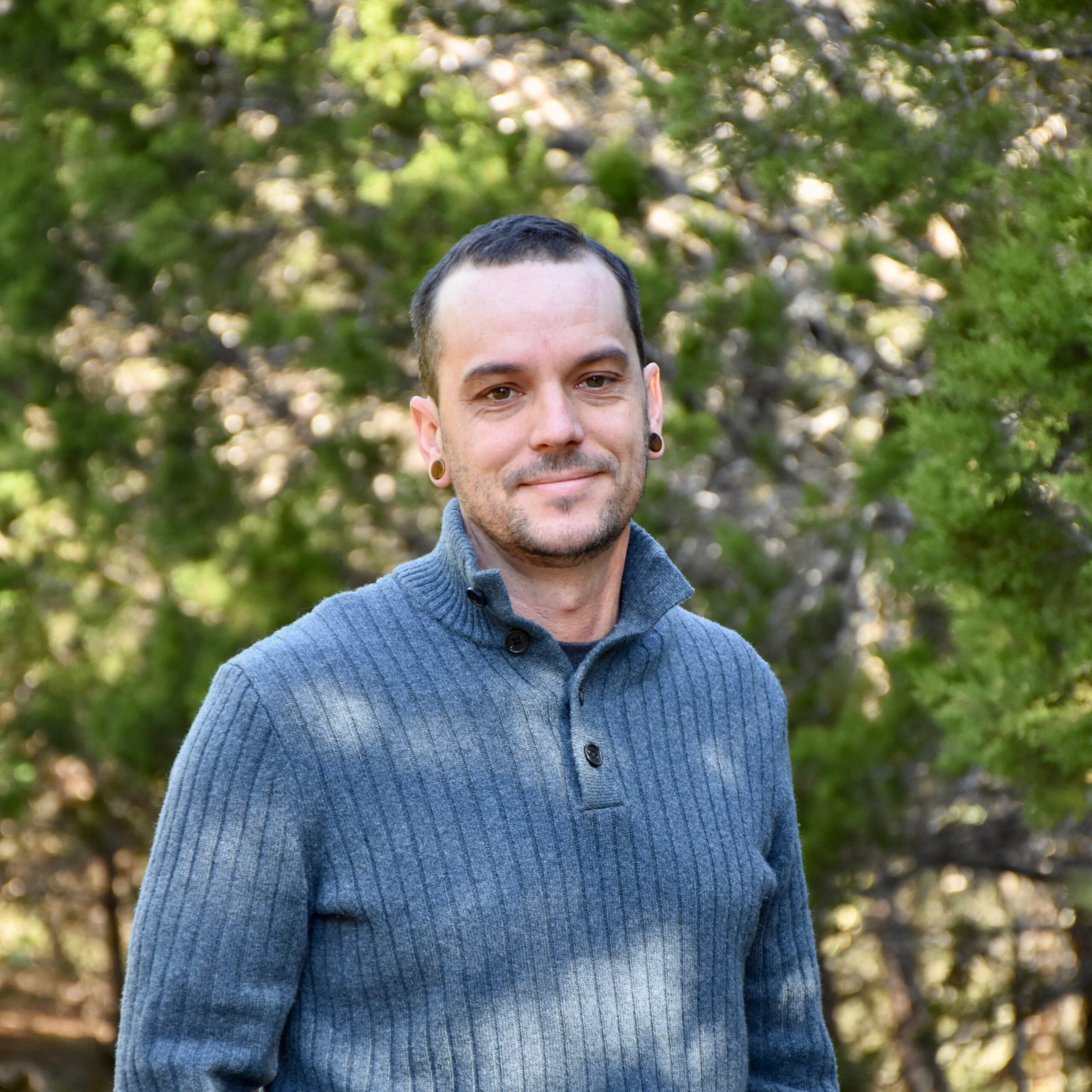
Reviewed by Chris Hudson, LPC
Founder & Executive Director – Lucent Recovery and Wellness, Austin, TX (2020–Present)
Leads clinical programs and develops innovative therapeutic approaches integrating experiential and creative therapies.
Board Member – Reklaimed, Austin, TX
Supports recovery-focused nonprofit initiatives fostering community and creative skill-building.
Clinical Leadership Roles – South Meadows Recovery, Inc.
Held leadership positions overseeing program development, clinical operations, and organizational management.
EDUCATION & CREDENTIALS
- M.A., Clinical Mental Health Counseling – Seminary of the Southwest (2021)
- B.A., Studio Art – Lewis & Clark College (2004)
- Licensed Professional Counselor (LPC), Texas
- Licensed Chemical Dependency Counselor (LCDC), Texas