When Anxiety Comes First: The Link Between Anxiety and Eating Disorders
Authored by the Clinical Team at Lucent Recovery and Wellness
Reviewed by Chris Hudson, MA, LPC, LCDC
Most of the people we work with at Lucent didn’t come to us because of food. They came because of the worry that wouldn’t turn off. The racing thoughts before a meal, the dread of being judged, the need to control something, anything, when life felt unmanageable. Somewhere along the way, that anxiety found an outlet in eating, or in not eating, and what started as a way to cope became its own problem. When we gently ask about the timeline, the story is remarkably consistent. The anxiety was there first.
That pattern isn’t a coincidence, and it isn’t rare. Anxiety and eating disorders are deeply intertwined, and understanding how they feed each other changes what effective treatment looks like. If you’re worried about yourself or someone you love, this article walks through what the research shows, why these two struggles so often travel together, and what genuine, whole-person recovery involves.
What the research shows about anxiety and eating disorders
Anxiety is the single most common mental health condition to co-occur with an eating disorder. According to the National Institute of Mental Health, when researchers looked at people with anorexia, bulimia, and binge eating disorder, all three had their highest comorbidity with anxiety disorders. A large 2022 review in the Journal of Eating Disorders, which synthesized more than 200 studies, put the number in perspective: up to 62 percent of people with an eating disorder also live with an anxiety disorder. That’s not a footnote. That’s a majority.
What’s just as striking is the order in which these conditions tend to appear. In a study of women presenting for eating disorder treatment, about two-thirds also met criteria for an anxiety disorder, and among those, roughly seven in ten reported that the anxiety came first. Social anxiety was the most common form. This lines up with what we see clinically. For many people, anxiety is the soil the eating disorder grows in, not the other way around.
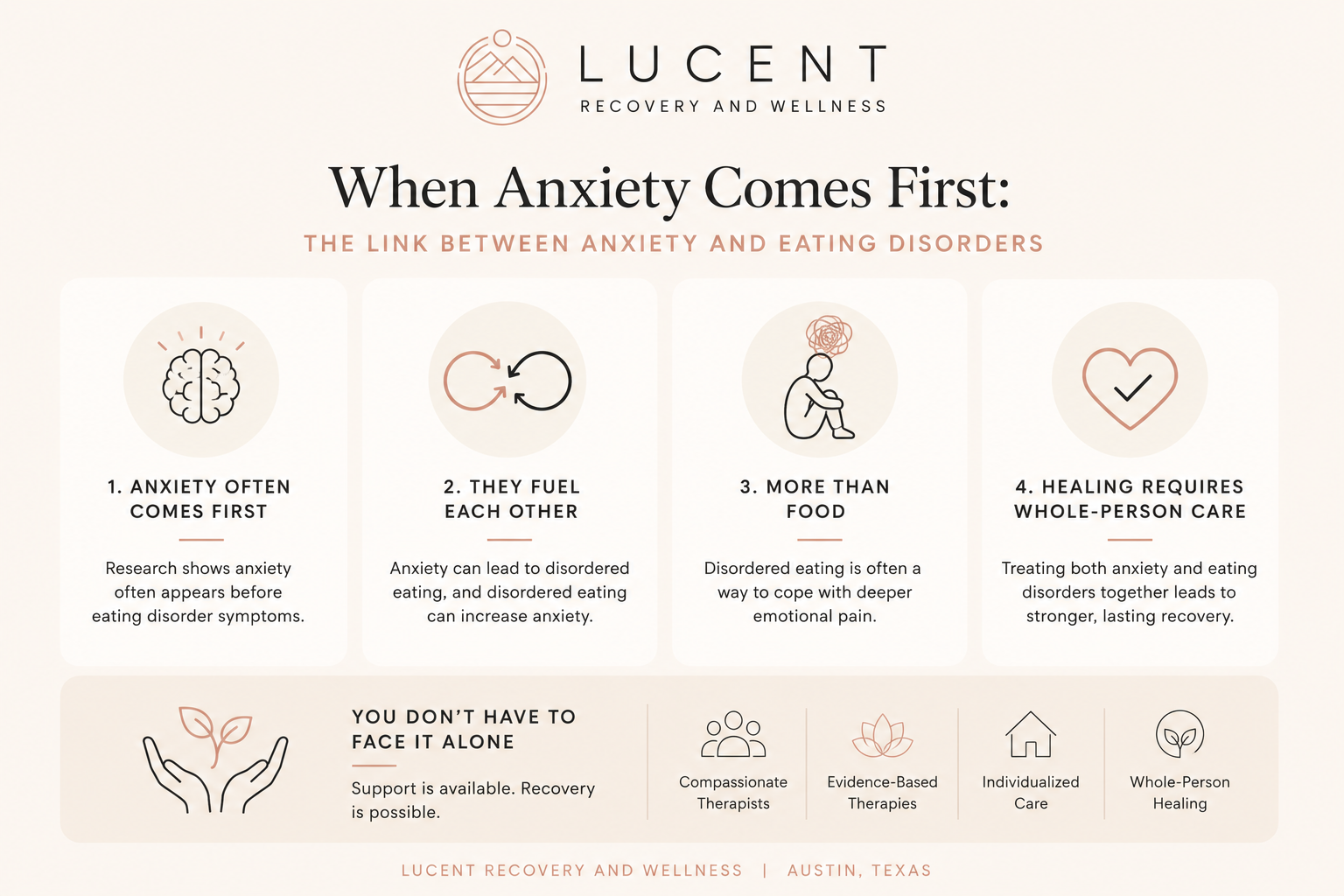
More recent work reinforces the connection and adds nuance. A 2024 systematic review and meta-analysis in European Child & Adolescent Psychiatry pooled 54 studies and found that anxiety symptoms in adolescence predicted later eating disorder symptoms and higher odds of developing an eating disorder. The researchers were careful to note the effects were modest and called for more study, but the pattern was consistent, and importantly, the relationship ran in both directions, meaning anxiety can fuel disordered eating and disordered eating can deepen anxiety. It becomes a loop.
We’ll add one honest caveat, because we think trustworthy information matters more than tidy answers. A 2025 systematic review examining medications for anxiety in people with eating disorders found the evidence was still mixed and called for more rigorous research. There’s no quick pharmaceutical fix here. Medication can play a supporting role for some people, but therapy and skilled, individualized care remain at the center of recovery.
Why anxiety and eating disorders feed each other
If anxiety so often comes first, the natural question is why it so frequently leads to disordered eating. In our experience, it usually comes down to control and relief.
Anxiety is, at its core, a feeling of threat and uncertainty. For someone whose inner world feels chaotic or unsafe, food is one of the few things that seems controllable. Restricting can create a temporary sense of order and accomplishment. Bingeing can numb or quiet unbearable feelings for a little while. Rigid rules around eating can make an unpredictable world feel more predictable. None of this is a character flaw or a choice. It’s the mind reaching for whatever lowers the distress in the moment, even when the long-term cost is high.
Social anxiety deserves special mention, since it shows up so often in this population. Fear of being judged can attach itself to appearance, eating in front of others, or body image, and that fear can drive both avoidance and disordered behaviors. Perfectionism, another close cousin of anxiety, adds fuel by setting impossible standards. Over time, the eating disorder and the anxiety start reinforcing each other. Anxiety drives the behavior, the behavior offers brief relief, and then guilt and physical depletion crank the anxiety back up. Breaking that cycle usually takes more than willpower.
What it can look like
Because anxiety and eating concerns overlap so much, the signs can blur together. Someone might describe intense worry around mealtimes, a need for strict routines or rules about food, or avoidance of social situations that involve eating. There may be constant mental checking, reassurance seeking, or a preoccupation with body and food that crowds out other parts of life. Physical signs of anxiety, like restlessness, trouble sleeping, or difficulty concentrating, often sit right alongside changes in eating.
We want to be careful and gentle here, because every person’s experience is different, and a list of signs is never a diagnosis. A trauma history, depression, or obsessive-compulsive patterns can also be part of the picture. What matters most is not fitting a checklist but noticing when worry and eating have started to shrink someone’s world. That’s the moment to reach out, well before things reach a crisis.
Why treating the eating disorder without the anxiety often falls short
Here’s something we’ve learned the hard way, alongside the wider field. When treatment focuses only on the eating behaviors and ignores the anxiety underneath, progress tends to be fragile. Someone might stabilize their eating in a structured setting, then relapse once they return to the same anxious thoughts and the same triggers that started the cycle. The eating disorder was doing a job. If the anxiety that hired it is still running the show, the symptoms often come back.
This is why we believe in treating the whole person rather than a single diagnosis. Evidence-based therapies like cognitive behavioral therapy, dialectical behavior therapy, and acceptance and commitment therapy give people concrete skills to manage anxiety, tolerate distress, and respond to difficult thoughts without turning to disordered behaviors. When the anxiety becomes more manageable, the pull toward those behaviors tends to ease. The two have to be addressed together.
How we approach anxiety and co-occurring concerns at Lucent
At Lucent Recovery and Wellness, we’re a clinician-owned mental health practice in Austin, and individualized care is the whole point of how we’re built. We know that no two people arrive with the same story, so we don’t run anyone through a one-size-fits-all protocol.
Our licensed, master’s-level therapists draw on evidence-based approaches, including CBT, DBT, ACT, mindfulness-based interventions, and trauma-informed care, and we match the approach to the person. For many clients, group therapy is a turning point, because anxiety thrives in isolation and shame, and sitting with others who understand can be profoundly relieving. Depending on what someone needs, care might take the form of our Intensive Outpatient Program, our Partial Hospitalization Program, or ongoing mental health counseling. Because anxiety and disordered eating affect families too, we also involve loved ones through our family support work.
We also believe in being honest about scope. When someone’s primary struggle is an eating disorder, dedicated eating disorder treatment matters, and it should address the anxiety and other conditions that come with it rather than treating food in isolation. Specialized programs like ViaMar Health, which treats eating disorders alongside co-occurring anxiety, depression, and trauma, reflect the kind of integrated, whole-person model the research points toward. Getting someone to the right level and type of care is part of doing this well, and we’d always rather make a thoughtful referral than stretch beyond what serves a person best.
Supporting a loved one
If you’re watching someone you love struggle with anxiety and eating, you probably feel some mix of worry, confusion, and helplessness. A few things tend to help more than others.
Try to lead with curiosity and warmth rather than fixing or controlling. Comments about food, weight, or appearance usually backfire, even when they come from love. What helps is a steady, nonjudgmental presence and a willingness to listen without rushing to solutions. It also helps to understand that the eating behaviors may be serving an anxious mind in ways that aren’t obvious from the outside, so patience matters. And take care of your own wellbeing too, because supporting someone through recovery is a marathon. Bringing the family into treatment, when it’s appropriate, gives everyone a shared language and a plan.
When to reach out for professional help
There’s no bar a person has to clear to deserve support. If anxiety and eating have started taking up more and more space, interfering with relationships, work or school, or peace of mind, that’s reason enough to talk to a professional. You don’t have to wait for a crisis or for things to get “bad enough.”
If you or someone you know is in immediate danger or having thoughts of suicide, please call or text 988, the Suicide and Crisis Lifeline, right away. For eating disorder support and referrals, the National Alliance for Eating Disorders runs a clinician-staffed helpline. And if you’re ready to explore treatment for anxiety or a co-occurring concern, reaching out to a program is a strong next step.
Common myths that get in the way
“It’s just anxiety, it’ll pass.” Anxiety disorders are real, treatable medical conditions, and when they go unaddressed they can drive other problems, including disordered eating. Getting help early tends to make recovery easier.
“The eating is the whole problem.” For many people, the eating disorder is the visible tip of an anxious iceberg. Treating only the behaviors, without the anxiety underneath, often leads to relapse.
“You have to look a certain way to have an eating disorder.” Eating disorders affect people of every body size, gender, age, and background, and most people with one are not underweight. The same is true of anxiety. It doesn’t have a “look.”
“Needing help is a weakness.” Reaching out takes courage, not weakness. The people we admire most are the ones who were willing to ask.
Frequently asked questions
Does anxiety cause eating disorders? Anxiety doesn’t cause eating disorders in a simple, direct way, and not everyone with anxiety develops one. But research consistently shows that anxiety often precedes eating disorders and raises the risk of developing one, and that the two reinforce each other. For many people, disordered eating begins partly as a way to manage overwhelming anxiety.
If I treat my anxiety, will the eating disorder go away on its own? Not necessarily, and we’d be cautious about promising that. Once an eating disorder takes hold, it usually needs direct attention alongside the anxiety. The good news is that addressing the anxiety tends to remove fuel from the fire and makes eating disorder recovery more durable. The two are best treated together.
What kind of therapy helps with both anxiety and disordered eating? Approaches with strong evidence include cognitive behavioral therapy, dialectical behavior therapy, and acceptance and commitment therapy. These help people manage anxious thoughts, build distress tolerance, and respond differently to triggers. The right mix depends on the individual, which is why an assessment matters.
Should I consider medication? Medication can help some people, often as part of a broader plan rather than a stand-alone solution. A 2025 review found the evidence for medications targeting anxiety in eating disorders is still mixed, so this is a decision to make carefully with a qualified prescriber, alongside therapy.
Can anxiety and eating concerns be treated at the same time? Yes, and in most cases they should be. Integrated, whole-person care that addresses both is more effective than treating one and ignoring the other. The specifics, including the level of care, depend on each person’s needs and safety.
My anxiety feels manageable most days. Is it still worth getting help? Absolutely. You don’t have to be in crisis to benefit from support. Working on anxiety earlier, before it drives other patterns, is often easier and can prevent bigger struggles down the road.
A hopeful path forward
We opened with a pattern we see again and again: the anxiety was there first, and the eating disorder grew out of it. We want to close with the hopeful side of that same truth. When we understand anxiety as part of the story rather than a side issue, we can treat what’s actually driving the struggle. And when the anxiety becomes more manageable, people so often find that their relationship with food, with their bodies, and with themselves can heal too.
Recovery isn’t a straight line, and we’d never promise a quick fix. But with individualized, evidence-based care and real support, meaningful and lasting change is possible. You are not your anxiety, and you are not your eating disorder. Both can be treated, and you don’t have to face them alone.
Ready to talk to someone?
If anxiety, disordered eating, or both have started to weigh on you or someone you love, we’re here to help. Our team is glad to answer your questions, talk through what care could look like, and help you figure out the right next step, with no pressure and no judgment. You can reach out to us or call 512-588-3899 whenever you’re ready.

Reviewed by Chris Hudson, LPC
Founder & Executive Director – Lucent Recovery and Wellness, Austin, TX (2020–Present)
Leads clinical programs and develops innovative therapeutic approaches integrating experiential and creative therapies.
Board Member – Reklaimed, Austin, TX
Supports recovery-focused nonprofit initiatives fostering community and creative skill-building.
Clinical Leadership Roles – South Meadows Recovery, Inc.
Held leadership positions overseeing program development, clinical operations, and organizational management.
EDUCATION & CREDENTIALS
- M.A., Clinical Mental Health Counseling – Seminary of the Southwest (2021)
- B.A., Studio Art – Lewis & Clark College (2004)
- Licensed Professional Counselor (LPC), Texas
- Licensed Chemical Dependency Counselor (LCDC), Texas