Archive for the
‘Uncategorized’ Category

Who Is a Good Fit for a Mental Health PHP Program?

Authored by the Clinical Team at Lucent Recovery and Wellness
Reviewed by Chris Hudson, MA, LPC, LCDC

A mental health Partial Hospitalization Program, or PHP, may be a good fit for adults whose symptoms are disrupting daily functioning enough to require daily therapeutic structure, but who do not need inpatient care, medical detox, or 24-hour supervision.PHP often fits people who can remain safe outside a hospital setting, but whose depression, anxiety, trauma symptoms, mood instability, or co-occurring concerns are too disruptive to manage with weekly therapy or IOP-level support alone.

Quick Answer: Who Is a Good Fit for a Mental Health PHP Program?

A good fit for PHP is usually someone whose mental health symptoms require a structured mental health program during the day, but who can safely live outside an inpatient program or residential setting.

PHP is often considered when:

  • depression, anxiety, trauma symptoms, mood instability, or co-occurring concerns are significantly disrupting daily functioning
  • symptoms are too persistent, intense, or destabilizing for weekly therapy or IOP alone
  • the person can remain safe outside 24-hour care
  • the person can attend and participate in daily or near-daily programming
  • work, school, parenting, self-care, sleep, or basic routines are significantly impaired
  • the person needs more clinical monitoring and structure than IOP provides
  • the person does not require inpatient hospitalization, medical detox, or continuous supervision

PHP placement depends less on the diagnosis by itself and more on how much daily structure is needed for safety, functioning, and emotional regulation to stabilize.

The PHP Fit Profile

Many people who fit PHP are safe outside 24-hour care, but not reliably stable without daily structure. Their symptoms may be shaping the day instead of simply interrupting it.

In our experience, PHP is often appropriate when the question is no longer how to fit treatment around a person’s daily responsibilities. Daily treatment may be needed to rebuild the stability, structure, and capacity required to return to those responsibilities over time.

Depression may make it difficult to get out of bed, shower, eat consistently, respond to messages, or follow through on basic responsibilities. Anxiety may take over large parts of the day through panic, avoidance, rumination, reassurance-seeking, or fear of leaving home. Trauma symptoms may make ordinary interactions, conflict, sleep, or daily transitions feel difficult to manage. Mood instability may make functioning unpredictable from one day to the next.

For some people, life has narrowed around managing symptoms. Work or school may be paused, reduced, inconsistent, or barely manageable. Relationships may feel strained because the person is withdrawing, reacting intensely, shutting down, or needing more support than loved ones know how to provide. Self-care may happen only when someone else prompts it. Sleep, meals, hygiene, medication routines, and basic organization may no longer hold consistently.

A person who fits PHP may still have insight. They may want help. They may be willing to participate in treatment. But they may not be able to maintain progress with long gaps between therapeutic contacts. They may stabilize briefly after a session or supportive conversation, then deteriorate again when the structure disappears.

PHP can fit when a person does not need to be in a hospital, but also cannot rely on weekly therapy or several treatment days per week to hold stability. The person may be safe, but daily functioning is significantly disrupted. They may be ready to engage in treatment, but need a full therapeutic day to help rebuild stability, routine, coping capacity, and follow-through.

Clinical Criteria That Support PHP Placement

Mental health professionals do not usually recommend PHP based on diagnosis alone. They consider how symptoms affect safety, functioning, participation, environment, and stability across the full day. A level of care assessment is the first step in determining whether PHP is appropriate.

Clinicians look for the least restrictive setting that still provides enough structure for stabilization. PHP may be appropriate when weekly outpatient therapy or an Intensive Outpatient Program (IOP) does not provide enough structure, but inpatient treatment, residential care, or 24-hour supervision is not clinically necessary.

Decision Domain What Supports PHP Fit
Safety and risk Safety can be managed outside 24-hour care, but symptoms require daily structure, monitoring, and clinical support to reduce the risk of further deterioration.
Symptom severity Symptoms are persistent, intense, or destabilizing without daily treatment structure, but do not require inpatient hospitalization or continuous supervision.
Daily functioning Work, school, family roles, self-care, sleep, meals, medication routines, or basic daily responsibilities are significantly disrupted.
Co-occurring complexity Mental health, substance use, psychiatric, medical, or practical needs require coordinated care across providers, but can still be managed safely outside inpatient treatment.
Recovery environment The person can live outside inpatient care, but the home or recovery environment may not provide enough structure by itself to support stability without daily treatment.
Support system Family, peers, providers, or other supports may be limited, strained, inconsistent, or insufficient without the structure of a daily program.
Engagement and participation The person can attend and participate in full-day programming, meet with providers, engage in groups, and work toward treatment goals even if motivation or stability fluctuates.
Treatment history Weekly therapy or IOP may not have provided enough support, or the person may be stepping down from inpatient or residential care and still need daily structure.

When PHP Is Usually Not the Right Fit

PHP is not usually appropriate when someone’s needs are either less intensive or more intensive than PHP can safely and effectively support.

For some people, PHP may be more structure than is clinically necessary. For others, PHP may not provide enough supervision or stabilization. The right fit depends on safety, symptom severity, functioning, treatment goals, time commitment, environment, and ability to participate.

PHP may not be the right level of care when:

  • symptoms can be managed safely with weekly therapy, outpatient treatment, or IOP
  • daily therapeutic structure is not clinically necessary
  • the person is mainly seeking intensive individual therapy but does not want group therapy sessions
  • the person cannot realistically participate in the time commitment required for PHP
  • logistical barriers make consistent attendance unrealistic
  • safety cannot be maintained outside a supervised setting
  • suicidal ideation is active, unstable, or high-risk
  • there is immediate danger to self or others
  • medical detox is needed
  • symptoms require 24-hour monitoring
  • psychosis, mania, or disorganized thinking prevents consistent participation
  • the living environment is unsafe or too unstable to support outpatient treatment without additional structure

When needs are lower acuity, IOP or weekly outpatient therapy may be more appropriate. When needs are higher acuity, inpatient treatment, crisis care, residential treatment, medical detox, or PHP with housing and wraparound support may be more appropriate depending on the person’s individual needs.

If someone is in immediate danger or experiencing a mental health emergency, call or text 988, contact emergency services, or go to the nearest emergency room.

What PHP Provides for Someone Who Is a Good Fit

PHP provides a full therapeutic day for people who need daily structure without 24-hour inpatient care.

PHP offers a higher level of outpatient support than IOP or traditional outpatient therapy. It commonly includes daily programming in a structured environment, group therapy, individual counseling, psychiatric care, medication management when appropriate, skills practice, care coordination, and treatment planning.

PHP can be helpful because it gives the day a therapeutic structure when symptoms have started setting the structure instead. Instead of waiting several days or a full week between treatment contacts, a person receives repeated support across the treatment week. Clinicians can observe patterns more frequently, adjust the treatment plan more quickly, and help the person practice coping skills while symptoms are still active.

PHP can also help rebuild the rhythm of daily life. When depression, anxiety, trauma symptoms, mood instability, or co-occurring concerns have disrupted sleep, meals, routines, motivation, relationships, and follow-through, a structured treatment day can help restore consistency. PHP supports symptom relief, stabilization, skill-building, and preparation for a lower level of care when the person is ready.

Why Lucent’s PHP May Be a Good Fit When Mental Health Is the Primary Concern

Lucent Recovery and Wellness provides mental health PHP for adults in Austin who need daily outpatient structure for depression, anxiety, trauma, mood instability, and related mental health conditions. Lucent’s outpatient continuum is designed around mental health as the primary clinical focus, with support for co-occurring substance use disorders when relevant.

Some treatment programs are primarily built around substance use treatment and later add on mental health services. Lucent’s Partial Hospitalization Program is designed primarily to support mental health needs while still recognizing that substance use, trauma, family stress, executive functioning, and life instability may also affect long-term recovery.

Lucent’s clinician-owned PHP includes structured group programming, but the support surrounding our programming is not treated as one-size-fits-all. Our team is mission-focused and passionate about customizing care to individual needs that can change over time. Treatment planning may include different combinations of individual therapy, psychiatric care, medication management, case management, coaching, family or support-system involvement, and experiential services depending on a person’s symptoms, functioning, recovery environment, and goals.

Daily programming gives the treatment team more opportunities to notice patterns as they unfold across the week. This level of responsiveness and coordination is critical when symptoms shift quickly, motivation fluctuates, or the person needs help stabilizing before the next setback becomes larger.

For some clients, housing may also be considered when the recovery environment is part of the problem. That does not mean every PHP client needs housing. It means environmental stability is one factor clinicians may consider when determining what support is needed for progress to hold outside treatment hours. The ability to incorporate housing and intensive support outside of treatment hours allows Lucent to provide comprehensive care in the outpatient setting when environmental stability is part of the clinical picture.

Why Structure Still Matters After Finding the Right Level of Care

Being a good fit for PHP does not mean the treatment day alone is the only structure that matters. The level of care is important, but what often makes the difference for people in a PHP program is how support and structure is customized for their needs within the PHP level of care.

Two people can both be appropriate for PHP and still need different treatment options, support services, and levels of case management, coaching, psychiatric coordination, family involvement, or support outside group hours. One person may need full-day programming to stabilize symptoms. Another may also need help with routines, appointments, implementing coping strategies, medication consistency, communication with family, or practical follow-through between treatment days.

When outpatient care does not account for the person’s specific needs and real-life environment, progress can fade after the treatment day ends even when PHP is technically the right level of care.

For a deeper look at why treatment structure affects stability after care begins, and how outpatient support can be adapted around the individual, see our guide to why outpatient mental health progress breaks down between sessions.

Frequently Asked Questions

Who is a good fit for a mental health PHP program?

A good fit for a mental health PHP program is usually someone whose symptoms are significantly disrupting daily functioning, but who can remain safe outside 24-hour care and participate in structured treatment during the day.

PHP often fits people who need more daily structure and intensive care than weekly therapy or IOP provides, but who do not need inpatient care, medical detox, or continuous supervision.

Is PHP good for depression, anxiety, or trauma?

PHP treatment can be a good fit for depression, anxiety, or trauma symptoms when those symptoms are disrupting everyday life, self-care, work, school, relationships, sleep, or emotional regulation.

PHP provides daily structure, group support, individual therapy, psychiatric care, medication management when appropriate, and skills practice for people who need more support than lower levels of outpatient care can provide.

Can I go to PHP while working or going to school?

PHP usually requires a significant time commitment because it provides a structured treatment day. Some people may be able to maintain limited work, school, or family responsibilities while attending PHP, but full-time obligations may be difficult to continue during treatment.

Whether PHP fits a work or school schedule depends on symptom severity, program schedule, treatment goals, and the person’s ability to participate consistently.

Who is not appropriate for PHP?

PHP is usually not appropriate when someone can be safely and effectively supported with weekly therapy or IOP, does not need daily structure, cannot commit to the time requirement, or is looking only for intensive individual therapy without group-based programming.

PHP is also not appropriate when someone needs medical detox, cannot remain safe outside supervised care, has unstable suicidal ideation, requires 24-hour monitoring, or cannot participate consistently in programming.

How do clinicians decide if PHP is the right level of care?

Clinicians consider safety, symptom severity, daily functioning, co-occurring needs, recovery environment, support system, treatment history, and ability to participate. PHP may be recommended when symptoms require daily therapeutic structure, but the person can remain safe outside inpatient or residential care.

How to Find Out Whether PHP Is the Right Fit

The best way to determine whether PHP is appropriate is through a clinical assessment. At Lucent Recovery and Wellness, level-of-care recommendations consider safety, symptom severity, daily functioning, co-occurring needs, recovery environment, support system, treatment history, time commitment, and ability to participate. Our goal is to help you make an informed decision.

If PHP is the right fit, treatment should provide daily structure that supports stabilization, skill-building, and progress toward a lower level of care when clinically appropriate. If another level of care is more appropriate, the assessment can help clarify that before treatment begins.

Contact Lucent Recovery and Wellness to schedule a level-of-care assessment.

Healing and recovery at Lucent Recovery and Wellness

Reviewed by Chris Hudson, LPC

Founder & Executive Director – Lucent Recovery and Wellness, Austin, TX (2020–Present)
Leads clinical programs and develops innovative therapeutic approaches integrating experiential and creative therapies.

Board Member – Reklaimed, Austin, TX
Supports recovery-focused nonprofit initiatives fostering community and creative skill-building.

Clinical Leadership Roles – South Meadows Recovery, Inc.
Held leadership positions overseeing program development, clinical operations, and organizational management.

EDUCATION & CREDENTIALS

  • M.A., Clinical Mental Health Counseling – Seminary of the Southwest (2021)
  • B.A., Studio Art – Lewis & Clark College (2004)
  • Licensed Professional Counselor (LPC), Texas
  • Licensed Chemical Dependency Counselor (LCDC), Texas

Who Is a Good Fit for a Mental Health IOP Program?

Authored by the Clinical Team at Lucent Recovery and Wellness
Reviewed by Chris Hudson, MA, LPC, LCDC

A mental health Intensive Outpatient Program, or IOP, may be a good fit for adults who need more structure than weekly therapy, but who do not need inpatient care, medical detox, or 24-hour supervision.IOP often fits people whose mental health symptoms are interfering with daily life while they are still able to remain safe, live outside a treatment facility, attend programming consistently, and continue some work, school, family, or daily responsibilities.

Quick Answer: Who Is a Good Fit for a Mental Health IOP Program?

A good fit for IOP is usually someone whose symptoms are serious enough to require structured treatment several days per week, but stable enough to be managed outside a hospital or residential setting.

IOP may be appropriate when:

  • depression, anxiety, trauma symptoms, mood instability, or co-occurring concerns are affecting daily life
  • weekly therapy is not providing enough structure, repetition, or support
  • the person can remain safe outside 24-hour care
  • the person can attend scheduled programming and participate consistently
  • work, school, parenting, caregiving, or daily responsibilities are strained but still possible
  • the home or living environment is stable enough to support outpatient treatment
  • symptoms require more support than weekly therapy, but not 24-hour care or daily PHP-level structure

Diagnosis is not typically the most important factor when determining if someone is an appropriate fit for IOP. The more important factors are safety, daily functioning, recovery environment, treatment needs, and whether a person can participate consistently in structured outpatient care.

The IOP Fit Profile

Many people who fit IOP are still functioning on the outside, but struggling internally.

They may still be going to work, attending school, taking care of children, helping family members, paying bills, answering messages, and getting through the day. From the outside, they may look capable. Internally, daily life may feel much harder than it looks.

In our experience, many people who fit IOP are not obviously reaching a breaking point from the outside. The visible parts of life may still be getting done, but the effort required to keep those parts moving has become increasingly difficult to sustain. What is less visible is how little capacity may be left once those responsibilities are finished.

This can show up as getting through work and then crashing afterward. It may look like keeping up with major responsibilities but having nothing left for relationships, self-care, meals, sleep, or basic routines. Some people are still meeting deadlines, but only through anxiety, avoidance, perfectionism, or emotional shutdown. Others are parenting or caregiving for loved ones while feeling irritable, numb, panicked, depleted, or close to tears much of the time.

For many people in this position, weekly therapy may still be helpful. The problem is that the support does not last long enough. A person may leave therapy with insight, relief, or a plan, but find that symptoms return before the next appointment. Coping skills may make sense in session, but become difficult to use during real-life stress. Depression may make follow-through feel impossible. Anxiety may keep a person in a cycle of worry, avoidance, and overcontrol. Trauma symptoms may make everyday situations feel more threatening or overwhelming than others can see.

IOP can fit when someone does not need to step away from life completely, but also cannot keep trying to manage symptoms with once-a-week support alone. They may not necessarily be in crisis. They may still be functioning. But functioning is becoming harder to sustain without more structure, accountability, and therapeutic contact.

Clinical Criteria That Support IOP Placement

Clinicians do not usually recommend IOP based on diagnosis alone. They consider how symptoms affect safety, functioning, participation, environment, and stability between treatment contacts. A level of care assessment is the first step in determining an appropriate placement.

Clinicians generally look for the lowest level of support that can safely help progress hold. IOP may be appropriate when outpatient therapy is not enough, but PHP, inpatient treatment, or residential care is not clinically necessary.

Decision Domain What Supports IOP Fit
Safety and risk Safety can be maintained outside 24-hour care. The person does not require continuous monitoring, but may benefit from more frequent clinical contact and support.
Symptom severity Symptoms are persistent, disruptive, or escalating between weekly sessions, but are not so acute that inpatient treatment or daily PHP-level structure is required.
Daily functioning Work, school, family roles, self-care, or daily routines are strained, but not fully collapsed. The person can still participate in some responsibilities while receiving structured treatment.
Co-occurring complexity Mental health, substance use, psychiatric, medical, or practical needs require coordination, but can still be managed safely in an outpatient setting.
Recovery environment The person has a stable enough place to live between treatment days. The environment does not need to be perfect, but it must be safe enough to support outpatient care.
Support system Family, peers, providers, or other supports may help the person remain stable outside program hours. A limited support system does not automatically rule out IOP, but it affects treatment planning.
Engagement and participation The person can attend programming, participate in groups, meet with providers, and practice skills between sessions with support and accountability.
Treatment history Weekly therapy may not have provided enough structure, or the person may be stepping down from a higher level of care and ready for less intensive support.

When IOP Is Usually Not the Right Fit

IOP is not usually appropriate when someone needs continuous supervision, medical stabilization, or a treatment setting that can respond immediately throughout the day and night.

IOP may not be the right level of care when:

  • safety cannot be maintained outside a supervised setting
  • suicidal ideation is active, unstable, or high-risk
  • there is immediate danger to self or others
  • medical detox is needed
  • symptoms require 24-hour monitoring
  • psychosis, mania, or disorganized thinking prevents consistent participation
  • the person cannot attend or engage in scheduled programming
  • the living environment is unsafe or too unstable to support outpatient treatment

In these situations, another configuration of care may be more appropriate, such as PHP, inpatient treatment, crisis care, residential treatment, medical detox, or PHP with added housing and wraparound support when the clinical level is appropriate but the living environment is not stable enough.

If someone is in immediate danger or experiencing a mental health emergency, call or text 988, contact emergency services, or go to the nearest emergency room.

What IOP Provides for Someone Who Is a Good Fit

IOP adds structure while allowing daily life to remain part of treatment.

IOP offers treatment several days per week through a combination of group therapy, individual counseling, skills practice, psychiatric support when appropriate, medication management when indicated, care coordination, and treatment planning. This gives a person more treatment options and therapeutic contact than weekly therapy while still allowing time outside programming to practice skills in real situations.

What often matters in IOP is shortening the distance between learning a skill, trying it in real life, and getting help with what happened next. A person can learn a coping skill, test it during the week, return to treatment, talk through what happened, and practice again. That rhythm can help skills become more usable under stress and more durable for long-term recovery.

IOP also helps interrupt patterns associated with mental health conditions that grow worse in isolation. More frequent clinical and peer support can help people notice when symptoms are escalating, when avoidance is increasing, when routines are falling apart, or when coping strategies are not holding. The program creates more opportunities to adjust the treatment plan before symptoms reach a crisis point.

Why Lucent’s IOP May Be a Good Fit When Mental Health Is the Primary Concern

Lucent Recovery and Wellness provides mental health IOP for adults in Austin who need structured outpatient support for depression, anxiety, trauma, mood instability, and related mental health concerns. Lucent’s outpatient continuum is designed around mental health as the primary clinical focus, with support for co-occurring substance use disorders when relevant.

Some treatment programs are primarily built around substance use treatment and later add on mental health support. Lucent’s clinician-owned outpatient care model is designed primarily to support mental health needs while still recognizing that substance use, trauma, family stress, executive functioning, and life instability may also affect recovery.

Lucent’s Intensive Outpatient Program includes group therapy sessions, individual therapy, psychiatric care, medication management when appropriate, case management, coaching, and family or support-system involvement when clinically appropriate. Our goal is to match a person’s symptoms, functioning, support system, and real-life needs to the right level of structured care.

This kind of outpatient work depends on a well-supported team that can notice when someone who still appears functional is beginning to lose ground. Lucent strives to provide enough structure and responsiveness to support progress before symptoms escalate into a higher level of disruption.

For adults who are still functioning but struggling to sustain stability, Lucent’s IOP can provide support without requiring them to step completely away from work, school, family, or daily life.

Why Structure Still Matters After Finding the Right Level of Care

Being a good fit for IOP does not mean every IOP program will provide the same kind of support. The level of care matters, but so does the structure inside that level of care.

Two people can both be appropriate for IOP and still need different levels of coordination, psychiatric support, coaching, family involvement, case management, or help between treatment days. One person may need group therapy and skills practice several days per week. Another may also need help rebuilding routines, communicating with family, coordinating medication support, or applying coping skills outside the therapy room.

When outpatient treatment approaches do not account for the person’s specific needs and real-life environment, progress can fade between sessions even when the level of care is technically appropriate.

For a deeper look at why treatment structure affects stability after care begins, and how Lucent customizes treatment to the individual, see our guide to why outpatient mental health progress breaks down between sessions.

Frequently Asked Questions

Who is a good fit for a mental health IOP program?

A good fit for a mental health IOP program is usually someone whose mental health symptoms are interfering with daily life, but who can remain safe outside 24-hour care, live in a stable enough environment, and participate in structured treatment several days per week.

IOP often fits people who need more support than weekly therapy, but do not need inpatient care, medical detox, or daily PHP-level structure.

Is IOP treatment good for depression and anxiety?

IOP can be a good fit for depression and anxiety when symptoms are affecting daily functioning, relationships, work, school, or self-care, but the person can still remain safe outside supervised care.

IOP may provide more structure, coping skills practice, group support, individual therapy, and psychiatric coordination than weekly therapy alone.

Can I go to IOP while working or going to school?

Many people attend IOP while continuing some work, school, parenting, or family responsibilities. IOP is designed for people who need structured support for their recovery process but do not need to step away from daily life completely.

Whether IOP fits a work or school schedule depends on the program schedule, symptom severity, and the person’s ability to participate consistently.

Who is not appropriate for IOP?

IOP is usually not appropriate when someone needs medical detox, cannot remain safe outside supervised care, has unstable suicidal ideation, requires 24-hour monitoring, or cannot participate consistently in scheduled programming.

In those situations, inpatient treatment, crisis care, residential treatment, PHP, or another level of care may be more appropriate.

How do clinicians decide if IOP is the right level of care?

Clinicians consider safety, symptom severity, daily functioning, co-occurring needs, recovery environment, support system, treatment history, and ability to participate. IOP may be recommended when symptoms require more structure than weekly therapy, but the person can remain safe and engaged outside 24-hour care.

How to Find Out Whether IOP Is the Right Fit

The best way to determine whether IOP is appropriate is through a clinical assessment. At Lucent Recovery and Wellness, level-of-care recommendations consider safety, symptom severity, daily functioning, co-occurring needs, recovery environment, support system, treatment history, and ability to participate. Our goal is to help you make an informed decision.

If IOP is the right fit, the goal is to provide enough structure to support progress while helping you stay connected to work, school, family, and daily life. If another level of care is more appropriate, the assessment can help clarify that before treatment begins.

Take the next step. Contact Lucent Recovery and Wellness to schedule a level-of-care assessment.

Healing and recovery at Lucent Recovery and Wellness

Reviewed by Chris Hudson, LPC

Founder & Executive Director – Lucent Recovery and Wellness, Austin, TX (2020–Present)
Leads clinical programs and develops innovative therapeutic approaches integrating experiential and creative therapies.

Board Member – Reklaimed, Austin, TX
Supports recovery-focused nonprofit initiatives fostering community and creative skill-building.

Clinical Leadership Roles – South Meadows Recovery, Inc.
Held leadership positions overseeing program development, clinical operations, and organizational management.

EDUCATION & CREDENTIALS

  • M.A., Clinical Mental Health Counseling – Seminary of the Southwest (2021)
  • B.A., Studio Art – Lewis & Clark College (2004)
  • Licensed Professional Counselor (LPC), Texas
  • Licensed Chemical Dependency Counselor (LCDC), Texas

How Housing, Active Case Management, and Support Outside Program Hours Change What PHP Actually Provides

Authored by the Clinical Team at Lucent Recovery and Wellness
Reviewed by Chris Hudson, MA, LPC, LCDC

Transitional housing and wraparound support while attending mental health PHP may be needed when a person requires daily PHP-level treatment, but also needs active support outside treatment hours because independent living, routines, appointments, medication consistency, or follow-through are not stable enough on their own.

This added support often fits people who no longer need inpatient care or 24-hour supervision, but are not yet ready to manage the demands of independent living without closer monitoring, support, and timely intervention outside the treatment day.

Quick Answer: Who Needs Transitional Housing and Wraparound Support While Attending Mental Health PHP?

Transitional housing and wraparound support while attending mental health PHP may be needed when a person requires the daily therapeutic structure of PHP and also needs help maintaining stability in the hours before, after, and between treatment days.

Transitional housing and wraparound support may be needed during mental health PHP when:

  • PHP-level treatment is clinically necessary, but the treatment day alone is not enough to support functional stability
  • Repeated transitions out of inpatient care for bipolar disorder, schizophrenia, or schizoaffective disorder have resulted in destabilization despite continued outpatient treatment
  • the person can remain safe outside inpatient care, but safety risks have the potential to emerge without closer monitoring, support, and timely intervention
  • independent living tasks such as medications, appointments, meals, sleep, transportation, or daily routines require active support rather than passive planning or recommendations
  • the person has done better in structured settings but repeatedly lost stability when support dropped too quickly
  • the current living environment is unsafe, chaotic, isolating, unsupported, or too unstructured to support progress
  • family or other supports are limited, strained, overburdened, or not able to provide enough structure consistently
  • the person can participate in PHP programming, but needs more support to follow through outside clinical hours
  • inpatient or residential treatment is no longer necessary, but independent living is not yet realistic without a more supported transition

The added transitional housing and wraparound decision depends on whether life outside the treatment day can support progress, not simply on the diagnosis or the PHP level itself.

The Bridge Between Inpatient Care and Independent Living

Many people who need transitional housing and wraparound support while attending PHP are in the difficult middle stage after inpatient or residential treatment. They no longer need 24-hour supervision, but returning directly to independent living would reduce support too quickly.

A person may be stable enough to leave inpatient care and still not be ready to manage medications, appointments, transportation, meals, sleep, family stress, and daily routines without more help.

In our experience, this transition can look reasonable on paper before it is workable in real life. A discharge plan may list appointments, medications, coping strategies, and follow-up care, but those pieces still require someone to organize a day, tolerate unstructured time, ask for help early, and follow through before small problems become larger ones.

Transitional housing and wraparound support during PHP can serve as a bridge in that gap. The clinical day remains intensive, but support also extends into the parts of life where previous transitions have broken down. This support helps a person practice independence with enough structure around them for progress to become more durable before they are expected to sustain it alone.

The Profile of Someone Who Needs Transitional Housing and Wraparound Support During PHP

Many people who need transitional housing and wraparound support during PHP can participate meaningfully in treatment during the day, but struggle to hold onto progress once the treatment day ends.

They may do well in a structured setting. They may attend groups, engage with clinicians, understand the treatment plan, and appear more stable while support is close at hand. The harder part often begins later: in the evening, overnight, across weekends, or during the unstructured parts of daily life when they are expected to manage everything independently again.

This may look like medications becoming inconsistent, appointments being missed, sleep schedules deteriorating, meals becoming irregular, or transportation and daily planning becoming difficult to organize. A person may isolate after programming, return to a chaotic home environment, become overwhelmed by ordinary tasks, or lose momentum as soon as there is no one nearby helping them translate treatment into real life.

Family members may also be exhausted from functioning as the entire support system, even when they care deeply and want to help. In those situations, the problem is not only the person’s symptoms. It is that the support system around them may not be able to provide the amount of structure the transition requires.

A person who fits this profile may not need inpatient care. They may be safe enough to live outside a hospital and capable of participating in PHP. But they may still need active help rebuilding the practical parts of life that allow treatment to hold: waking up, taking medication, getting to appointments, eating regularly, managing transportation, following through with outside providers, tolerating evenings and weekends, and gradually practicing greater independence with support still available.

Transitional housing and wraparound support during PHP may be needed when the clinical level of care is right, but life outside the treatment day still requires more structure than independent living can provide.

Clinical Criteria That Support Adding Transitional Housing and Wraparound Support to PHP

Mental health professionals do not usually recommend adding transitional housing and wraparound support to PHP based on diagnosis alone. They consider how symptoms affect safety, daily functioning, participation, recovery environment, support needs, and the person’s ability to maintain progress outside treatment hours. A level of care assessment is the first step in determining whether this configuration of support is appropriate.

The assessment should clarify whether PHP alone is enough, or whether added transitional housing and wraparound support are needed for progress to hold outside treatment hours. Transitional housing and wraparound support may be appropriate during PHP when inpatient or residential treatment is not clinically necessary, but standard PHP without additional environmental and practical support is not enough to sustain stability.

Decision Domain What Supports Adding Transitional Housing and Wraparound Support to PHP
Safety and risk Safety can be managed outside inpatient care, but safety risks have the potential to emerge without closer monitoring, support, and timely intervention outside treatment hours.
Symptom severity Symptoms require PHP-level daily structure plus reinforcement outside the treatment day so progress does not fade during unstructured time.
Daily functioning Independent living tasks, routines, appointments, medication consistency, meals, sleep, transportation, or follow-through require active monitoring, support, and intervention rather than passive planning or recommendations.
Co-occurring complexity Mental health, substance use, psychiatric, medical, legal, family, or practical needs require active coordination across providers and supports.
Recovery environment The current living environment is unsafe, chaotic, isolating, unsupported, or too unstructured to support progress outside the treatment day.
Support system Family, peers, or outside supports may be limited, strained, overburdened, or unable to provide enough structure consistently.
Engagement and participation The person can participate in PHP programming, but needs support to follow through outside clinical hours and during transitions, evenings, weekends, or unstructured time.
Treatment history The person may have done well in structured settings but repeatedly lost stability after returning to independent living, less supported care, or a recovery environment that could not hold progress.

When Transitional Housing and Wraparound Support During PHP Is Usually Not the Right Fit

Transitional housing and wraparound support during PHP is not usually appropriate when someone’s needs can be safely and effectively met with less intensive support, or when their needs are too acute to be managed outside 24-hour care.

For some people, standard PHP may be enough. They may have stable housing, enough support outside treatment, and the ability to use that support on their own. They may be able to manage medications, transportation, appointments, meals, sleep, and daily routines without active intervention between treatment days.

For others, transitional housing and wraparound support during PHP may still not provide enough supervision. Transitional housing and outpatient support are not substitutes for inpatient or residential treatment when 24-hour care is clinically necessary.

Transitional housing and wraparound support during PHP may not be the right fit when:

  • standard PHP, IOP, or weekly outpatient therapy can safely and effectively meet the person’s needs
  • the person has a stable living environment, enough support, and can utilize that support independently
  • daily routines, medications, appointments, meals, transportation, and follow-through can be managed without active monitoring or intervention
  • housing or coaching would be helpful but is not clinically necessary at this level of intensity
  • safety cannot be maintained outside a supervised 24-hour setting
  • suicidal ideation is active, unstable, or high-risk
  • there is immediate danger to self or others
  • medical detox is needed
  • symptoms require hospital-level monitoring
  • psychosis, mania, or disorganized thinking prevents participation in PHP
  • the person cannot engage consistently in structured outpatient programming

When needs are lower acuity, standard PHP, IOP, or weekly outpatient therapy may be more appropriate. When needs are higher acuity, inpatient treatment, crisis care, residential treatment, or medical detox may be required.

If someone is in immediate danger or experiencing a mental health emergency, call or text 988, contact emergency services, or go to the nearest emergency room.

What Transitional Housing and Wraparound Support Add During Mental Health PHP

For someone who needs this added support, transitional housing and wraparound services extend PHP beyond the treatment day by helping stabilize the parts of life that happen outside the therapy room.

PHP provides daily clinical structure through group therapy, individual counseling, psychiatric care, medication management when appropriate, skills practice, care coordination, and treatment planning. Transitional housing and wraparound support add a more structured living environment, active case management, coaching outside group hours, medication accountability, transportation support when needed, and help with routines, appointments, daily organization, and practical follow-through.

The value of this model is continuity. A person is not expected to move abruptly from highly structured care into fully independent living simply because inpatient treatment is no longer necessary. Instead, support continues during the period when treatment gains are most vulnerable to falling apart in real life.

That can be critical during a step-down from inpatient or residential treatment, especially for people who have repeatedly stabilized in structured settings and then lost ground after discharge. It can also matter for people in outpatient care whose clinical symptoms and real-world functioning remain too intertwined to treat the therapy day and the rest of life as separate problems.

Transitional housing and wraparound support provide enough structure, accountability, and intervention for independent functioning to become more realistic over time.

Why Lucent May Be a Good Fit When PHP Alone Is Not Enough

Lucent Recovery and Wellness can combine mental health PHP with transitional housing and wraparound support for adults in Austin whose clinical needs and real-life functioning both require attention. Our transitional services are often critical for people with bipolar disorder, schizophrenia, or schizoaffective disorder, who have struggled to gain traction after inpatient treatment. Lucent’s outpatient continuum is designed around mental health as the primary clinical focus, with support for co-occurring substance use disorders when relevant.

Some treatment programs are primarily built around substance use treatment and later add on mental health services. Lucent’s care is designed primarily to support mental health needs while still recognizing that substance use, trauma, family stress, executive functioning, practical barriers, and environmental instability may all affect long-term recovery.

For clients who need more than the PHP treatment day alone, Lucent can incorporate transitional housing, active case management, coaching, medication accountability, transportation support when necessary, family or support-system involvement, and coordination with outside providers as part of a more comprehensive outpatient care plan.

For this profile, recommendations and passive action plans alone are often not enough. Clients often need active support in the moments when follow-through is most likely to break down.

Lucent’s clinician-owned model depends on staff who are well supported, connected to the mission, and invested in helping clients rebuild stability in real life, not simply clocking into a shift. For this level of care, the quality and responsiveness of the team is crucial because support is often needed in the moments when functioning begins to slip: when an appointment is about to be missed, a routine is breaking down, medication follow-through is becoming inconsistent, or a client needs help carrying coping strategies into the next part of the day.

For people who are clinically appropriate for PHP but not yet ready for unsupported independent living, Lucent’s treatment environment can respond to the full pattern of need: symptoms, functioning, recovery environment, support system, and the practical demands of returning to daily life.

Why Structure Determines Whether Progress Holds After Treatment Hours

Needing transitional housing and wraparound support during PHP means the structure outside the therapy room is clinically relevant to a person’s progress. The level of care matters, but what happens when programming ends often makes the difference for long-term progress.

Two people can both be appropriate for PHP and still need very different levels of support after the treatment day. One may be able to return home, follow recommendations, and maintain stability independently. Another may need active case management, coaching, medication support, family coordination, or a more structured living environment so that progress does not dissolve during evenings, weekends, or transitions.

This page explains who may need transitional housing and wraparound support during PHP. The next question is why that structure can determine whether outpatient progress holds once the treatment day ends.

For a deeper look at how the recovery environment, support outside therapy, and the design of outpatient care affect stability, see our guide to why outpatient mental health progress breaks down between sessions.

Frequently Asked Questions

Who needs transitional housing and wraparound support while attending mental health PHP?

Transitional housing and wraparound support while attending mental health PHP may be needed when a person requires daily PHP-level treatment and also needs active support outside treatment hours because independent living, routines, appointments, medication consistency, or follow-through are not stable enough on their own.

This added support often fits people who no longer need inpatient care, but are not yet ready to manage independent living without closer monitoring, structure, and intervention.

Is PHP with transitional housing the same as inpatient or residential treatment?

No. PHP with transitional housing is still an outpatient level of care. The person participates in PHP programming during the day and lives in a supportive housing environment outside treatment hours, but does not receive the 24-hour medical supervision provided in inpatient or residential treatment.

PHP with transitional housing may be appropriate when inpatient care is no longer necessary, but independent living would reduce support too quickly.

Why would someone need transitional housing and wraparound support while attending PHP?

Someone may need transitional housing and wraparound support while attending PHP when the clinical treatment is appropriate, but the environment they return to after programming is not stable enough to support progress. A person may need more help with sleep, routines, medication consistency, meals, transportation, appointments, accountability, or follow-through than standard PHP alone can provide.

Transitional housing can also help bridge the transition from inpatient or residential treatment back toward independent living.

Can someone attend PHP with transitional housing while working or going to school?

Some people may be able to maintain limited work, school, or family responsibilities while attending PHP with transitional housing, but this level of support is usually used when functioning outside treatment needs active structure. Full-time work or school may not be realistic early in treatment.

Whether work or school is appropriate depends on symptom severity, functional status, treatment goals, program schedule, and the person’s ability to participate consistently.

Who is not appropriate for transitional housing and wraparound support during PHP?

Transitional housing and wraparound support during PHP is usually not appropriate when someone can safely manage with standard PHP, IOP, or weekly outpatient therapy; has stable housing and enough support they can use independently; or does not need active intervention outside treatment hours.

It is also not appropriate when someone needs medical detox, cannot remain safe outside 24-hour care, has unstable suicidal ideation, requires hospital-level monitoring, or cannot participate consistently in PHP programming.

How do clinicians decide if transitional housing and wraparound support are needed during PHP?

Clinicians consider safety, symptom severity, daily functioning, co-occurring needs, recovery environment, support system, treatment history, and ability to participate. Transitional housing and wraparound support may be recommended during PHP when PHP is clinically appropriate, but active support outside treatment hours is also needed for safety, functioning, and progress to hold.

How to Find Out Whether Transitional Housing and Wraparound Support Are Needed During PHP

The best way to determine whether transitional housing and wraparound support are needed during PHP is through a clinical assessment. At Lucent Recovery and Wellness, level-of-care recommendations consider safety, symptom severity, daily functioning, co-occurring needs, recovery environment, support system, treatment history, ability to participate, and whether progress can realistically hold outside treatment hours without additional support.

If transitional housing and wraparound support are needed during PHP, care should provide enough clinical support and real-world structure to help a person move safely from higher support toward greater independence. If another configuration of care is more appropriate, the assessment can help clarify that before treatment begins.

Contact Lucent Recovery and Wellness to schedule a level-of-care assessment.

Healing and recovery at Lucent Recovery and Wellness

Reviewed by Chris Hudson, LPC

Founder & Executive Director – Lucent Recovery and Wellness, Austin, TX (2020–Present)
Leads clinical programs and develops innovative therapeutic approaches integrating experiential and creative therapies.

Board Member – Reklaimed, Austin, TX
Supports recovery-focused nonprofit initiatives fostering community and creative skill-building.

Clinical Leadership Roles – South Meadows Recovery, Inc.
Held leadership positions overseeing program development, clinical operations, and organizational management.

EDUCATION & CREDENTIALS

  • M.A., Clinical Mental Health Counseling – Seminary of the Southwest (2021)
  • B.A., Studio Art – Lewis & Clark College (2004)
  • Licensed Professional Counselor (LPC), Texas
  • Licensed Chemical Dependency Counselor (LCDC), Texas

From the River Walk to the Pearl District, San Antonio’s public identity is one of warmth and energy. It’s the seventh-largest city in the United States, one of the fastest-growing, and home to world-class medical institutions, a thriving hospitality sector, and cultural richness that draws millions of visitors each year.

But San Antonio is also one of the more economically unequal major cities in the country. A working class that sustains a service economy while often lacking access to the services it delivers to others. A mental health infrastructure that has historically fallen short of what a city with this level of need actually requires.

That gap is part of why IOP in San Antonio, TX, has become an increasingly important topic among clinicians, advocates, and residents navigating a system that doesn’t consistently show up when it’s needed most.

The Economic Underpinning of Mental Health in Bexar County

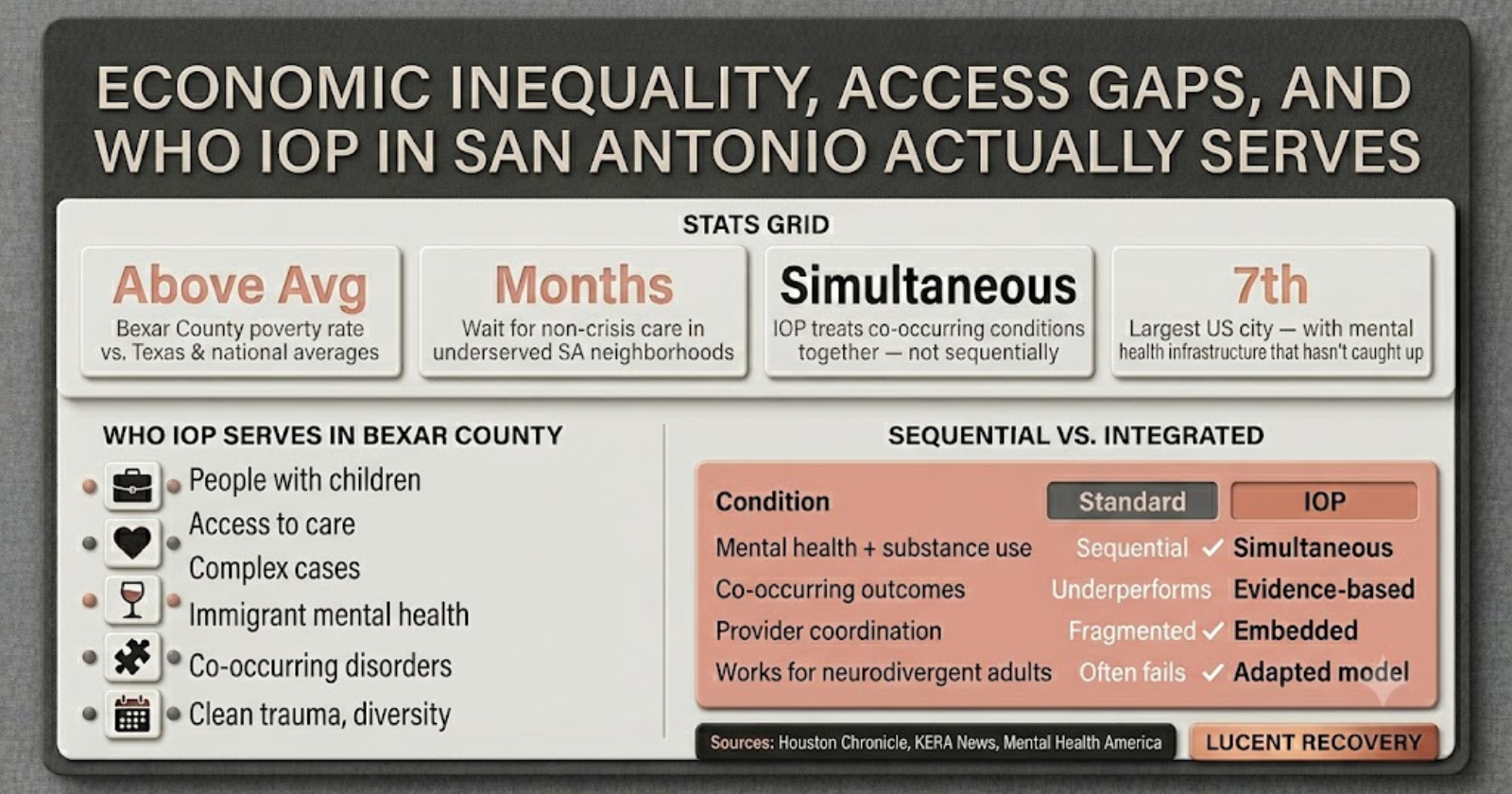
Economic stress and mental health are inseparable. Research is consistent: poverty, financial insecurity, housing instability, and employment precarity are among the strongest predictors of depression, anxiety, and trauma. Bexar County’s poverty rate consistently exceeds both the Texas and national averages, with concentrated poverty in the city’s south and west sides.

The San Antonio Express-News has covered the correlation between economic inequality and health outcomes in Bexar County, including mental health outcomes that track directly with income and zip code. Where people are struggling economically, mental health struggles follow. And the neighborhoods with the greatest mental health need often have the least mental health infrastructure, a compounding gap that makes reaching care genuinely difficult.

The Access Problem

Access to mental health care in San Antonio is stratified by income, insurance status, language, and geography. For someone with commercial insurance living on the north side, access to an IOP is challenging but navigable. For someone without insurance living on the south side, working two jobs, and most comfortable in Spanish, access to that same level of care is effectively nonexistent under the current system.

KSAT has reported on the insufficient capacity of publicly funded mental health services relative to Bexar County’s population. The Center for Health Care Services does essential work, but the scope of the need consistently exceeds the system’s reach.

IOP in San Antonio, TX occupies a specific position in this access landscape. Its clinical density, multiple days per week, multiple hours per session, means that the total investment in care is concentrated rather than spread across months of uncertain weekly appointments. For people with constrained schedules and limited flexibility, that concentration can actually make IOP more accessible than it initially appears.

What Recovery Actually Looks Like in a Complicated City

One of the more honest conversations in mental health care right now is about what “recovery” means for people navigating real-world complexity. For someone managing depression while working two jobs, parenting without a co-parent, and navigating a health system that doesn’t consistently speak their language, recovery is messier and more contingent than the standard clinical model often acknowledges.

Recovery in that context needs more than therapy. It needs psychoeducation, skills development, case coordination, and community. This is why the IOP model, when it’s built thoughtfully, includes all of those components rather than therapy alone.

Lucent’s piece on how trauma shapes real recovery and how mental health affects daily life addresses the complexity of recovery for people operating under sustained real-world pressure.

The Co-Occurring and Neurodivergent Dimension

San Antonio’s mental health population includes a significant number of adults with co-occurring conditions: mental health and substance use, mental health and neurodivergence, and mental health and chronic physical conditions. The public system in Bexar County is often siloed, with mental health services here and substance use services elsewhere, rarely well-integrated.

IOP programs providing coordinated care for co-occurring presentations are meaningfully different from programs treating conditions sequentially. The evidence base is consistent: co-occurring conditions require simultaneous treatment. Sequential approaches consistently underperform.

For the San Antonio population navigating these intersections, and there are many an IOP with genuine co-occurring capacity, addresses something the fragmented local system often can’t. This is particularly relevant given what research on neurodivergent adults shows about the failure of standard outpatient formats for people with ADHD, autism, and related presentations.

Why IOP Fits San Antonio’s Rhythm

There’s something about the IOP structure that aligns well with the San Antonio context. The group component builds community in a city where community is a core cultural value, where people gather around food, family, faith, and neighborhood in ways that define daily life. The skills focus on emotional regulation, distress tolerance, and interpersonal effectiveness resonates with a population that often comes to treatment not to talk about feelings, but to get concrete tools for getting through hard things.

And the structure of IOP showing up consistently, doing the work, building week over week, aligns with the ethic that runs through San Antonio’s working and military communities. It’s not passive. It asks something of people. That’s not a flaw in the model. It’s a feature.

For a city navigating real economic, demographic, cultural, and geographic IOP in San Antonio, TX, represents structured, meaningful support for people who need more than the system has historically been able to provide.

Healing and recovery at Lucent Recovery and Wellness

Reviewed by Chris Hudson, LPC

Founder & Executive Director – Lucent Recovery and Wellness, Austin, TX (2020–Present)
Leads clinical programs and develops innovative therapeutic approaches integrating experiential and creative therapies.

Board Member – Reklaimed, Austin, TX
Supports recovery-focused nonprofit initiatives fostering community and creative skill-building.

Clinical Leadership Roles – South Meadows Recovery, Inc.
Held leadership positions overseeing program development, clinical operations, and organizational management.

EDUCATION & CREDENTIALS

  • M.A., Clinical Mental Health Counseling – Seminary of the Southwest (2021)
  • B.A., Studio Art – Lewis & Clark College (2004)
  • Licensed Professional Counselor (LPC), Texas
  • Licensed Chemical Dependency Counselor (LCDC), Texas

The suburbs north of Dallas, Frisco, McKinney, Allen, Prosper, have become a symbol of Texas prosperity. Top-ranked schools. New construction. Safe streets. Low unemployment. On paper, these communities look like the absence of struggle. But mental health doesn’t follow economic indicators. Some of the most underserved adults in the DFW mental health system live in zip codes that don’t look like they need help.

This paradox is one reason why awareness of IOP in Dallas, TX, is growing among a demographic that rarely gets discussed in mental health conversations: middle- and upper-middle-class suburban adults who are quietly falling apart.

The Suburban Mental Health Blind Spot

The Dallas Morning News has covered the growing mental health strain in Dallas’s northern suburbs, particularly among parents navigating academic pressure, financial stress, and social comparison culture. The same economic success that makes the suburbs appear stable creates its own form of chronic stress: long commutes, social isolation despite dense neighborhoods, and a culture where asking for help signals weakness.

Texas as a whole ranks near the bottom nationally for mental health access relative to need, according to Mental Health America’s State of Mental Health in America report. Within Texas, the disparity between urban mental health infrastructure and suburban access is pronounced. Wealthy suburbs often lack adequate outpatient mental health providers relative to demand, and the providers that exist are frequently out-of-network or operating with closed practices.

The result is a population of adults who are symptomatic enough to need structured care but don’t know where to look and often don’t look because their circumstances don’t match what they imagine a mental health patient looks like.

What IOP Offers That Weekly Therapy Doesn’t

For someone whose mental health has crossed from “struggling” to “this is affecting my ability to function,” IOP offers something that once-weekly therapy fundamentally cannot: continuity and structure.

An intensive outpatient program typically runs three to five days per week, providing 9–15 hours of structured programming. That frequency creates momentum. It allows therapists to observe patterns across sessions. It builds a peer community among participants navigating similar experiences. And it creates scaffolding that holds people accountable in the spaces between sessions, which is often where progress breaks down.

Lucent’s piece on why outpatient progress breaks down between sessions addresses this directly: the gap between weekly appointments is often where the most important moments occur, and where the most dangerous slippage happens. IOP compresses that gap.

DFW’s Specific Mental Health Landscape in 2026

Several factors shape the DFW picture in ways that distinguish it from other metros:

Population growth and provider lag. When a million people move to a region, mental health infrastructure doesn’t scale at the same pace. KERA News has documented the workforce shortage in North Texas behavioral health. More residents, the same number of providers, a widening gap.

Corporate culture concentration. Dallas is home to dozens of Fortune 500 headquarters. The professional culture that comes with that concentration is performance-oriented, fast-moving, and competitive, creating a psychological environment associated with elevated rates of anxiety, burnout, and depression.

Insurance complexity. Texas’s insurance market is competitive, but behavioral health coverage is inconsistently applied. Adults trying to access IOP in Dallas, TX, sometimes encounter delays in pre-authorization, confusion about benefits, or networks that don’t include quality providers.

Stigma. Texas’s cultural identity is bound up in self-reliance. That’s a real barrier. Research consistently shows that stigma delays help-seeking, and delayed help-seeking allows conditions to worsen to the point where more intensive care becomes necessary.

The Right Questions to Ask About IOP in Dallas

If someone in DFW is wondering whether IOP is the right fit, the starting point isn’t a specific program — it’s a clear-eyed assessment of current functioning. Some useful questions:

  • Is mental health affecting work performance, even if you’re still technically functional?
  • Are relationships with a partner, children, or close friends being damaged by symptoms?
  • Have you been through weekly therapy without making meaningful progress?
  • Are you managing with substances, overwork, or behavioral avoidance rather than addressing what’s underneath?
  • Have symptoms been present long enough that you know they’re not situational?

If several of those ring true, the question isn’t whether to get more help, it’s what level of care makes sense. Lucent’s guide to how to know when you’re ready for higher level care and signs therapy is not enough are useful reference points.

A Different Way to Think About “Intensive”

One of the barriers to considering IOP in Dallas, TX is the word itself. “Intensive” suggests severity that someone must be in crisis to qualify. But in clinical terms, intensive means structured and frequent, not that someone is in danger. Many of the people who benefit most from IOP are managing their daily lives more or less functionally. They’re not in crisis. They just haven’t been getting better.

IOP treats that population. It creates the conditions of frequency, community, structure, and accountability that allow real therapeutic work to happen and stick.

In a city where performance pressure is constant and vulnerability is undervalued, IOP represents something genuinely rare: a place where showing up fully to the work of getting better is the only expectation.

Healing and recovery at Lucent Recovery and Wellness

Reviewed by Chris Hudson, LPC

Founder & Executive Director – Lucent Recovery and Wellness, Austin, TX (2020–Present)
Leads clinical programs and develops innovative therapeutic approaches integrating experiential and creative therapies.

Board Member – Reklaimed, Austin, TX
Supports recovery-focused nonprofit initiatives fostering community and creative skill-building.

Clinical Leadership Roles – South Meadows Recovery, Inc.
Held leadership positions overseeing program development, clinical operations, and organizational management.

EDUCATION & CREDENTIALS

  • M.A., Clinical Mental Health Counseling – Seminary of the Southwest (2021)
  • B.A., Studio Art – Lewis & Clark College (2004)
  • Licensed Professional Counselor (LPC), Texas
  • Licensed Chemical Dependency Counselor (LCDC), Texas

Houston carries weight that most American cities don’t. Not just the economic weight of being the nation’s energy capital, or the demographic weight of being America’s most racially and ethnically diverse major city, but a literal meteorological weight. Hurricane Harvey. Winter Storm Uri. Repeated flooding events. The cumulative experience of a city that keeps being told to rebuild and keeps doing it has left a specific mark on Houston’s collective and individual mental health.

That context shapes why IOP in Houston, TX, has become an increasingly important resource for a city that is physically resilient but emotionally overextended.

The Long Tail of Climate Trauma in Houston

When Hurricane Harvey made landfall in August 2017, it deposited more than 60 inches of rain on the Houston metro. More than 200,000 homes were damaged or destroyed. One in three Houston residents was directly affected. The psychological aftermath, which researchers call the long tail of climate trauma, extended far beyond the storm’s physical footprint.

The Houston Chronicle documented the spike in anxiety, depression, and PTSD diagnoses following Harvey, noting that mental health system capacity was overwhelmed for months. What that data made plain was something clinicians had been saying for years: Harris County’s mental health infrastructure was inadequate before Harvey, and the storm exposed those inadequacies at scale.

Years later, the pattern has repeated. Winter Storm Uri in 2021 sent hundreds of thousands of Houstonians into days without heat, water, or power. The psychological impact of infrastructural failure, the experience of a city unable to protect its residents, compounds over time. For people with existing anxiety, depression, or trauma histories, these repeated exposures don’t just trigger symptoms. They layer and deepen them.

Diversity as Both Strength and Barrier

Houston is home to more than 145 languages. It is the most ethnically diverse major city in the United States. That diversity is a genuine strength in culture, community, and economic dynamism. But in mental health care, diversity creates complexity that the system often fails to navigate well.

Mental health stigma varies significantly across cultural communities. In many of Houston’s Vietnamese, Nigerian, Salvadoran, and South Asian communities, the cultural framework around mental health differs meaningfully from mainstream American clinical norms. Seeking professional help for psychological struggles can carry associations with weakness, family shame, or spiritual failing. These barriers aren’t irrational; they’re rooted in lived history. But they delay care and allow conditions to worsen.

Houston Public Media has covered the ongoing challenge of culturally competent mental health care in Harris County, noting the mismatch between a diverse population and a system that often defaults to Western, English-language frameworks. IOP in Houston, TX, that is equipped to work across cultural contexts with multilingual capacity and culturally humble clinical practice, addresses something that standard outpatient settings often cannot.

Houston’s Healthcare Geography Problem

Houston spans nearly 670 square miles. Getting to a mental health appointment can mean an hour of driving each way, through traffic that consistently ranks among the worst in the country. For someone managing depression — a condition that impairs motivation and executive function — that logistical burden is not a minor inconvenience. It’s one of the reasons people stop going.

IOP addresses this challenge structurally: instead of five separate one-hour therapy trips per week, someone attends three or four days in sessions lasting several hours. Travel is consolidated. Clinical benefit is dramatically higher per unit of time invested.

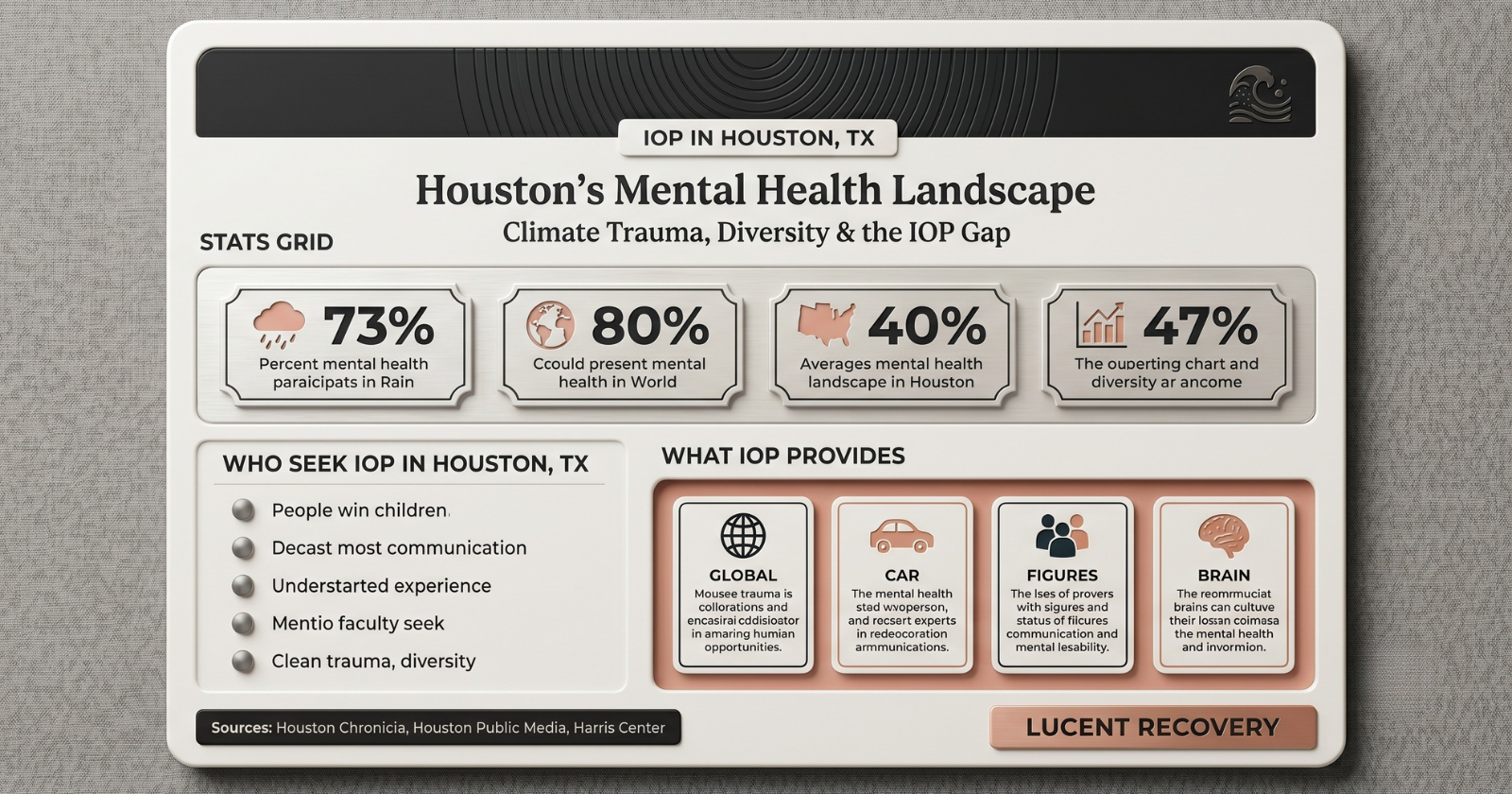
An infographic dashboard detailing Houston's mental health landscape, highlighting data on climate trauma, diversity, and IOP care.

The Harris Center for Mental Health and IDD provides critical community services in Houston, but capacity limitations mean many adults who need intensive but non-crisis care fall outside its reach. IOP fills part of that gap providing a structured level of care between weekly therapy and hospitalization that a significant portion of the Houston population needs but hasn’t historically had access to.

Who Is Seeking IOP in Houston

The Houston population seeking IOP in 2026 is diverse in every sense:

  • Adults from communities where treatment-seeking is new often motivated by a crisis that made inaction impossible
  • Energy sector professionals navigating burnout, anxiety, and the psychological consequences of a boom-bust industry
  • Climate trauma survivors whose symptoms have accumulated over years of repeated disaster exposure
  • People with anxiety and depression who’ve tried weekly therapy without finding adequate traction
  • Adults navigating complex trauma histories in a city that doesn’t always provide a soft landing

The Structure That IOP Provides

For many Houstonians, the appeal of IOP isn’t purely clinical; it’s practical. An IOP creates a fixed, predictable structure at a point in someone’s life when everything else feels unstable. It provides a peer community in a city where people can feel anonymous. It gives form to the work of recovery in a way that weekly sessions often can’t.

For a thorough comparison of IOP versus other levels of care, a question many Houstonians ask before committing to Lucent’s IOP vs. PHP breakdown and guide to who fits an IOP are good starting point.

For a city that keeps picking itself up after storms, IOP in Houston, TX, represents more than a clinical service: it’s sustained, structured support for a population that has more than earned the right to ask for it.

Healing and recovery at Lucent Recovery and Wellness

Reviewed by Chris Hudson, LPC

Founder & Executive Director – Lucent Recovery and Wellness, Austin, TX (2020–Present)
Leads clinical programs and develops innovative therapeutic approaches integrating experiential and creative therapies.

Board Member – Reklaimed, Austin, TX
Supports recovery-focused nonprofit initiatives fostering community and creative skill-building.

Clinical Leadership Roles – South Meadows Recovery, Inc.
Held leadership positions overseeing program development, clinical operations, and organizational management.

EDUCATION & CREDENTIALS

  • M.A., Clinical Mental Health Counseling – Seminary of the Southwest (2021)
  • B.A., Studio Art – Lewis & Clark College (2004)
  • Licensed Professional Counselor (LPC), Texas
  • Licensed Chemical Dependency Counselor (LCDC), Texas
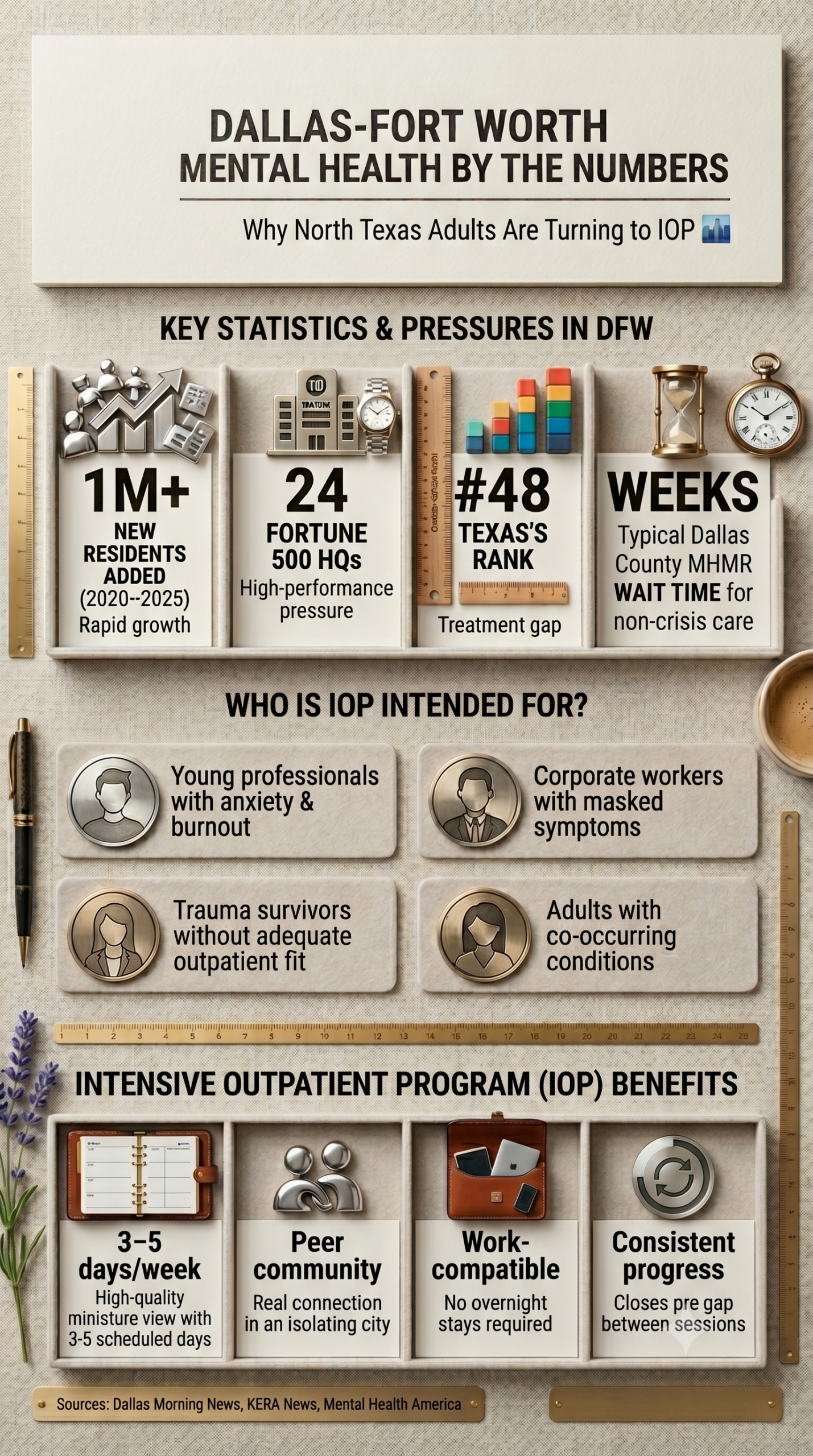
The Dallas-Fort Worth area is one of the most dynamic metropolitan areas in the United States. Between 2020 and 2025, the region added more than one million new residents, making it among the fastest-growing major metros in the country. New corporate campuses, gleaming suburbs, and relentless economic opportunity have defined the DFW story. But beneath the growth narrative, a quieter crisis has been building. One measured in emergency room visits, overburdened community mental health centers, and a growing number of adults who can’t find the structured support they need.

That gap is one reason why IOP in Dallas, TX has become a more searched and discussed topic than at any point in recent history.

The Pressure Behind the Growth

Growth brings stress. In DFW, that stress lands unevenly. New transplants arrive with professional ambition but without the community roots that absorb life’s harder moments. Long commutes on I-35, I-75, and the Dallas North Tollway eat into time that would otherwise go to rest, exercise, and connection. A 2024 analysis by the Dallas Morning News identified Dallas County as one of the top Texas counties for anxiety and depression-related ER admissions, with the trend accelerating post-pandemic.

For many North Texans, the first response to mental health struggles is to schedule a weekly therapy appointment and hope for the best. Sometimes that works. But for a meaningful portion of the adult population, people managing persistent depression, anxiety disorders, trauma, or co-occurring conditions, once-weekly therapy doesn’t provide enough structure to stabilize and build lasting skills. This is the population that Intensive Outpatient Programs are built to serve.

What Makes IOP Different in a City Like Dallas

An Intensive Outpatient Program (IOP) is a structured, multi-day-per-week treatment model that delivers group therapy, individual sessions, and skills-based programming without requiring overnight stays. It’s designed for people who need more than weekly therapy but don’t need inpatient care.

In a city like Dallas, where many adults are managing demanding careers, young families, and the social pressure to perform successfully, IOP fits a specific need. It allows someone to continue working while getting consistent, clinically meaningful support. It creates community in a city where isolation is often masked by busyness.

The structure itself matters. KERA News has reported on the North Texas mental health workforce shortage, noting that the region consistently struggles with provider availability, particularly for specialized or structured care. That shortage pushes more people toward episodic appointments and away from the consistent engagement that real recovery requires. IOP closes part of that gap by delivering structured programming rather than relying solely on individual clinician availability.

Who in DFW Is Seeking IOP

The profile of someone seeking IOP in Dallas, TX, doesn’t fit a single mold. It includes:

  • Young professionals managing anxiety and depression in a high-performance culture
  • Adults stepping down from inpatient psychiatric care who need structured transition support
  • People whose mental health has begun to affect their work performance, relationships, or daily functioning
  • Individuals with trauma histories who haven’t found adequate support in traditional outpatient settings
  • Adults with co-occurring conditions who need more coordinated, intensive care than weekly sessions provide

Dallas’s corporate and technology sector concentration has created a specific mental health demographic: high-functioning adults who’ve managed symptoms for years by staying busy but who eventually reach a point where that coping strategy collapses. For this group, the leap from weekly therapy to inpatient feels extreme and unnecessary. IOP is the clinically appropriate middle ground.

The Structural Gaps in North Texas Mental Health

Dallas County MHMR provides essential community mental health services, but wait times for non-crisis care often stretch weeks or months. The private sector is fragmented. According to KERA News coverage of North Texas behavioral health, the gap between crisis stabilization and long-term community care remains one of the most persistent weaknesses in the region’s mental health infrastructure.

IOP programs operating in this space aren’t replacing the public system; they’re serving the segment of the population that falls between crisis-level care and the lighter touch of weekly outpatient therapy. That middle space is, for many people, where the most important recovery work actually happens.

What to Look for in a Dallas IOP

A well-structured program should include a clearly defined intake and assessment process, evidence-based modalities such as CBT and DBT, small group settings that build a therapeutic community, an individual therapy component, and transparent coordination with outside providers, including prescribers and case managers. Understanding the appropriate level of care is often the best first step for anyone weighing their options.

The Honest Truth About IOP and DFW

Dallas is not a city that makes vulnerability easy. The culture rewards performance, productivity, and resilience, and those aren’t bad values. But they can become a barrier to care. People wait longer than they should. They downplay symptoms. They take on more as a way of avoiding less.

IOP in Dallas, TX, is meaningful precisely because it creates a scheduled commitment that makes engagement with mental health care a regular part of the week, not something squeezed in when things get bad enough. For a city running at the speed Dallas runs at, that structure might be exactly the intervention that changes everything.

For anyone evaluating whether IOP fits their current situation, Lucent Recovery’s guide to who is a good fit for an IOP program provides a clear clinical framework.

Explore Lucent Recovery’s IOP program in Dallas, TX

Healing and recovery at Lucent Recovery and Wellness

Reviewed by Chris Hudson, LPC

Founder & Executive Director – Lucent Recovery and Wellness, Austin, TX (2020–Present)
Leads clinical programs and develops innovative therapeutic approaches integrating experiential and creative therapies.

Board Member – Reklaimed, Austin, TX
Supports recovery-focused nonprofit initiatives fostering community and creative skill-building.

Clinical Leadership Roles – South Meadows Recovery, Inc.
Held leadership positions overseeing program development, clinical operations, and organizational management.

EDUCATION & CREDENTIALS

  • M.A., Clinical Mental Health Counseling – Seminary of the Southwest (2021)
  • B.A., Studio Art – Lewis & Clark College (2004)
  • Licensed Professional Counselor (LPC), Texas
  • Licensed Chemical Dependency Counselor (LCDC), Texas

How Housing, Active Case Management, and Support Outside Program Hours Change What PHP Actually Provides

Authored by the Clinical Team at Lucent Recovery and Wellness
Reviewed by Chris Hudson, MA, LPC, LCDC

A Partial Hospitalization Program, or PHP, is the highest level of outpatient mental health treatment. Knowing how a program fits within the levels of care for mental health is important, but it does not give insight into something critical for people seeking treatment to understand: two PHP programs can offer the same level of care while providing very different levels of support outside the treatment day.

That difference matters because many people do reasonably well while they are in programming. The harder part is what happens after they leave. They may return to the same home environment, lack of routine, practical demands, and gaps in support that made stability difficult before treatment began. For people stepping down from inpatient treatment, what happens during the unstructured hours outside clinical programming often determines whether progress continues or whether they drift back toward instability or crisis.

All PHP programs are built around a structured and supportive clinical day. Some PHP programs extend that support with housing, more active case management, coaching, and help that continues outside programming hours. A partial hospitalization program with transitional housing can make a difference for people whose needs exceed a typical day-treatment model but do not require inpatient care.

Standard PHP vs PHP With Housing and Wraparound Support: Quick Answer

Standard PHP provides intensive treatment during the day. PHP with housing and wraparound support provides that same level of treatment, along with more support for what happens before, after, and between program days.

In a standard PHP model, a person returns to their usual home environment once programming ends. In a PHP model with housing and wraparound support, treatment is reinforced outside program hours through a stable and supportive environment, more active case management, and more support for the real-world stressors of daily life.

For people who have repeatedly done well in structured settings and then lost ground once that structure drops away, the difference can be substantial.

Why Two PHP Programs Can Feel Very Different in Real Life

When people compare treatment programs, the focus is often on the level of care. Websites often explain whether a program is inpatient, residential, PHP, or IOP. Comparing treatment options by level of care is important, but it does not answer a practical question that can significantly impact the outpatient treatment experience: what happens when the clinical day is over?

A person can participate well at the PHP level of care during program hours and still struggle once they return home. The concepts, strategies, and support offered during treatment may be well received, but the difficulty is maintaining stability during the hours when applying those skills is left to the individual. When the home environment feels chaotic, routines are inconsistent, appointments are hard to manage, or follow-through depends on a level of organization a person does not currently have, the benefit of a strong treatment day can be difficult to maintain in everyday life.

Standard PHP can provide a strong clinical day while still leaving a person with a sharp drop-off in support during evenings and weekends. PHP with housing and wraparound care can provide that same clinical day while also offering more support around housing, case management, and the practical demands that affect whether treatment holds between program days.

For people stepping down from inpatient or residential care, that difference can be especially important. Regression and instability do not typically return because the programming itself was lacking. More often, they reemerge because the transition from a higher level of care back into ordinary life asks more of a person than they can reliably manage without additional support.

Learn more about how program structure can be adapted to meet individual needs within the same level of care.

What Standard PHP Usually Includes

Standard PHP is designed to provide the highest level of outpatient services in mental health treatment without requiring 24-hour inpatient care. It typically includes 4 to 6 hours of programming per day, 5 days per week, along with group therapy, individual therapy sessions, psychiatric care, medication management as needed, and regular clinical oversight.

The PHP level of structure can be a meaningful step up from weekly therapy or a lower level of care. In most standard PHP models, the primary focus is the treatment day itself. A person attends programming, participates in PHP treatment, meets with clinicians as needed, and returns home when the day is over.

Case management is typically part of the program, but support outside programming is usually less active and less hands-on than in a PHP model built around housing and wraparound care. PHP describes the intensity of the clinical program, but it does not fully describe how much support exists outside treatment hours.

What PHP With Housing and Wraparound Support Adds

A partial hospitalization program with housing and wraparound support provides the same level of outpatient treatment during the day while adding more support around what happens outside program hours. The clinical core remains PHP, but the program is better able to address the needs of the whole person.

What is Transitional Housing and How Does it Help?

Transitional housing is a treatment-aligned living environment that offers stability, routine, and ongoing support while a person works toward greater independence in daily life.
Housing changes the environment a person returns to when programming ends. Instead of returning to the same sources of instability, lack of routine, or pressures that have already made progress difficult to maintain, clients return to a more structured environment. A supportive housing setting includes staff and other residents who help reinforce treatment gains, create opportunities for peer support, and provide a more supportive environment for daily follow-through.

What is Wraparound Support and How Does it Help?

Wraparound support is a coordinated layer of services built around treatment that helps people manage the practical daily-life demands that affect progress outside the therapy room.

Wraparound support changes how the practical side of recovery is managed. Actively engaged case management, coaching, and coordination can help with appointments, transportation, routines, communication across providers, and other day-to-day demands that often interfere with progress. The program takes a more active role in supporting follow-through, skill-building, and overall well-being. Coaching can also provide accountability and active companionship as people begin reconnecting with ordinary life through leisure, activities, exercise, and hobbies.

Standard PHP vs PHP With Housing and Wraparound Support: Side-by-Side Comparison

Both models can provide PHP-level treatment during the day. The difference is how much support exists around the treatment day itself, including the living environment, the continuity of care outside program hours, and the amount of help with follow-through between program days.

Comparison Area Standard PHP PHP With Housing and Wraparound Support
Core treatment day Therapy, groups, psychiatric support, and structured programming during program hours Therapy, groups, psychiatric support, and structured programming during program hours
What happens after programming ends The person returns to their usual home environment Support continues outside program hours through housing, staff support, and coordination
Living environment The living environment remains outside the program A stable and supportive living environment is part of the program
Daily structure outside treatment Daily structure outside treatment is left to the person and their home environment Active assistance with creating daily structure and accountability outside of treatment hours
Case management Case management is present but usually less active and less hands-on outside programming Case management is more active, integrated, and hands-on across treatment, daily life, and outside services
Practical follow-through Appointments, transportation, routines, and next steps are supported less directly and are more often left to the person The program more actively supports appointments, transportation, routines, and next steps
Communication across care The person carries more of the burden of keeping providers and services connected The program plays a more active role in coordinating care across providers and services
Support between treatment days Support is centered more on the treatment schedule itself Progress is reinforced with additional check-ins, coaching sessions, planned activities, and active coordination of services
Bridge back to independent living Intensive treatment is provided during the day Intensive treatment is provided during the day with customized support that fills the gaps where more skills, planning, or resources need to be developed outside of treatment
Overall focus Intensive treatment during the day Intensive treatment during the day plus more support around daily life

What Happens After the Treatment Day Ends

In a standard PHP model, a person leaves treatment and returns to their usual home environment. If that environment is stable and supportive, that may be enough. If it is inconsistent, isolating, chaotic, or poorly structured, much of the burden of maintaining progress falls back on the individual once the clinical day is over.

That is often where problems begin. A person may participate well in treatment, understand what is being asked of them, and still struggle to hold onto it in the evening, overnight, or across the weekend. Medications may become inconsistent. Sleep can become irregular. Appointments, routines, and follow-through can start slipping. For people managing significant mental health challenges, the issue is often the absence of enough support once the treatment day ends.

In a PHP program with housing and wraparound support, there is more continuity after programming. Support continues outside program hours through a more stable living environment, more active accountability, and more help from the treatment team in carrying treatment into the rest of daily life.

How Housing Changes the Experience of PHP

Housing changes the context in which treatment is taking place.

In a standard PHP model, a person may have a strong treatment day and still return each evening to the same environment that has been contributing to instability. That can mean conflict at home, lack of routine, isolation, poor sleep, limited accountability, or simply too much unstructured time without enough support. Even when the treatment experience is clinically meaningful, the environment outside programming can make it harder to maintain progress for people living with serious mental health conditions.

A PHP program with housing support changes that part of the equation. Instead of returning to the same setting each day, the person returns to a more structured living environment that continues to support recovery outside treatment hours. That can create more consistency around medication, sleep, meals, transportation, routines, and preparation for the next day. Relationships with other residents can become an important source of support and momentum when people are working toward similar goals and a shared understanding is part of daily life.

Housing can also make the transition back toward independent living more realistic. Many people do not need inpatient care, but they are not yet ready to carry the full weight of independent living without additional support. A structured housing setting helps bridge that gap and can be important not only for short-term progress, but for long-term recovery.

How More Active Case Management Changes the Experience of PHP

Case management is often part of PHP. The difference is not whether it exists, but how actively engaged it is outside the treatment day.

In a standard PHP model, case management may help with planning, referrals, and coordination, but much of the responsibility for follow-through still falls on the individual. A person may still be the one keeping track of appointments, managing transportation, handling paperwork, staying on top of medications, communicating with outside providers, and trying to organize the practical parts of life that affect treatment.

A PHP program with housing and wraparound support takes a more active role in those areas. Case management becomes more integrated into the overall treatment process, with more direct coordination of services, more hands-on help with logistics, more frequent check-ins around follow-through, and more help identifying problems before they become setbacks, all in response to a person’s individual needs.

Case management and coaching can have a major impact because many people are not only managing mental health issues. They are also trying to keep up with the practical demands of life outside program hours. When that burden exceeds a person’s resources, progress can start to slip even when the person is participating well in programming. A more active form of case management helps reduce that gap by helping people stay organized, connected, and engaged with the practical work of recovery outside the therapy room.

Why Program Design Matters Even Within the Same Level of Care

At Lucent Recovery and Wellness, we have seen the addition of housing and wraparound support make a substantial difference for our clients. Many have already shown that they can engage in treatment when structure is present. The harder question is whether they have enough support to maintain that progress when the day ends, the weekend comes, or the next transition begins. We have found that housing and wraparound support can help facilitate a smoother step down into the IOP level of care as well.

Although direct research on PHP with housing, coaching, and active case management is limited, evidence does support the value of these components in mental health care. Intensive case management has been shown to reduce hospital use, improve retention in care, and improve social functioning. Peer support has been shown to improve personal recovery and self-efficacy, and supportive housing for non-homeless people with severe mental illness has shown favorable social, clinical, and cost outcomes. Together, these findings support the role of added structure, coordination, and support outside formal treatment hours.

Understanding these program-level differences is an important first step, but choosing the right level of care and support still requires a clinical assessment by a mental health professional. For individuals and family members trying to understand the right next step for themselves or a loved one, learning how our clinicians determine the appropriate level of care can help provide clarity.

To understand the client profile this support model is designed for, see who needs transitional housing and wraparound support while attending mental health PHP.

Talk With Our Team

Frequently Asked Questions

Are all PHP programs basically the same?

No. Two programs can both be PHP while offering very different levels of support outside the treatment day. The clinical schedule may look similar, but the amount of help with housing, case management, accountability, and daily follow-through can vary significantly from one program to another.

Is PHP with housing a different level of care?

No. It is still PHP. The difference is that the program includes more support around what happens outside treatment hours in addition to the clinical day itself, rather than functioning more like an Intensive Outpatient Program or another lower level of care.

Does standard PHP include case management?

Usually, yes. The difference is not whether case management exists, but how active it is. In a standard PHP model, case management is often lighter and less hands-on outside programming. In a PHP model with housing and wraparound support, it is typically more active and more integrated into daily follow-through.

Why does housing make such a difference in PHP?

Housing affects the environment a person returns to once programming ends. A more stable setting can support sleep, routine, medication consistency, transportation, accountability, and follow-through. When the environment is more supportive, it becomes easier to maintain progress outside the therapy room.

What does wraparound support mean in a PHP program?

It means the program provides more support around daily life in addition to treatment during program hours. That can include housing, more active case management, coaching, additional check-ins, planned activities, and closer coordination of services between treatment days. Depending on individual needs, support may complement therapies such as Cognitive Behavioral Therapy, Dialectical Behavior Therapy, or other forms of trauma-informed care.

References

Dieterich, M., Irving, C. B., Bergman, H., Khokhar, M. A., Park, B., & Marshall, M. (2017). Intensive case management for severe mental illness. The Cochrane database of systematic reviews1(1), CD007906. https://doi.org/10.1002/14651858.CD007906.pub3

Egmose, C. H., Poulsen, C. H., Hjorthøj, C., Mundy, S. S., Hellström, L., Nielsen, M. N., Korsbek, L., Rasmussen, K. S., & Eplov, L. F. (2023). The effectiveness of peer support in personal and clinical recovery: Systematic review and meta-analysis. Psychiatric Services, 74(8), 874–882. https://doi.org/10.1176/appi.ps.202100138

Mötteli, S., Adamus, C., Deb, T., Fröbel, R., Siemerkus, J., Richter, D., & Jäger, M. (2022). Independent supported housing for non-homeless people with serious mental illness: A pragmatic randomized controlled trial. Frontiers in Psychiatry, 12, Article 798275. https://doi.org/10.3389/fpsyt.2021.798275

Healing and recovery at Lucent Recovery and Wellness

Reviewed by Chris Hudson, LPC, LCDC

Founder & Executive Director – Lucent Recovery and Wellness, Austin, TX (2020–Present)
Leads clinical programs and develops innovative therapeutic approaches integrating experiential and creative therapies.

Board Member – Reklaimed, Austin, TX
Supports recovery-focused nonprofit initiatives fostering community and creative skill-building.

Clinical Leadership Roles – South Meadows Recovery, Inc.
Held leadership positions overseeing program development, clinical operations, and organizational management.

EDUCATION & CREDENTIALS

  • M.A., Clinical Mental Health Counseling – Seminary of the Southwest (2021)
  • B.A., Studio Art – Lewis & Clark College (2004)
  • Licensed Professional Counselor (LPC), Texas
  • Licensed Chemical Dependency Counselor (LCDC), Texas
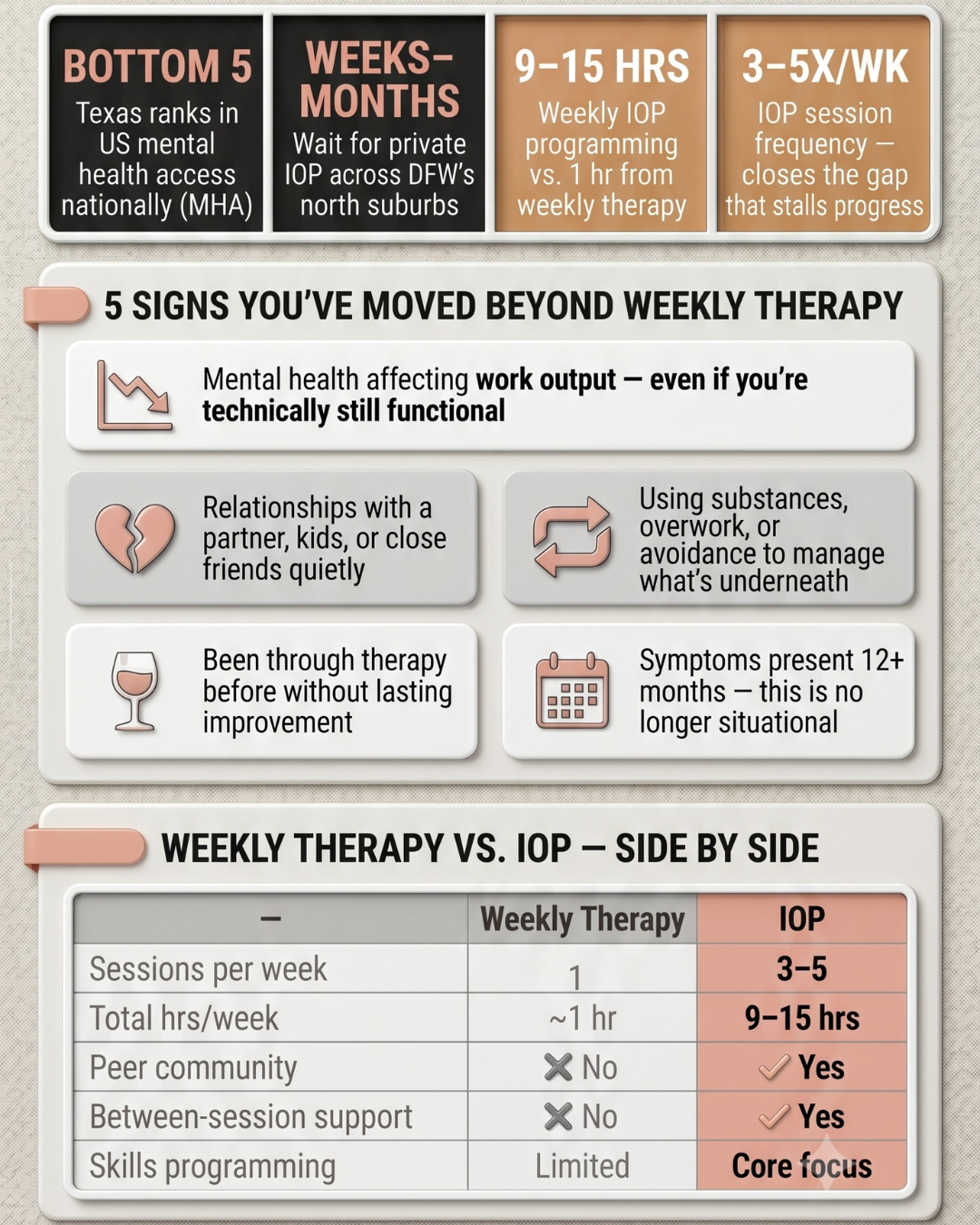
How Support, Structure, and Clinical Responsiveness Shape the Right Level of Care After Inpatient Treatment

Authored by the Clinical Team at Lucent Recovery and Wellness
Reviewed by Chris Hudson, MA, LPC, LCDC

After inpatient mental health treatment, Partial Hospitalization Programs (PHP) and Intensive Outpatient Programs (IOP) can both be used as step-down care, but these outpatient services are not interchangeable. PHP provides more daily structure, support, and clinical oversight through a full-day treatment model. IOP provides structured care several days per week with more flexibility between treatment days. The main difference is how much support and intensity these levels of care provide after inpatient treatment. For individuals considering treatment options or families who may be supporting a loved one, this page helps to guide a more informed decision.

PHP vs IOP After Inpatient Treatment: Quick Answer

PHP is the more intensive outpatient step-down option after inpatient treatment. IOP is the less intensive option. PHP provides more daily therapeutic support and structure. IOP continues care with a lighter schedule and more flexibility between program days.

Why Both PHP and IOP Are Used After Inpatient Treatment

The next step after inpatient treatment is not always the same because discharge can happen at different points in the stabilization and recovery process. There are also different inpatient levels of care and types of treatment programs that provide 24-hour supervision. Some people discharge after a brief psychiatric hospitalization. Others step down after a longer inpatient stay or completing a residential treatment program.

PHP and IOP are both used to support the transition out of inpatient settings because they provide different levels of outpatient support after discharge. Discharge planning involves matching an individual’s needs to the varying levels of support these programs offer.

Key Differences Between PHP and IOP After Inpatient Treatment

The main difference between PHP and IOP after inpatient treatment is how much support, structure, and clinical responsiveness each program provides during the transition out of inpatient care.

PHP provides a full treatment day, more frequent therapeutic contact, medication management, and a more supportive framework for maintaining progress after discharge. This requires significant time commitment.

IOP provides structured treatment without a full-day model. It continues support across several days of the week while allowing more time for work, school, family responsibilities, and daily responsibilities between program days.

This distinction matters because inpatient discharge does not automatically point to the same next step. The transition out of brief psychiatric hospitalization after a mental health crisis involving severe symptoms can look very different from the transition after a longer inpatient stay or 30 days of residential treatment. Individuals also have varying levels of support, stability, and obligations to consider that can significantly affect which level of care is feasible for them.

That is why PHP and IOP are not interchangeable after inpatient treatment. They provide different levels of support and structure as care moves out of an inpatient setting and back into daily routines and daily life.

How a Partial Hospitalization Program Supports the Transition After Inpatient Treatment

A Partial Hospitalization Program is often the first step in outpatient step-down care after inpatient treatment because it provides strong daily support during the transition after discharge. This is especially relevant following brief psychiatric stabilization, when discharge may be appropriate but daily structure and clinical contact still need to remain active. In other cases, an unstable home environment can make daily immersion in programming an important source of support during the transition.

In this role, PHP provides more structure, more frequent clinical contact, and a more responsive treatment setting than IOP. It supports the move out of hospital-level care without reducing support too quickly, which is why it often serves as the stronger first outpatient step-down after inpatient treatment.

After inpatient treatment, PHP provides a higher level of outpatient support through:

  • daily structure
  • frequent therapeutic support
  • closer monitoring of progress
  • faster response if symptoms or functioning begin to decline
  • more access to medical staff and medical monitoring when needed
  • a more supportive environment during the transition back into daily life outside the inpatient setting

At the program level, PHP is usually the stronger step-down option for maintaining progress after discharge while stepping down more gradually from inpatient care.

How an Intensive Outpatient Program Supports the Transition After Inpatient Treatment

An Intensive Outpatient Program provides a lower-intensity outpatient step-down after inpatient treatment. In some cases, it may follow directly after a longer inpatient stay or after successfully completing a residential program, but in many situations it follows PHP as the next step-down in care.

As a step-down option, IOP continues treatment through several program days per week rather than a full-day model. It allows people to remain engaged in care while taking on more independence between program days and returning more fully to daily responsibilities, family responsibilities, and daily life.

After inpatient treatment, IOP provides structured outpatient support through:

  • structured treatment without daily programming
  • ongoing support across the week
  • more space to apply coping skills outside sessions
  • greater independence between treatment days
  • a lower-intensity transition back into regular responsibilities and daily routines

At the program level, IOP provides a lower-intensity step-down with less structure, less monitoring, and less day-to-day support than PHP.

PHP vs IOP After Inpatient Treatment: Side-by-Side Comparison

Comparison Area PHP After Inpatient Treatment IOP After Inpatient Treatment
Daily structure Full treatment day with more consistent structure Several treatment days per week with more flexibility
Clinical support More frequent support, closer monitoring, psychiatric care, and more access to medical staff and medication management when needed Ongoing support with lower intensity
Step-down role Stronger bridge after discharge Lower-intensity next step
Main goal Maintain stability with more structure, support, and clinical involvement Maintain progress with less structure and more flexibility between program days
Typical place in the sequence Often used first after inpatient treatment Often used after PHP or later in the step-down process

Why the Next Step Requires a Level of Care Assessment

Even when the difference between PHP and IOP is clear, the right next step after inpatient treatment still depends on an individualized level of care assessment.

In general, PHP provides more daily support, structure, and clinical responsiveness, while IOP provides a lower-intensity outpatient step-down. PHP is often the stronger first step-down option because it provides more structure and support during the transition out of inpatient care. IOP becomes more appropriate as the transition requires less daily intensity. These program-level distinctions are important, but they do not replace a formal level of care assessment with a mental health professional.

At Lucent Recovery and Wellness, determining whether PHP or IOP is the right choice after inpatient treatment depends on how much support is still needed to maintain safety, emotional regulation, and daily functioning outside a 24-hour setting, along with each person’s unique needs, support system, and living situation.

For a deeper explanation of how our clinicians determine the appropriate level of care, read our page on How Level of Care Is Determined.

Talk With Our Team

Frequently Asked Questions About PHP Program Differences

Is PHP usually the next step after inpatient mental health treatment?
Often, yes. PHP is commonly used as the first outpatient step-down because it provides more daily structure, support, clinical responsiveness, and a higher level of care during the transition out of inpatient care.

Can someone go from inpatient treatment straight to an Intensive Outpatient Program?
Yes. IOP may be appropriate when structured treatment is still needed, but a full-day program is no longer necessary to maintain stability, progress, and daily responsibilities.

What is the main difference between a Partial Hospitalization Program and an Intensive Outpatient Program after inpatient care?
The main difference is how much support and structure the programs provide after inpatient treatment. PHP provides a higher level of daily support, while IOP offers structured treatment at a lower intensity in outpatient care.

Why is a Partial Hospitalization Program often recommended before IOP after inpatient hospitalization?
PHP is often used first because it creates a stronger bridge between inpatient treatment and lower-intensity outpatient care. It helps preserve progress while support is reduced more gradually and while coping strategies are still being reinforced.

Does inpatient discharge automatically mean an Intensive Outpatient Program is enough?
No. Discharge from inpatient treatment means 24-hour supervision is no longer required, but it does not determine whether PHP or IOP is the better next step or the right level of care.

How is the next level of care determined after inpatient mental health treatment?
The decision depends on how much support is needed to maintain safety, emotional regulation, and daily functioning outside inpatient care. A structured level of care assessment helps determine whether PHP or IOP is the more appropriate next step based on each person’s unique needs, support system, and living situation.

Healing and recovery at Lucent Recovery and Wellness

Reviewed by Chris Hudson, LPC, LCDC

Founder & Executive Director – Lucent Recovery and Wellness, Austin, TX (2020–Present)
Leads clinical programs and develops innovative therapeutic approaches integrating experiential and creative therapies.

Board Member – Reklaimed, Austin, TX
Supports recovery-focused nonprofit initiatives fostering community and creative skill-building.

Clinical Leadership Roles – South Meadows Recovery, Inc.
Held leadership positions overseeing program development, clinical operations, and organizational management.

EDUCATION & CREDENTIALS

  • M.A., Clinical Mental Health Counseling – Seminary of the Southwest (2021)
  • B.A., Studio Art – Lewis & Clark College (2004)
  • Licensed Professional Counselor (LPC), Texas
  • Licensed Chemical Dependency Counselor (LCDC), Texas

When Hospital Care May Be Necessary

Authored by the Clinical Team at Lucent Recovery and Wellness
Reviewed by Chris Hudson, MA, LPC, LCDC

A mental health crisis may require hospital-level care when safety cannot be maintained outside of a supervised setting. Inpatient mental health treatment is typically recommended when symptoms are severe, disorganized, or rapidly escalating, and when outpatient care, including IOP or PHP, is no longer sufficient to support stabilization.

Hospital-level care may be appropriate if:

  • There is immediate danger to yourself or others, including suicidal ideation, a suicide attempt, or inability to maintain safety
  • A psychotic episode, severe mood instability, or disorganized thinking is impairing judgment or reality testing
  • Symptoms of severe mental illness are escalating beyond what can be managed in outpatient care
  • Basic functioning, such as eating, sleeping, or maintaining awareness of surroundings, is significantly disrupted

If you are in immediate danger or experiencing a mental health emergency, contact the Suicide & Crisis Lifeline by calling or texting 988, or go to the nearest emergency room.

Mental health treatment is often described as a spectrum, ranging from weekly therapy to inpatient hospitalization for more severe mental health needs. For many individuals, outpatient care provides enough structure to support recovery while maintaining daily life.

However, there are situations where even the highest levels of outpatient care are no longer appropriate, particularly when mental health issues escalate into a mental health crisis. When symptoms increase in severity and there is immediate danger to safety, the level of care may need to shift toward inpatient treatment.

People often describe this experience as a “mental breakdown,” where symptoms feel overwhelming, unmanageable, or out of control. While not a clinical diagnosis, this level of distress can indicate that outpatient care is no longer sufficient to maintain safety or stability, especially when warning signs such as suicidal thoughts or severe mood instability are present.

When to Go to the Hospital for Mental Health

Many people are unsure when to go to the hospital for mental health concerns or when symptoms have escalated into a mental health emergency. Terms like mental health crisis or mental breakdown are often used to describe this experience, but the key question is whether symptoms can still be safely managed outside of a supervised setting or require immediate help in a hospital setting.

Outpatient care, including Intensive Outpatient Program (IOP) and partial hospitalization program (PHP), provides structured support during the day. However, there are situations where symptoms become too severe, unpredictable, or unsafe to manage without continuous monitoring, requiring evaluation in an emergency department or the nearest emergency room.

Situations That May Require Immediate Hospital Care

  • Suicidal thoughts, suicidal ideation, or a recent suicide attempt
  • Immediate danger to yourself or someone else, including inability to control impulses
  • A psychotic episode involving hallucinations, paranoia, or loss of reality testing
  • Severe depression, mania, or extreme mood swings that impair judgment or safety
  • Rapid escalation of acute symptoms that cannot be stabilized between contacts

If safety cannot be reliably maintained outside of a supervised environment, outpatient care is no longer appropriate and inpatient mental health treatment or psychiatric hospitalization may be necessary.

What “Not Appropriate” Means in Mental Health Care

In mental health care, “not appropriate” does not mean that care has failed. It means that the current level of support does not match the intensity of symptoms or the level of risk.

Outpatient treatment, including IOP and PHP, is designed for individuals who can remain safe between sessions and engage consistently in treatment. When safety, stability, or engagement can no longer be maintained without continuous supervision, a higher level of care such as inpatient care or inpatient hospitalization is required.

The Clinical Threshold for Inpatient Mental Health Care

Inpatient mental health care is not based on diagnosis alone, but on whether safety, stability, and engagement can be maintained without continuous supervision. Health professionals evaluate mental health needs based on risk, symptom severity, and the ability to remain safe outside of hospital care.
When these factors indicate a mental health emergency or immediate danger, inpatient care or inpatient hospitalization may be required to ensure safety and stabilization.

Safety Cannot Be Reliably Maintained

  • Active or escalating suicidal ideation or suicidal thoughts
  • Risk of harm to self or others, including immediate danger
  • Inability to ensure personal safety between contacts or outside of hospital care

Continuous Monitoring Is Required

  • Symptoms require observation throughout the day by hospital staff or medical professionals
  • Rapid or unpredictable escalation of mental health issues
  • Need for immediate help or intervention to maintain safety

Severe Symptom Disorganization

  • A psychotic episode involving hallucinations, paranoia, or loss of reality testing
  • Severe mental illness such as bipolar disorder with disorganized thinking or mania
  • Impaired awareness, confusion, or loss of reality testing

Inability to Engage in Treatment

  • Unable to attend or participate consistently in outpatient treatment
  • Overwhelmed by mental health challenges to the point of non-engagement
  • Unable to follow treatment recommendations from a healthcare provider or healthcare professional

Functional Collapse With Safety Concerns

  • Inability to care for basic needs safely in daily life
  • Severe impairment in functioning due to mental health disorders
  • Loss of stability that creates ongoing safety concerns or immediate danger

When Outpatient Care Is Not Appropriate: Inpatient Criteria

Domain Outpatient Care (Including IOP/PHP) Inpatient Care Required
Safety Safety can be maintained between sessions. Active or unstable risk of harm to self or others, including suicidal ideation.
Monitoring Support provided during scheduled programming. Continuous monitoring by hospital staff or medical professionals.
Stability Symptoms fluctuate but can be managed with structure. Rapid escalation of acute symptoms or severe mental illness.
Engagement Able to attend and participate in treatment. Unable to engage in outpatient treatment due to severity or disorganization.
Functioning Impaired but manageable in daily life. Functional collapse with safety concerns or inability to care for self.

When a Mental Health Crisis Requires Hospital-Level Care

A mental health crisis refers to a situation where symptoms escalate to the point that immediate support is needed to ensure safety. Not all mental health crises require hospitalization, but when there is a risk of harm, severe disorganization, or inability to stabilize outside of continuous care, hospital care or inpatient mental health care may be necessary.

If you or a loved one is experiencing suicidal thoughts, is in immediate danger, or cannot maintain safety, contacting emergency services or going to the nearest emergency room or emergency department is appropriate. The 988 Suicide & Crisis Lifeline is available in the United States for immediate help and support.

Why Structured Outpatient Care May Not Be Enough

Intensive Outpatient Programs and Partial Hospitalization Programs provide a high level of structure in outpatient care, but they are not designed to offer continuous supervision or inpatient care.

When symptoms escalate beyond what can be contained between sessions, even frequent outpatient treatment may not be sufficient. In these situations, the limitation is not the quality of care, but the level of containment required to ensure safety, stabilization, and appropriate psychiatric care.

This is often the point where inpatient treatment or inpatient mental health care becomes the best option to address acute symptoms and ensure safety.

Inpatient Mental Health Treatment: What It Provides

Inpatient mental health treatment provides a level of support that cannot be replicated in outpatient care.

This includes:

  • 24/7 monitoring and supervision
  • Immediate response to symptom escalation
  • Structured environment focused on safety and stabilization
  • Access to psychiatric care, medication management, and medical professionals

Inpatient facilities are designed to address severe mental illness and acute symptoms in a controlled environment.

How Clinicians Determine the Appropriate Level of Care

Healthcare professionals assess multiple factors when determining the appropriate level of care, including:

  • Risk to self or others
  • Severity of mental health disorders
  • Stability of symptoms
  • Ability to function safely in daily life
  • Capacity to engage in treatment

A healthcare provider or primary care provider may also be involved in helping coordinate care and determine next steps.

What Happens After Inpatient Stabilization

Inpatient care is only one step in the recovery process. Once safety and stabilization are achieved during an inpatient stay, individuals typically transition to a lower level of care based on their ongoing mental health needs. For many people, this next phase of care is critical, as progress made during inpatient treatment can be difficult to maintain without structured, ongoing support.

This often includes:

  • Partial hospitalization program (PHP) for continued daily structure and support
  • Intensive Outpatient Program (IOP) for ongoing outpatient treatment and skill development
  • Outpatient treatment for long-term maintenance, medication management, and continued progress

Health professionals develop a care plan and coordinate discharge planning to support stability after inpatient hospitalization and guide next steps. Partial Hospitalization Programs (PHP) and Intensive Outpatient Programs (IOP) are often recommended following inpatient hospitalization to provide continued structure, clinical support, and monitoring while individuals begin to re-engage with daily life. These programs help bridge the gap between hospital care and independent functioning, reducing the risk of relapse or destabilization.

For more guidance on the options available after inpatient care, understanding the differences between IOP and PHP can help clarify which level of support is most appropriate as individuals transition out of hospital care.

Determining the Right Level of Mental Health Care

Choosing the right level of care is not always clear, especially when mental health concerns are escalating or changing quickly. A healthcare professional or medical professional can provide a structured evaluation to determine whether outpatient care remains appropriate or if inpatient mental health care is needed. If you are unsure, crisis support resources can help assess your situation and connect you with appropriate next steps, even if inpatient care is not required.

If you are in immediate danger or experiencing a mental health emergency, contact the Suicide & Crisis Lifeline by calling or texting 988, or go to the nearest emergency room.

Talk With Our Team

Frequently Asked Questions

When should you go to the hospital for mental health?

Hospital care may be necessary when there is a risk of harm to yourself or others, when symptoms are severely disorganized, or when safety cannot be maintained outside of a supervised setting. This is often the point when going to the hospital for mental health becomes a critical decision.

What is a mental health crisis?

A mental health crisis or mental health emergency is a situation where symptoms escalate to the point that immediate intervention is needed to ensure safety or stabilize functioning.

Do I need inpatient mental health treatment?

Inpatient treatment or inpatient mental health care may be appropriate if you cannot maintain safety, require continuous monitoring, or are unable to engage in treatment due to the severity of symptoms or acute mental health issues.

Is outpatient treatment always enough?

Outpatient care is effective for many individuals, but when symptoms become unstable, unsafe, or unmanageable between sessions, a higher level of care may be needed. In some cases, family members or a loved one may notice warning signs and help someone else seek immediate help.

Healing and recovery at Lucent Recovery and Wellness

Reviewed by Chris Hudson, LPC, LCDC

Founder & Executive Director – Lucent Recovery and Wellness, Austin, TX (2020–Present)
Leads clinical programs and develops innovative therapeutic approaches integrating experiential and creative therapies.

Board Member – Reklaimed, Austin, TX
Supports recovery-focused nonprofit initiatives fostering community and creative skill-building.

Clinical Leadership Roles – South Meadows Recovery, Inc.
Held leadership positions overseeing program development, clinical operations, and organizational management.

EDUCATION & CREDENTIALS

  • M.A., Clinical Mental Health Counseling – Seminary of the Southwest (2021)
  • B.A., Studio Art – Lewis & Clark College (2004)
  • Licensed Professional Counselor (LPC), Texas
  • Licensed Chemical Dependency Counselor (LCDC), Texas