Between the River Walk and the Reality: The Mental Health Inequality San Antonio Doesn’t Talk About
From the River Walk to the Pearl District, San Antonio’s public identity is one of warmth and energy. It’s the seventh-largest city in the United States, one of the fastest-growing, and home to world-class medical institutions, a thriving hospitality sector, and cultural richness that draws millions of visitors each year.
But San Antonio is also one of the more economically unequal major cities in the country. A working class that sustains a service economy while often lacking access to the services it delivers to others. A mental health infrastructure that has historically fallen short of what a city with this level of need actually requires.
That gap is part of why IOP in San Antonio, TX, has become an increasingly important topic among clinicians, advocates, and residents navigating a system that doesn’t consistently show up when it’s needed most.
The Economic Underpinning of Mental Health in Bexar County
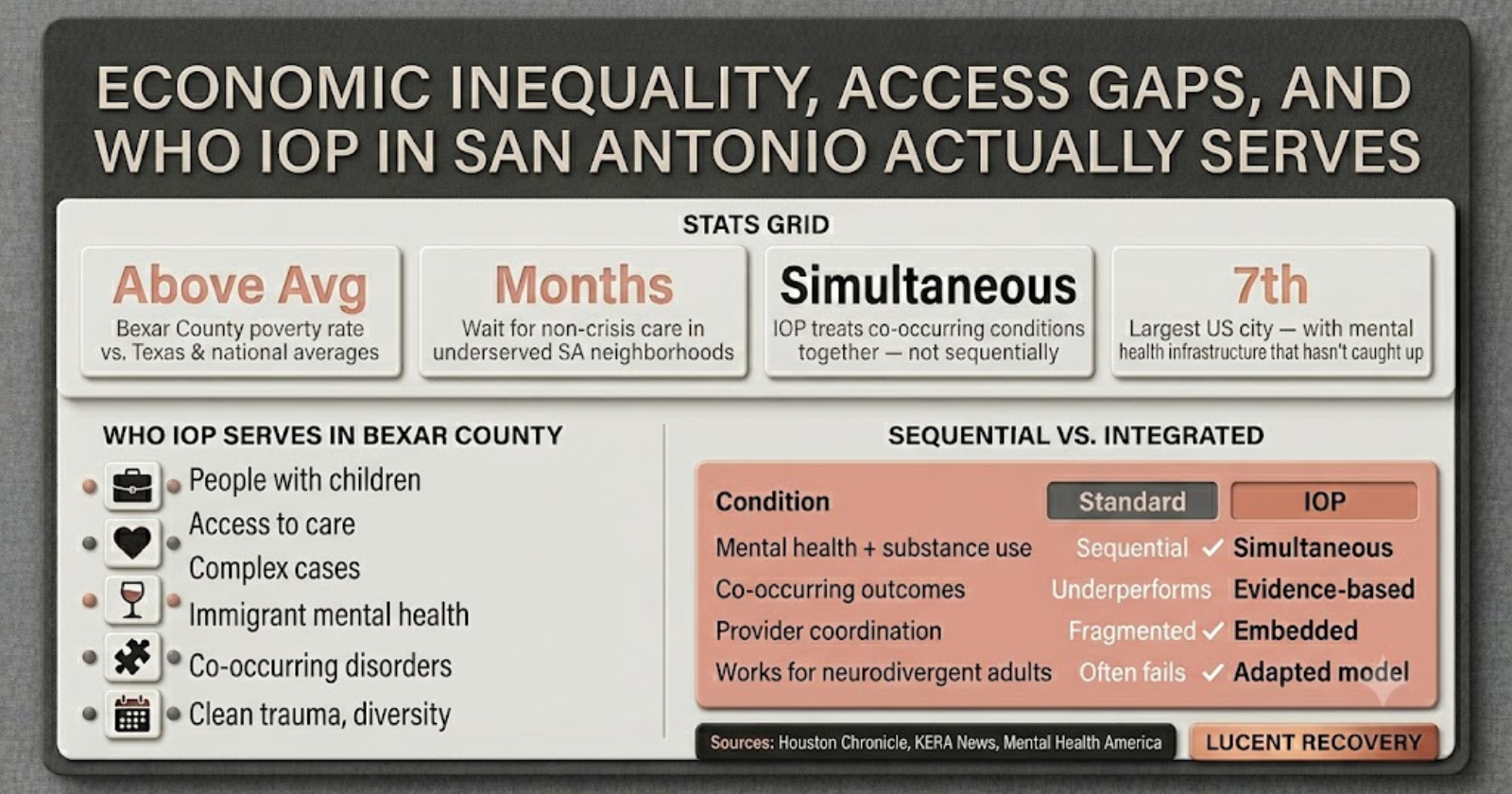
Economic stress and mental health are inseparable. Research is consistent: poverty, financial insecurity, housing instability, and employment precarity are among the strongest predictors of depression, anxiety, and trauma. Bexar County’s poverty rate consistently exceeds both the Texas and national averages, with concentrated poverty in the city’s south and west sides.
The San Antonio Express-News has covered the correlation between economic inequality and health outcomes in Bexar County, including mental health outcomes that track directly with income and zip code. Where people are struggling economically, mental health struggles follow. And the neighborhoods with the greatest mental health need often have the least mental health infrastructure, a compounding gap that makes reaching care genuinely difficult.
The Access Problem
Access to mental health care in San Antonio is stratified by income, insurance status, language, and geography. For someone with commercial insurance living on the north side, access to an IOP is challenging but navigable. For someone without insurance living on the south side, working two jobs, and most comfortable in Spanish, access to that same level of care is effectively nonexistent under the current system.
KSAT has reported on the insufficient capacity of publicly funded mental health services relative to Bexar County’s population. The Center for Health Care Services does essential work, but the scope of the need consistently exceeds the system’s reach.
IOP in San Antonio, TX occupies a specific position in this access landscape. Its clinical density, multiple days per week, multiple hours per session, means that the total investment in care is concentrated rather than spread across months of uncertain weekly appointments. For people with constrained schedules and limited flexibility, that concentration can actually make IOP more accessible than it initially appears.
What Recovery Actually Looks Like in a Complicated City
One of the more honest conversations in mental health care right now is about what “recovery” means for people navigating real-world complexity. For someone managing depression while working two jobs, parenting without a co-parent, and navigating a health system that doesn’t consistently speak their language, recovery is messier and more contingent than the standard clinical model often acknowledges.
Recovery in that context needs more than therapy. It needs psychoeducation, skills development, case coordination, and community. This is why the IOP model, when it’s built thoughtfully, includes all of those components rather than therapy alone.
Lucent’s piece on how trauma shapes real recovery and how mental health affects daily life addresses the complexity of recovery for people operating under sustained real-world pressure.
The Co-Occurring and Neurodivergent Dimension
San Antonio’s mental health population includes a significant number of adults with co-occurring conditions: mental health and substance use, mental health and neurodivergence, and mental health and chronic physical conditions. The public system in Bexar County is often siloed, with mental health services here and substance use services elsewhere, rarely well-integrated.
IOP programs providing coordinated care for co-occurring presentations are meaningfully different from programs treating conditions sequentially. The evidence base is consistent: co-occurring conditions require simultaneous treatment. Sequential approaches consistently underperform.
For the San Antonio population navigating these intersections, and there are many an IOP with genuine co-occurring capacity, addresses something the fragmented local system often can’t. This is particularly relevant given what research on neurodivergent adults shows about the failure of standard outpatient formats for people with ADHD, autism, and related presentations.
Why IOP Fits San Antonio’s Rhythm
There’s something about the IOP structure that aligns well with the San Antonio context. The group component builds community in a city where community is a core cultural value, where people gather around food, family, faith, and neighborhood in ways that define daily life. The skills focus on emotional regulation, distress tolerance, and interpersonal effectiveness resonates with a population that often comes to treatment not to talk about feelings, but to get concrete tools for getting through hard things.
And the structure of IOP showing up consistently, doing the work, building week over week, aligns with the ethic that runs through San Antonio’s working and military communities. It’s not passive. It asks something of people. That’s not a flaw in the model. It’s a feature.
For a city navigating real economic, demographic, cultural, and geographic IOP in San Antonio, TX, represents structured, meaningful support for people who need more than the system has historically been able to provide.
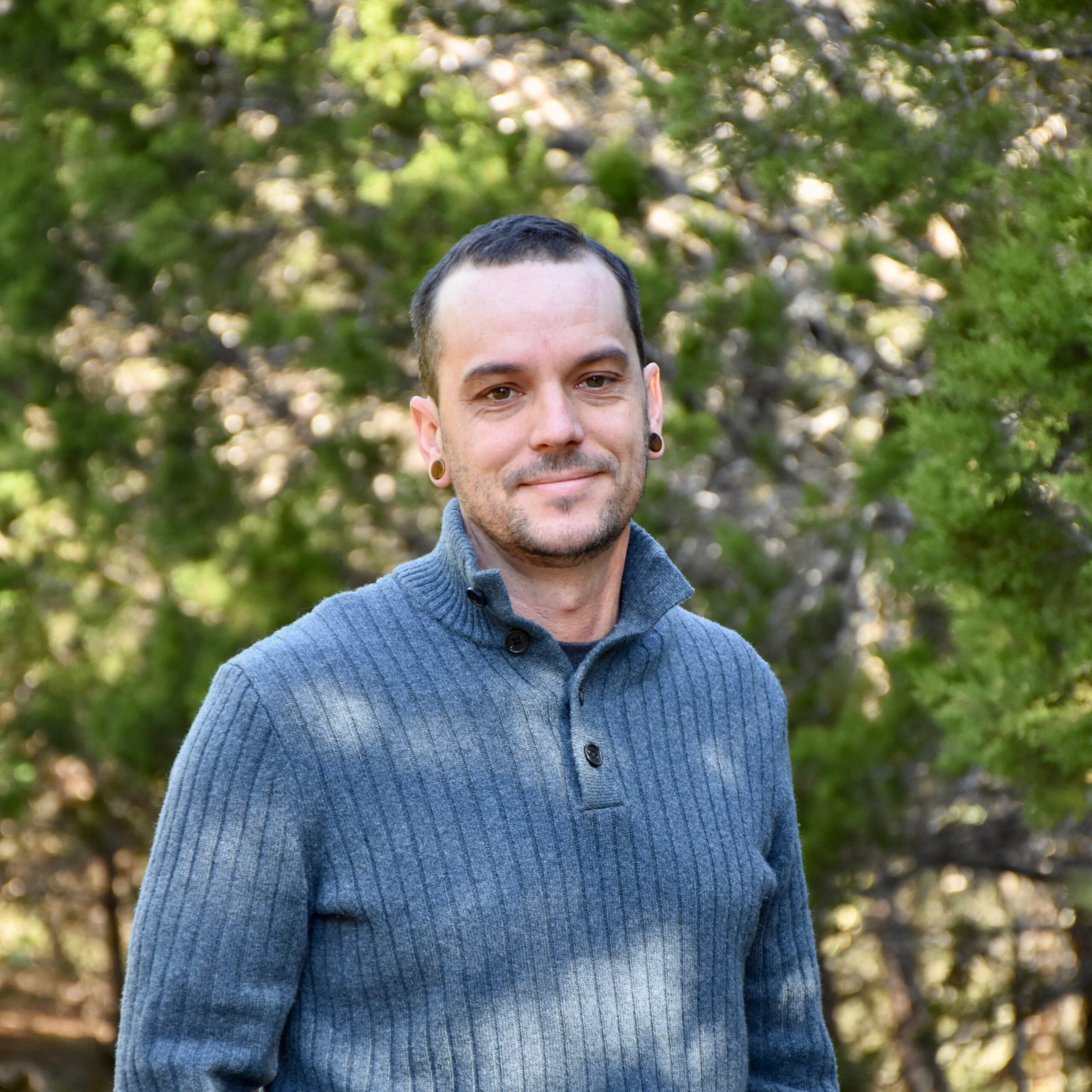
Reviewed by Chris Hudson, LPC
Founder & Executive Director – Lucent Recovery and Wellness, Austin, TX (2020–Present)
Leads clinical programs and develops innovative therapeutic approaches integrating experiential and creative therapies.
Board Member – Reklaimed, Austin, TX
Supports recovery-focused nonprofit initiatives fostering community and creative skill-building.
Clinical Leadership Roles – South Meadows Recovery, Inc.
Held leadership positions overseeing program development, clinical operations, and organizational management.
EDUCATION & CREDENTIALS
- M.A., Clinical Mental Health Counseling – Seminary of the Southwest (2021)
- B.A., Studio Art – Lewis & Clark College (2004)
- Licensed Professional Counselor (LPC), Texas
- Licensed Chemical Dependency Counselor (LCDC), Texas