The Suburban Mental Health Blind Spot No One in DFW Is Talking About
The suburbs north of Dallas, Frisco, McKinney, Allen, Prosper, have become a symbol of Texas prosperity. Top-ranked schools. New construction. Safe streets. Low unemployment. On paper, these communities look like the absence of struggle. But mental health doesn’t follow economic indicators. Some of the most underserved adults in the DFW mental health system live in zip codes that don’t look like they need help.
This paradox is one reason why awareness of IOP in Dallas, TX, is growing among a demographic that rarely gets discussed in mental health conversations: middle- and upper-middle-class suburban adults who are quietly falling apart.
The Suburban Mental Health Blind Spot
The Dallas Morning News has covered the growing mental health strain in Dallas’s northern suburbs, particularly among parents navigating academic pressure, financial stress, and social comparison culture. The same economic success that makes the suburbs appear stable creates its own form of chronic stress: long commutes, social isolation despite dense neighborhoods, and a culture where asking for help signals weakness.
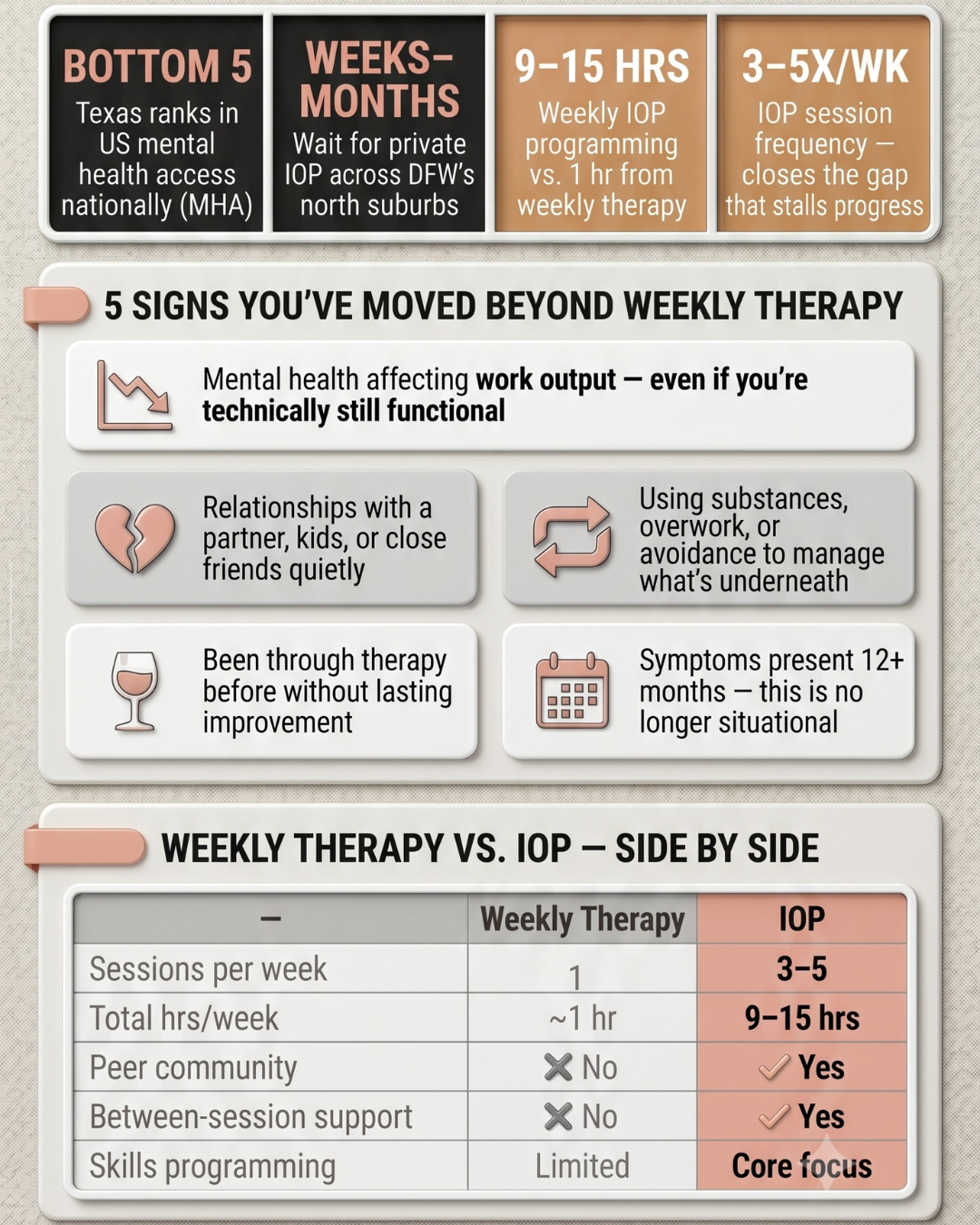
Texas as a whole ranks near the bottom nationally for mental health access relative to need, according to Mental Health America’s State of Mental Health in America report. Within Texas, the disparity between urban mental health infrastructure and suburban access is pronounced. Wealthy suburbs often lack adequate outpatient mental health providers relative to demand, and the providers that exist are frequently out-of-network or operating with closed practices.
The result is a population of adults who are symptomatic enough to need structured care but don’t know where to look and often don’t look because their circumstances don’t match what they imagine a mental health patient looks like.
What IOP Offers That Weekly Therapy Doesn’t
For someone whose mental health has crossed from “struggling” to “this is affecting my ability to function,” IOP offers something that once-weekly therapy fundamentally cannot: continuity and structure.
An intensive outpatient program typically runs three to five days per week, providing 9–15 hours of structured programming. That frequency creates momentum. It allows therapists to observe patterns across sessions. It builds a peer community among participants navigating similar experiences. And it creates scaffolding that holds people accountable in the spaces between sessions, which is often where progress breaks down.
Lucent’s piece on why outpatient progress breaks down between sessions addresses this directly: the gap between weekly appointments is often where the most important moments occur, and where the most dangerous slippage happens. IOP compresses that gap.
DFW’s Specific Mental Health Landscape in 2026
Several factors shape the DFW picture in ways that distinguish it from other metros:
Population growth and provider lag. When a million people move to a region, mental health infrastructure doesn’t scale at the same pace. KERA News has documented the workforce shortage in North Texas behavioral health. More residents, the same number of providers, a widening gap.
Corporate culture concentration. Dallas is home to dozens of Fortune 500 headquarters. The professional culture that comes with that concentration is performance-oriented, fast-moving, and competitive, creating a psychological environment associated with elevated rates of anxiety, burnout, and depression.
Insurance complexity. Texas’s insurance market is competitive, but behavioral health coverage is inconsistently applied. Adults trying to access IOP in Dallas, TX, sometimes encounter delays in pre-authorization, confusion about benefits, or networks that don’t include quality providers.
Stigma. Texas’s cultural identity is bound up in self-reliance. That’s a real barrier. Research consistently shows that stigma delays help-seeking, and delayed help-seeking allows conditions to worsen to the point where more intensive care becomes necessary.
The Right Questions to Ask About IOP in Dallas
If someone in DFW is wondering whether IOP is the right fit, the starting point isn’t a specific program — it’s a clear-eyed assessment of current functioning. Some useful questions:
- Is mental health affecting work performance, even if you’re still technically functional?
- Are relationships with a partner, children, or close friends being damaged by symptoms?
- Have you been through weekly therapy without making meaningful progress?
- Are you managing with substances, overwork, or behavioral avoidance rather than addressing what’s underneath?
- Have symptoms been present long enough that you know they’re not situational?
If several of those ring true, the question isn’t whether to get more help, it’s what level of care makes sense. Lucent’s guide to how to know when you’re ready for higher level care and signs therapy is not enough are useful reference points.
A Different Way to Think About “Intensive”
One of the barriers to considering IOP in Dallas, TX is the word itself. “Intensive” suggests severity that someone must be in crisis to qualify. But in clinical terms, intensive means structured and frequent, not that someone is in danger. Many of the people who benefit most from IOP are managing their daily lives more or less functionally. They’re not in crisis. They just haven’t been getting better.
IOP treats that population. It creates the conditions of frequency, community, structure, and accountability that allow real therapeutic work to happen and stick.
In a city where performance pressure is constant and vulnerability is undervalued, IOP represents something genuinely rare: a place where showing up fully to the work of getting better is the only expectation.
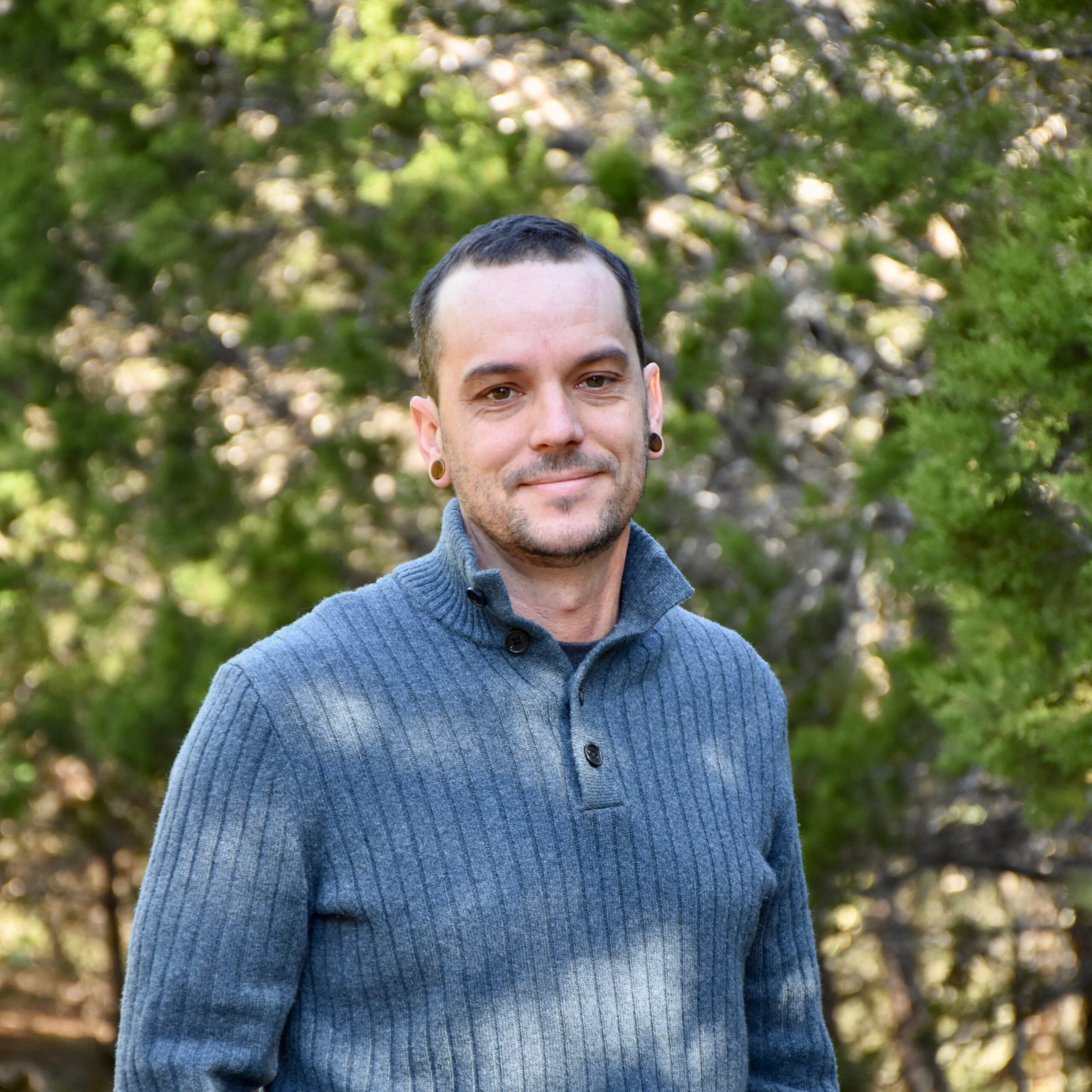
Reviewed by Chris Hudson, LPC
Founder & Executive Director – Lucent Recovery and Wellness, Austin, TX (2020–Present)
Leads clinical programs and develops innovative therapeutic approaches integrating experiential and creative therapies.
Board Member – Reklaimed, Austin, TX
Supports recovery-focused nonprofit initiatives fostering community and creative skill-building.
Clinical Leadership Roles – South Meadows Recovery, Inc.
Held leadership positions overseeing program development, clinical operations, and organizational management.
EDUCATION & CREDENTIALS
- M.A., Clinical Mental Health Counseling – Seminary of the Southwest (2021)
- B.A., Studio Art – Lewis & Clark College (2004)
- Licensed Professional Counselor (LPC), Texas
- Licensed Chemical Dependency Counselor (LCDC), Texas