After the Storm: The Mental Health Reckoning Houston Can’t Keep Rebuilding Around
Houston carries weight that most American cities don’t. Not just the economic weight of being the nation’s energy capital, or the demographic weight of being America’s most racially and ethnically diverse major city, but a literal meteorological weight. Hurricane Harvey. Winter Storm Uri. Repeated flooding events. The cumulative experience of a city that keeps being told to rebuild and keeps doing it has left a specific mark on Houston’s collective and individual mental health.
That context shapes why IOP in Houston, TX, has become an increasingly important resource for a city that is physically resilient but emotionally overextended.
The Long Tail of Climate Trauma in Houston
When Hurricane Harvey made landfall in August 2017, it deposited more than 60 inches of rain on the Houston metro. More than 200,000 homes were damaged or destroyed. One in three Houston residents was directly affected. The psychological aftermath, which researchers call the long tail of climate trauma, extended far beyond the storm’s physical footprint.
The Houston Chronicle documented the spike in anxiety, depression, and PTSD diagnoses following Harvey, noting that mental health system capacity was overwhelmed for months. What that data made plain was something clinicians had been saying for years: Harris County’s mental health infrastructure was inadequate before Harvey, and the storm exposed those inadequacies at scale.
Years later, the pattern has repeated. Winter Storm Uri in 2021 sent hundreds of thousands of Houstonians into days without heat, water, or power. The psychological impact of infrastructural failure, the experience of a city unable to protect its residents, compounds over time. For people with existing anxiety, depression, or trauma histories, these repeated exposures don’t just trigger symptoms. They layer and deepen them.
Diversity as Both Strength and Barrier
Houston is home to more than 145 languages. It is the most ethnically diverse major city in the United States. That diversity is a genuine strength in culture, community, and economic dynamism. But in mental health care, diversity creates complexity that the system often fails to navigate well.
Mental health stigma varies significantly across cultural communities. In many of Houston’s Vietnamese, Nigerian, Salvadoran, and South Asian communities, the cultural framework around mental health differs meaningfully from mainstream American clinical norms. Seeking professional help for psychological struggles can carry associations with weakness, family shame, or spiritual failing. These barriers aren’t irrational; they’re rooted in lived history. But they delay care and allow conditions to worsen.
Houston Public Media has covered the ongoing challenge of culturally competent mental health care in Harris County, noting the mismatch between a diverse population and a system that often defaults to Western, English-language frameworks. IOP in Houston, TX, that is equipped to work across cultural contexts with multilingual capacity and culturally humble clinical practice, addresses something that standard outpatient settings often cannot.
Houston’s Healthcare Geography Problem
Houston spans nearly 670 square miles. Getting to a mental health appointment can mean an hour of driving each way, through traffic that consistently ranks among the worst in the country. For someone managing depression — a condition that impairs motivation and executive function — that logistical burden is not a minor inconvenience. It’s one of the reasons people stop going.
IOP addresses this challenge structurally: instead of five separate one-hour therapy trips per week, someone attends three or four days in sessions lasting several hours. Travel is consolidated. Clinical benefit is dramatically higher per unit of time invested.
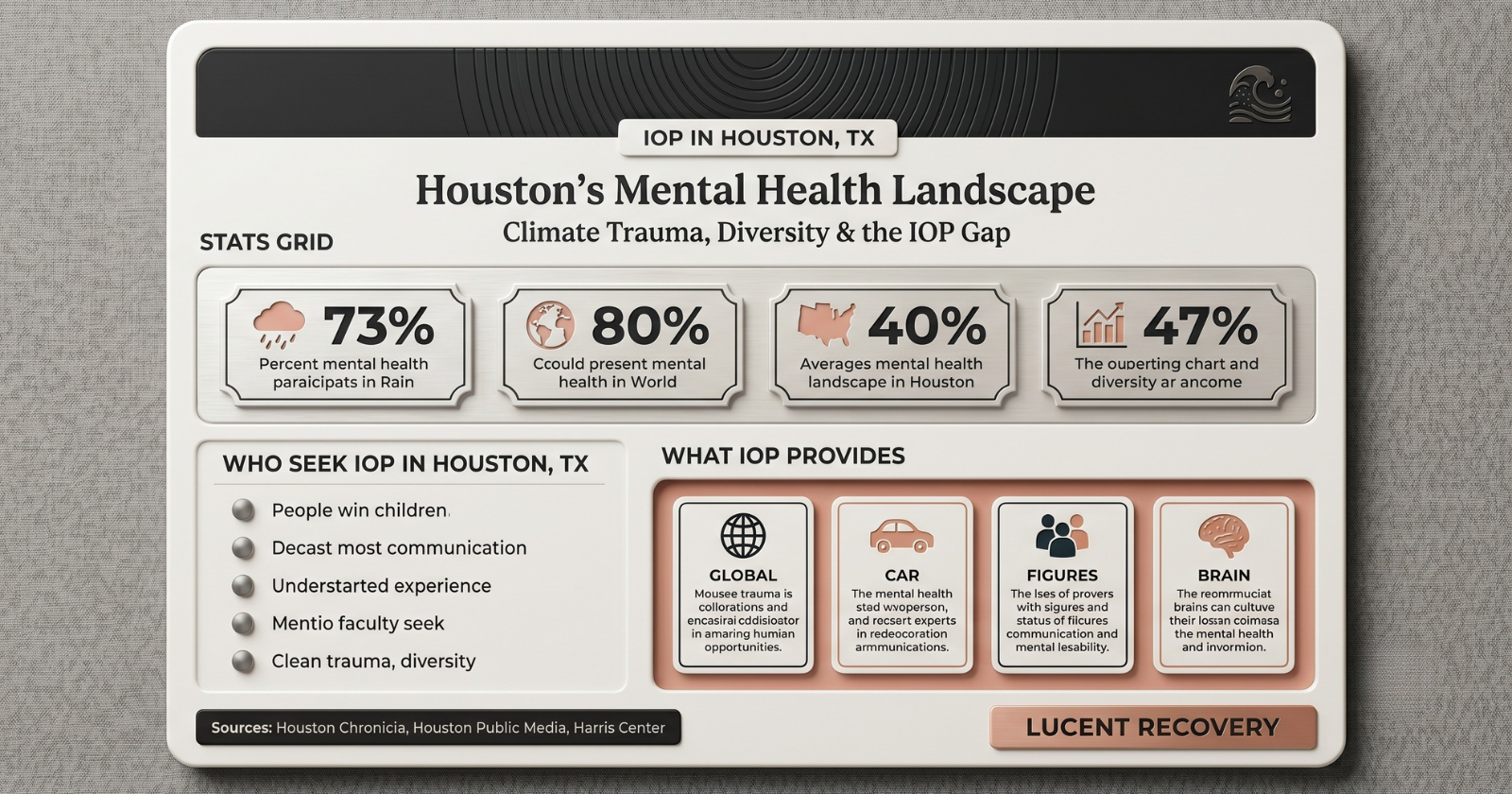
The Harris Center for Mental Health and IDD provides critical community services in Houston, but capacity limitations mean many adults who need intensive but non-crisis care fall outside its reach. IOP fills part of that gap providing a structured level of care between weekly therapy and hospitalization that a significant portion of the Houston population needs but hasn’t historically had access to.
Who Is Seeking IOP in Houston
The Houston population seeking IOP in 2026 is diverse in every sense:
- Adults from communities where treatment-seeking is new often motivated by a crisis that made inaction impossible
- Energy sector professionals navigating burnout, anxiety, and the psychological consequences of a boom-bust industry
- Climate trauma survivors whose symptoms have accumulated over years of repeated disaster exposure
- People with anxiety and depression who’ve tried weekly therapy without finding adequate traction
- Adults navigating complex trauma histories in a city that doesn’t always provide a soft landing
The Structure That IOP Provides
For many Houstonians, the appeal of IOP isn’t purely clinical; it’s practical. An IOP creates a fixed, predictable structure at a point in someone’s life when everything else feels unstable. It provides a peer community in a city where people can feel anonymous. It gives form to the work of recovery in a way that weekly sessions often can’t.
For a thorough comparison of IOP versus other levels of care, a question many Houstonians ask before committing to Lucent’s IOP vs. PHP breakdown and guide to who fits an IOP are good starting point.
For a city that keeps picking itself up after storms, IOP in Houston, TX, represents more than a clinical service: it’s sustained, structured support for a population that has more than earned the right to ask for it.
Reviewed by Chris Hudson, LPC
Founder & Executive Director – Lucent Recovery and Wellness, Austin, TX (2020–Present)
Leads clinical programs and develops innovative therapeutic approaches integrating experiential and creative therapies.
Board Member – Reklaimed, Austin, TX
Supports recovery-focused nonprofit initiatives fostering community and creative skill-building.
Clinical Leadership Roles – South Meadows Recovery, Inc.
Held leadership positions overseeing program development, clinical operations, and organizational management.
EDUCATION & CREDENTIALS
- M.A., Clinical Mental Health Counseling – Seminary of the Southwest (2021)
- B.A., Studio Art – Lewis & Clark College (2004)
- Licensed Professional Counselor (LPC), Texas
- Licensed Chemical Dependency Counselor (LCDC), Texas