The Hidden Mental Health Toll of DFW’s Growth Boom
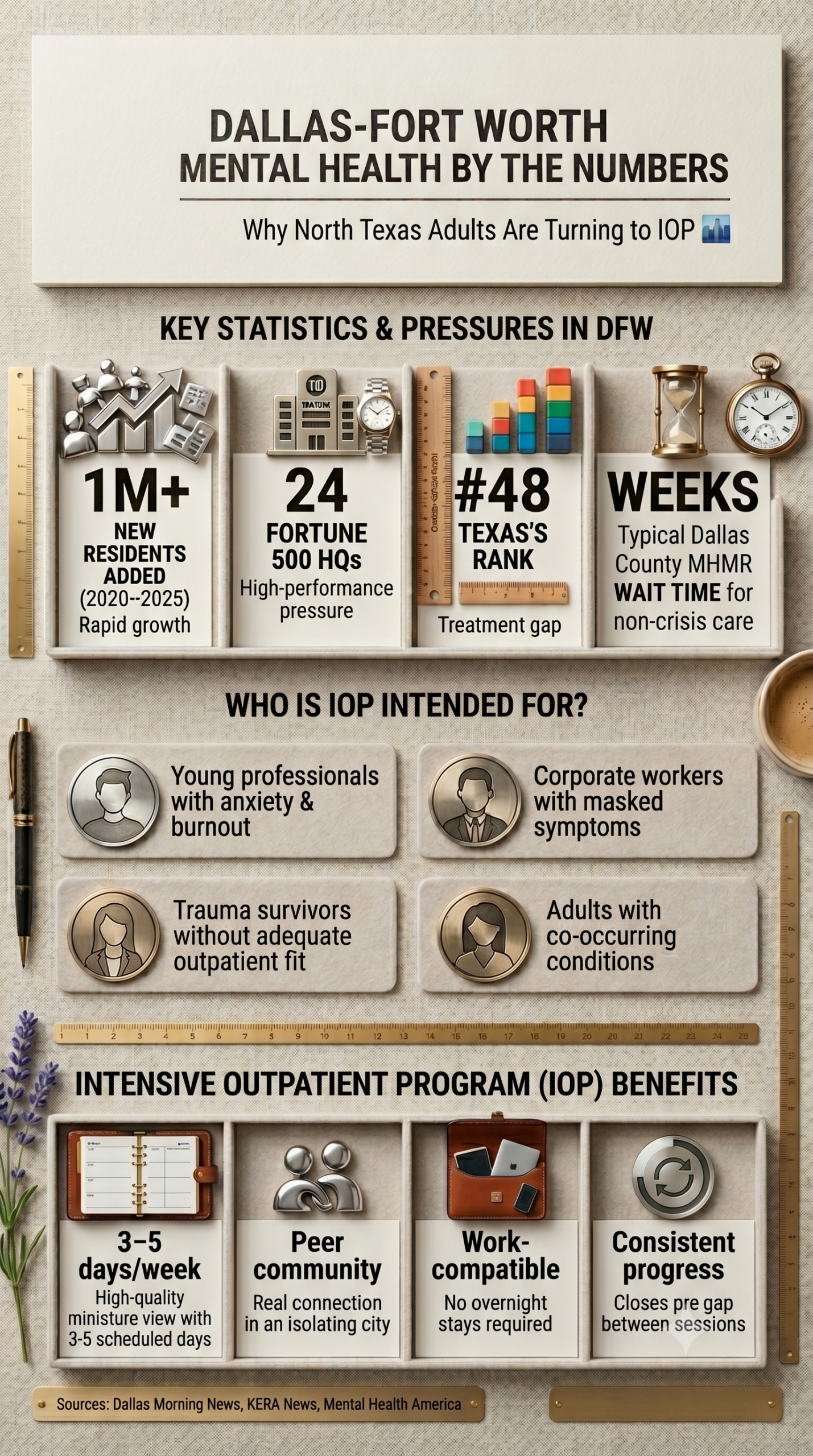
The Dallas-Fort Worth area is one of the most dynamic metropolitan areas in the United States. Between 2020 and 2025, the region added more than one million new residents, making it among the fastest-growing major metros in the country. New corporate campuses, gleaming suburbs, and relentless economic opportunity have defined the DFW story. But beneath the growth narrative, a quieter crisis has been building. One measured in emergency room visits, overburdened community mental health centers, and a growing number of adults who can’t find the structured support they need.
That gap is one reason why IOP in Dallas, TX has become a more searched and discussed topic than at any point in recent history.
The Pressure Behind the Growth
Growth brings stress. In DFW, that stress lands unevenly. New transplants arrive with professional ambition but without the community roots that absorb life’s harder moments. Long commutes on I-35, I-75, and the Dallas North Tollway eat into time that would otherwise go to rest, exercise, and connection. A 2024 analysis by the Dallas Morning News identified Dallas County as one of the top Texas counties for anxiety and depression-related ER admissions, with the trend accelerating post-pandemic.
For many North Texans, the first response to mental health struggles is to schedule a weekly therapy appointment and hope for the best. Sometimes that works. But for a meaningful portion of the adult population, people managing persistent depression, anxiety disorders, trauma, or co-occurring conditions, once-weekly therapy doesn’t provide enough structure to stabilize and build lasting skills. This is the population that Intensive Outpatient Programs are built to serve.
What Makes IOP Different in a City Like Dallas
An Intensive Outpatient Program (IOP) is a structured, multi-day-per-week treatment model that delivers group therapy, individual sessions, and skills-based programming without requiring overnight stays. It’s designed for people who need more than weekly therapy but don’t need inpatient care.
In a city like Dallas, where many adults are managing demanding careers, young families, and the social pressure to perform successfully, IOP fits a specific need. It allows someone to continue working while getting consistent, clinically meaningful support. It creates community in a city where isolation is often masked by busyness.
The structure itself matters. KERA News has reported on the North Texas mental health workforce shortage, noting that the region consistently struggles with provider availability, particularly for specialized or structured care. That shortage pushes more people toward episodic appointments and away from the consistent engagement that real recovery requires. IOP closes part of that gap by delivering structured programming rather than relying solely on individual clinician availability.
Who in DFW Is Seeking IOP
The profile of someone seeking IOP in Dallas, TX, doesn’t fit a single mold. It includes:
- Young professionals managing anxiety and depression in a high-performance culture
- Adults stepping down from inpatient psychiatric care who need structured transition support
- People whose mental health has begun to affect their work performance, relationships, or daily functioning
- Individuals with trauma histories who haven’t found adequate support in traditional outpatient settings
- Adults with co-occurring conditions who need more coordinated, intensive care than weekly sessions provide
Dallas’s corporate and technology sector concentration has created a specific mental health demographic: high-functioning adults who’ve managed symptoms for years by staying busy but who eventually reach a point where that coping strategy collapses. For this group, the leap from weekly therapy to inpatient feels extreme and unnecessary. IOP is the clinically appropriate middle ground.
The Structural Gaps in North Texas Mental Health
Dallas County MHMR provides essential community mental health services, but wait times for non-crisis care often stretch weeks or months. The private sector is fragmented. According to KERA News coverage of North Texas behavioral health, the gap between crisis stabilization and long-term community care remains one of the most persistent weaknesses in the region’s mental health infrastructure.
IOP programs operating in this space aren’t replacing the public system; they’re serving the segment of the population that falls between crisis-level care and the lighter touch of weekly outpatient therapy. That middle space is, for many people, where the most important recovery work actually happens.
What to Look for in a Dallas IOP
A well-structured program should include a clearly defined intake and assessment process, evidence-based modalities such as CBT and DBT, small group settings that build a therapeutic community, an individual therapy component, and transparent coordination with outside providers, including prescribers and case managers. Understanding the appropriate level of care is often the best first step for anyone weighing their options.
The Honest Truth About IOP and DFW
Dallas is not a city that makes vulnerability easy. The culture rewards performance, productivity, and resilience, and those aren’t bad values. But they can become a barrier to care. People wait longer than they should. They downplay symptoms. They take on more as a way of avoiding less.
IOP in Dallas, TX, is meaningful precisely because it creates a scheduled commitment that makes engagement with mental health care a regular part of the week, not something squeezed in when things get bad enough. For a city running at the speed Dallas runs at, that structure might be exactly the intervention that changes everything.
For anyone evaluating whether IOP fits their current situation, Lucent Recovery’s guide to who is a good fit for an IOP program provides a clear clinical framework.
Explore Lucent Recovery’s IOP program in Dallas, TX
Reviewed by Chris Hudson, LPC
Founder & Executive Director – Lucent Recovery and Wellness, Austin, TX (2020–Present)
Leads clinical programs and develops innovative therapeutic approaches integrating experiential and creative therapies.
Board Member – Reklaimed, Austin, TX
Supports recovery-focused nonprofit initiatives fostering community and creative skill-building.
Clinical Leadership Roles – South Meadows Recovery, Inc.
Held leadership positions overseeing program development, clinical operations, and organizational management.
EDUCATION & CREDENTIALS
- M.A., Clinical Mental Health Counseling – Seminary of the Southwest (2021)
- B.A., Studio Art – Lewis & Clark College (2004)
- Licensed Professional Counselor (LPC), Texas
- Licensed Chemical Dependency Counselor (LCDC), Texas