
Mental Health Care Is Failing Texans. Here’s How Lucent Recovery and Wellness in Austin Is Changing That (Updated – May, 2026)
One in five adults in the United States lives with a mental health condition. In Texas, the odds of getting treatment for that condition are among the worst in the country.
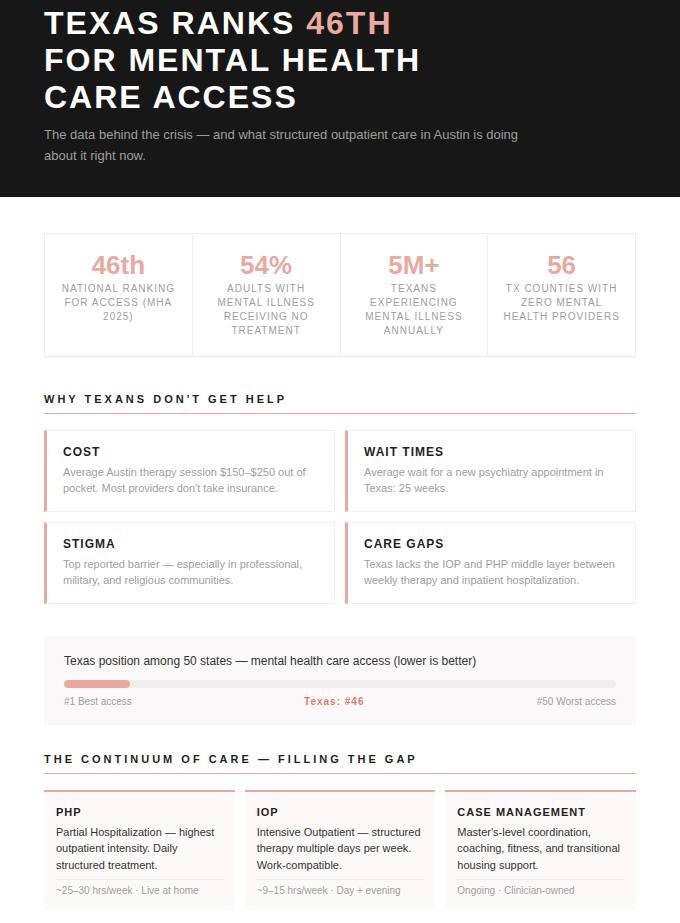
According to Mental Health America’s 2025 State of Mental Health in America report, Texas ranks 51st in the nation for access to mental health care, a position it has held for multiple consecutive years. More than 5 million Texas adults experience a mental illness in a given year, and most of them will never receive treatment for it.
That’s not a funding gap. That’s not a staffing shortage. That is a system failure, and it is measurable, documentable, and getting worse as Texas’s population grows.
But in Austin, one clinic is operating with a fundamentally different model.
The Texas Mental Health Crisis: What the 2025 Data Shows
The numbers behind Texas’s ranking are worth sitting with:
- 51st nationally for access to mental health care, a measure covering insurance coverage, treatment availability, cost, and workforce (Mental Health America, 2025). Texas ranks 46th on the report’s separate overall measure, which blends access with prevalence.
- Nearly 1 in 5 Texas adults with a mental illness had no health insurance, the worst rate of any state in the country.
- More than 4 in 10 Texans experiencing frequent mental distress could not afford to see a doctor.
- Texas has roughly one psychiatrist for every 11,758 residents, according to the Texas Department of State Health Services, and 170 counties have no licensed psychiatrist at all.
- 246 of Texas’s 254 counties are wholly or partly designated by the federal government as mental health professional shortage areas.
- Texas sits among the ten states with the lowest per capita state mental health agency spending, based on national expenditure data analyzed in peer-reviewed research.
The COVID-19 pandemic accelerated these trends. The 2021 freeze, ongoing housing instability in Austin, and the economic pressure of one of the fastest-growing metros in the country have compounded mental health strain across every demographic, from young professionals to college students to families managing multiple stressors at once.
Austin is not immune. In fact, the city’s rapid growth has created its own specific pressures: housing costs that climbed sharply between 2020 and 2024, social isolation in sprawling new developments, and a tech-sector culture that rewards performance and penalizes vulnerability.
Why Most People Don’t Get Help
The access problem is not simply a matter of availability. Even in cities with mental health providers, the barriers are real and varied:
Cost. Outpatient therapy in Austin averages $150 to $250 per session out of pocket. Many providers don’t take insurance.
Wait times. In much of the state, the wait for a new psychiatry appointment runs into months rather than weeks. In rural counties it can be longer still, and in some it isn’t a wait at all, because there is no provider to wait for.
Stigma. Among Texans with mental health conditions, stigma remains one of the most commonly reported barriers to seeking care, particularly in professional, religious, and military-connected communities.
Complexity. Navigating insurance panels, step-down levels of care, and the difference between a therapist, psychiatrist, and case manager is genuinely confusing, and the burden of figuring it out falls entirely on the person who is already struggling.
Gaps between care levels. Texas has inpatient psychiatric facilities. It has private therapists. What it lacks is a robust middle layer: the intensive outpatient and partial hospitalization programs that serve people who need more than weekly therapy but don’t need hospitalization.
That middle layer is exactly where Lucent Recovery and Wellness operates.
What Lucent Recovery and Wellness Actually Does
Lucent Recovery and Wellness is a clinician-owned outpatient mental health treatment center in Austin. Founded in 2020, it was built specifically to fill the gap in the Texas care continuum, to be the kind of place that treats people with the seriousness and warmth their conditions require.
This is not a drop-in counseling center. Lucent offers a structured, clinical-grade continuum of care designed around each individual client:
Intensive Outpatient Program (IOP)
Lucent’s IOP provides multiple therapy sessions per week, including individual, group, and skills-based work, while allowing clients to continue living at home, maintaining work or school, and staying connected to their support systems. It bridges the gap between weekly therapy and full residential treatment.
Treatment modalities include:
- Cognitive Behavioral Therapy (CBT): targets the distorted thought patterns that drive anxiety, depression, and emotional dysregulation
- Dialectical Behavior Therapy (DBT): builds emotion regulation, distress tolerance, and interpersonal effectiveness skills
- EMDR (Eye Movement Desensitization and Reprocessing): structured, evidence-based trauma processing
- Somatic Experiencing: body-based trauma resolution
- Mindfulness-Based Stress Reduction (MBSR): structured practice for managing stress reactivity
Partial Hospitalization Program (PHP)
For clients who need more structured support, Lucent’s PHP offers a higher level of clinical intensity, typically five days per week, while still maintaining outpatient status. It is the highest level of care that does not require overnight residency.
Master’s-Level Case Management
Every client at Lucent has access to case management by master’s-level clinicians who coordinate care, navigate system barriers, and provide continuity across every aspect of a client’s treatment and life situation.
Recovery Coaching and Fitness
Lucent integrates experiential recovery coaching and health and fitness programming as clinical components, not add-ons. Research consistently shows that physical activity and structured goal-setting are meaningful adjuncts to mental health treatment.
Transitional Housing
For clients who need structured living support during or after treatment, Lucent’s transitional housing program provides a stable environment while intensive care continues.
What Makes Lucent Different from Standard Outpatient Care
Texas has outpatient mental health providers. What it rarely has is this:
Clinician-owned. Lucent is not a private equity-backed behavioral health chain. It was founded by clinicians who still practice there. That matters for clinical quality and for the culture of care clients experience.
Low clinician-to-client ratios. Large group practices and hospital-affiliated programs often carry caseloads that make genuine individualization impossible. Lucent’s structure is designed around smaller caseloads and deeper clinical relationships.
Trauma-informed at every level. Trauma-informed care is not a checkbox at Lucent. It shapes intake, treatment planning, how sessions are structured, and how clinicians are trained. For many of the people who come through the door, unresolved trauma sits underneath the presenting diagnosis. That’s why it isn’t optional. It’s the foundation.
Integrated services under one roof. Rather than requiring clients to navigate multiple providers across the city, Lucent offers therapy, case management, psychiatric coordination, coaching, and fitness support as a coherent package.
“We’ve had clients tell us this was the first time they felt like a clinician really listened. That kind of connection is where the healing begins.”
Chris Hudson, MA, LPC, LCDC, Founder and Executive Director
What Healing Actually Looks Like
Clinical measures matter, but the human outcomes matter more. Clients who complete Lucent’s programs commonly report:
- Meaningful reduction in anxiety, depression, and acute emotional distress
- Improved capacity to manage relationships and regulate stress responses
- Renewed sense of purpose and personal identity
- Reconnection with family and community support systems
- Skills and strategies they use independently long after treatment ends
For many clients, Lucent represents the first time they have been able to speak about trauma, mental health, or emotional pain without shame or fear of judgment. That experience alone, being genuinely seen, is often the turning point.
What Needs to Change at the System Level
Lucent is one clinic. Texas’s mental health crisis requires systemic solutions:
- Increased state investment in community mental health funding, since Texas remains among the lowest-spending states per capita
- Expanded Medicaid access. Texas is one of the states that has not expanded Medicaid, which leaves hundreds of thousands of low-income Texans without mental health coverage
- Workforce development. Training and licensing pipelines for LPCs, LCSWs, and psychiatrists, with real incentives to practice in rural and underserved areas
- Anti-stigma campaigns at the employer and community level, particularly in sectors like the military, oil and gas, and tech, where help-seeking is culturally penalized
- Expanded IOP and PHP infrastructure across the state. The middle of the care continuum, where Lucent operates, is the most underdeveloped and the most needed
Until those changes happen, clinics like Lucent hold the line.
Frequently Asked Questions
Does Lucent accept insurance?
Lucent works with many insurance providers. Call 512-588-3899 to verify your specific coverage before beginning treatment.
Who is a good fit for Lucent’s IOP?
Adults experiencing moderate to significant mental health symptoms, including depression, anxiety, PTSD, trauma, bipolar disorder, personality disorders, or co-occurring substance use, who need more support than weekly therapy but do not require inpatient hospitalization.
What is the difference between IOP and PHP?
IOP typically involves 9 to 15 hours of structured treatment per week. PHP is more intensive, generally 25 to 30 hours per week. Both allow clients to live at home. Your intake clinician will recommend the appropriate level based on your current clinical picture.
Does Lucent offer services outside Austin?
Lucent’s facility is in Austin, serving clients from across the Austin metro area, including people who relocate temporarily to access the transitional housing program.
If You’re Ready to Take the Next Step
Texas’s mental health system is failing too many people. But that doesn’t mean you have to wait for the system to fix itself.
Lucent Recovery and Wellness is ready to help now, with clinical expertise, genuine compassion, and a structure designed to meet you where you are.
Call: 512-588-3899
Location: 4807 Spicewood Springs Rd #1100, Austin, TX 78759
Online: Contact us
You don’t have to carry this alone. And you don’t have to spend months on a waiting list to start getting real help.
Sources
Mental Health America, State of Mental Health in America 2025: Access to Care Rankings. State-level rankings measuring access to insurance, treatment, quality and cost of coverage, and workforce availability.
https://mhanational.org/the-state-of-mental-health-in-america/data-rankings/access-to-care/
Mental Health America, State of Mental Health in America 2025: Adult Rankings. Eight-measure ranking of adult mental illness prevalence and access to care by state, including insurance coverage and cost barriers.
https://mhanational.org/the-state-of-mental-health-in-america/data-rankings/adult-ranking/
Mental Health America, October 2025. State mental health rankings released. Summary of the 2025 report findings, including state-level insurance coverage gaps.
https://mhanational.org/news/state-mental-health-rankings-released/
Texas Department of State Health Services, Health Professions Resource Center. Mental Health Workforce in Texas. County-level distribution of the Texas mental health workforce, including provider ratios and counties without providers.
https://www.dshs.texas.gov/sites/default/files/chs/hprc/publications/Mental-Health-Workforce.pdf
National Institutes of Health, PubMed Central. System Effects of Mental Health Agency Expenditures and Mental Health Parity Legislation at the State Level. Peer-reviewed analysis of state mental health agency per capita expenditures and their relationship to workforce availability and shortage-area coverage.
https://pmc.ncbi.nlm.nih.gov/articles/PMC12528280/
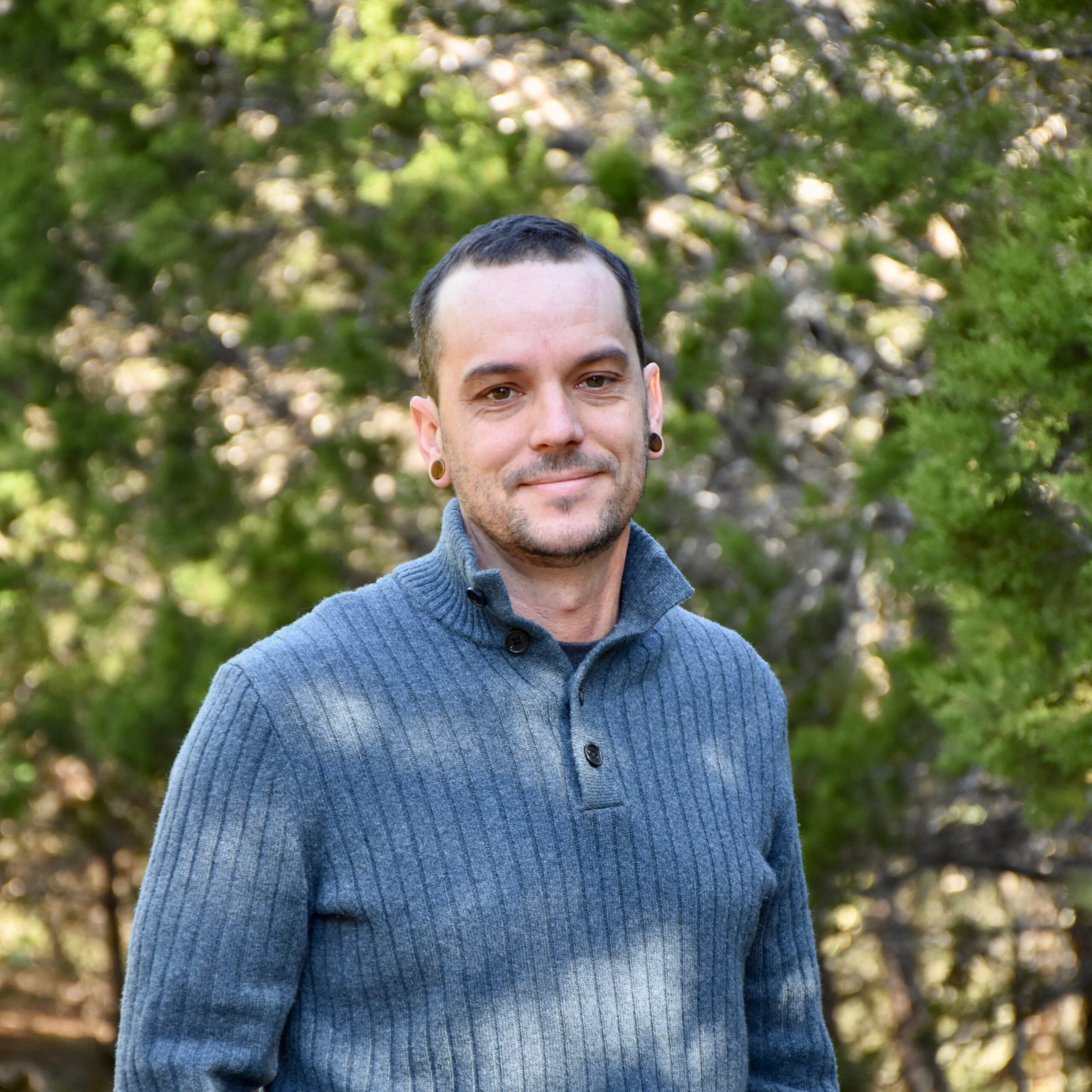
Reviewed by Chris Hudson, MA, LPC, LCDC
Last reviewed: August 2026
Chris Hudson is the Founder and Executive Director of Lucent Recovery and Wellness in Austin, where he leads clinical programs and develops therapeutic approaches integrating experiential and creative therapies. He holds an M.A. in Clinical Mental Health Counseling from Seminary of the Southwest and is a Licensed Professional Counselor and Licensed Chemical Dependency Counselor in Texas. He previously held clinical leadership roles at South Meadows Recovery and serves on the board of Reklaimed, an Austin nonprofit supporting recovery through community and creative skill-building.