What Is a Sociopath? Understanding Antisocial Personality Disorder Signs & Treatment (Updated — May, 2026)
When most people hear the word “sociopath,” they picture a movie villain cold, calculating, untouchable. The reality of antisocial personality disorder (ASPD) is far more nuanced, and far more human, than that.
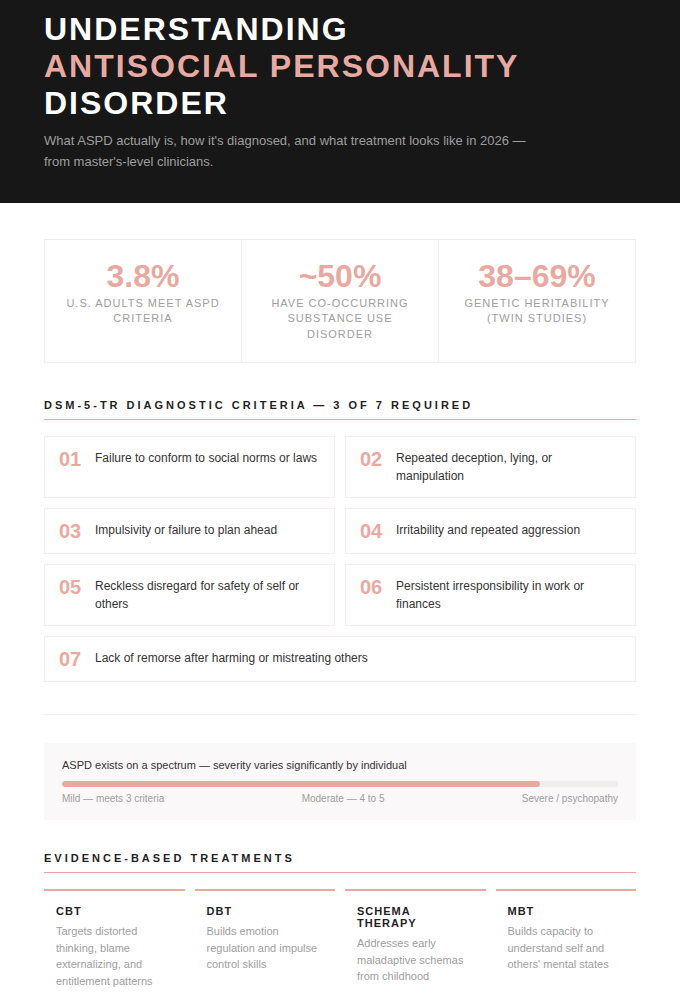
As of 2026, an estimated 3.8% of the U.S. adult population meets diagnostic criteria for ASPD that’s roughly 10 million people. Many of them are not in prison. Many are in relationships, workplaces, and families near you. And many of them are suffering in ways that get overlooked because the stigma around this diagnosis is still enormous.
This article will walk you through what ASPD actually is, how it’s diagnosed, what modern treatment looks like, and why the language we use around it matters more than most people realize.
What Is Antisocial Personality Disorder (ASPD)?
Antisocial personality disorder is a Cluster B personality disorder characterized by a persistent pattern of disregarding and violating the rights of others. It is the clinical term that replaced older, more stigmatizing labels like “sociopath” or “psychopath” terms that, as Dr. Ramone Ford of the Cleveland Clinic notes, “have been used in the past to demonize people.”
To receive an ASPD diagnosis, a person must be at least 18 years old and show evidence of conduct disorder before age 15. Diagnosis is based on the DSM-5-TR criteria, which requires at least three of the following:
- Consistent failure to conform to social norms or laws
- Repeated deception — lying, using false identities, manipulating others for personal gain
- Impulsivity or chronic failure to plan ahead
- Irritability and aggression (repeated physical fights or assaults)
- Reckless disregard for the safety of self or others
- Consistent irresponsibility in work obligations or financial commitments
- Lack of remorse after harming, mistreating, or stealing from others
It’s critical to understand: ASPD exists on a spectrum. Not every person with this diagnosis displays the same behaviors at the same intensity. Context, co-occurring conditions, and trauma history all shape how ASPD presents.
Sociopath vs. Psychopath vs. ASPD: What’s the Difference?
These terms are often used interchangeably, but they mean different things clinically:
| Term | Status | Notes |
|---|---|---|
| ASPD | Official DSM-5-TR diagnosis | Clinical standard; umbrella category |
| Sociopathy | Informal/lay term | Often used to describe ASPD; being phased out |
| Psychopathy | Research construct (PCL-R) | Considered a severe subtype of ASPD; not a standalone DSM diagnosis |
Key clinical distinction: Psychopathy involves more pronounced callousness, predatory behavior, and neurological differences (reduced amygdala reactivity). Not everyone with ASPD meets the threshold for psychopathy in fact, most don’t.
Signs and Patterns Mental Health Professionals Look For
Diagnosis requires a thorough evaluation by a licensed clinician. That said, common patterns that prompt clinical assessment include:
Relational patterns
- Chronic difficulty sustaining meaningful relationships
- Tendency to exploit, manipulate, or deceive close contacts
- Shallow emotional expression or difficulty with genuine intimacy
- Repeated conflict with authority figures (employers, institutions, family)
Behavioral patterns
- History of legal troubles or rule violations
- Co-occurring substance use disorders (present in ~50% of people with ASPD)
- Engagement in risky or illegal activities without apparent concern for consequences
- Chronic unemployment or financial instability
Emotional characteristics
- Limited capacity for remorse or empathy
- Tendency to externalize blame
- Superficial charm that masks manipulative intent
- Emotional volatility, especially under stress
Important: Many of these patterns overlap with trauma responses, PTSD, bipolar disorder, and BPD. Only a qualified clinician conducting a full assessment can make an accurate diagnosis.
What Causes ASPD? What the 2025–2026 Research Shows
ASPD does not have a single cause. Current research points to a biopsychosocial model meaning biological, psychological, and social factors all contribute.
Biological factors:
- Reduced grey matter volume in frontal and temporal regions associated with empathy and decision-making
- Altered amygdala reactivity (reduced fear response)
- Genetic heritability estimated at 38–69% across twin studies
Developmental/psychological factors:
- Early childhood trauma, neglect, or abuse is strongly associated
- Conduct disorder in childhood is a prerequisite for adult ASPD diagnosis
- Attachment disruptions in early caregiving relationships
Social/environmental factors:
- Exposure to violence, chaotic home environments, or peer groups normalizing antisocial behavior
- Socioeconomic disadvantage and limited access to mental health support in formative years
The 2025 Journal of Personality Disorders research reinforces that trauma-informed care is not just helpful but essential in treating ASPD — because the majority of people with this diagnosis carry significant unprocessed trauma.
Treatment for ASPD: What Actually Works in 2026
ASPD has historically been described as “difficult to treat” and there is truth to that. But the framing misses something important: the field has made significant progress in the last decade, and meaningful improvement is achievable with the right approach.
Psychotherapy
Cognitive Behavioral Therapy (CBT) remains the most evidence-supported approach. It targets the distorted thinking patterns entitlement, minimization of harm, externalizing blame that drive ASPD behaviors.
Schema Therapy has shown particular promise for personality disorders, including ASPD. It addresses early maladaptive schemas rooted in childhood experiences.
Dialectical Behavior Therapy (DBT) is especially effective when emotional dysregulation and impulsivity are prominent features, or when co-occurring BPD is present.
Mentalization-Based Treatment (MBT) focuses on building the capacity to understand one’s own and others’ mental states directly targeting the empathy deficits central to ASPD.
Group therapy provides structured social feedback in a controlled environment a uniquely important modality for a disorder that fundamentally affects how a person relates to others.
Medication
There is no FDA-approved medication specifically for ASPD. However, medications may be used to target co-occurring symptoms:
- Mood stabilizers (lithium, valproate) for impulsivity and aggression
- SSRIs for co-occurring depression or anxiety
- Antipsychotics in cases with significant agitation or psychotic features
What Comprehensive Care Looks Like
At Lucent Recovery and Wellness in Austin, TX, we work with clients whose ASPD diagnoses are often entangled with trauma histories, substance use, and relational ruptures that have accumulated over years. Our approach is individualized, trauma-informed, and built around the whole person not just the diagnosis.
Our Intensive Outpatient Program (IOP) provides structured, evidence-based care through CBT, DBT, and EMDR modalities chosen based on each client’s clinical profile, not a one-size-fits-all protocol. Master’s-level case management and recovery coaching provide continuity between sessions.
“Every person who walks through our doors is carrying their own story. We don’t see disorders or labels we see individuals who deserve compassionate, evidence-based care that meets them exactly where they are.” Lucent Recovery Clinical Team
The Role of Family and Support Systems
Loving someone with ASPD is exhausting, confusing, and often painful. Families frequently describe feeling manipulated, dismissed, or unsafe — and those experiences are real and valid.
What family members need to know:
- Setting and holding boundaries is not cruelty it is protection for both parties
- Professional guidance (individual therapy, family therapy) helps loved ones process the relational impact
- Support groups for families of people with personality disorders exist and are invaluable
- Self-care is not optional caregiver burnout is common and serious
At Lucent, we offer guidance for families as a core part of the treatment process because healing rarely happens in isolation.
Breaking the Stigma: Why the Language We Use Matters
The word “sociopath” carries decades of cultural baggage. It’s been used to describe killers in crime shows, manipulative exes in Reddit threads, and political figures in Twitter arguments. Most of this use has nothing to do with the clinical reality of ASPD.
When we conflate ASPD with irredeemable evil, we:
- Discourage people from seeking diagnosis and treatment
- Reduce complex human beings to a label
- Make it harder for families to understand what they’re actually dealing with
- Undermine the clinical efforts of professionals trying to help
Person-first language “a person living with ASPD” rather than “a sociopath” isn’t political correctness. It’s clinical accuracy and basic dignity.
Frequently Asked Questions About ASPD
Can someone with ASPD truly change?
Yes though change is typically gradual and requires sustained engagement with treatment. Research shows that ASPD symptoms often decrease in severity with age, and structured therapeutic intervention can accelerate this process. Motivation to change is a significant predictor of outcomes.
Is ASPD the same as narcissistic personality disorder (NPD)?
No. Both are Cluster B disorders and share some surface features (manipulation, grandiosity, lack of empathy). But NPD is driven primarily by fragile self-esteem and a need for admiration, while ASPD is defined by a broader disregard for others’ rights. A person can have both.
Can ASPD be diagnosed in children or teenagers?
The adult diagnosis of ASPD requires evidence of conduct disorder before age 15. Children and teens can be diagnosed with conduct disorder, but the ASPD label is not applied until age 18.
Does ASPD always lead to criminal behavior?
No. While ASPD is overrepresented in criminal justice populations (studies estimate 50–80% of incarcerated individuals may meet criteria), the majority of people with ASPD are not incarcerated. Many function in everyday society, often in high-status professional roles.
What’s the difference between ASPD and sociopathy?
Clinically, they describe the same condition. “Sociopathy” is an informal term that predates the DSM formalization of ASPD. Most mental health professionals now use ASPD as the preferred, less stigmatizing term.
Getting Help
If you or someone you love is navigating ASPD whether as the person living with it or as a family member affected by it — professional support is available and meaningful progress is possible.
At Lucent Recovery and Wellness in Austin, TX, our master’s-level clinicians specialize in complex mental health presentations including personality disorders, co-occurring trauma, and substance use. We offer:
- Intensive Outpatient Program (IOP)
- Partial Hospitalization Program (PHP)
- Individual Counseling
- Case Management
- Recovery Coaching
Call us at 512-588-3899 or contact us online to schedule a confidential consultation.
Seeking help isn’t weakness. It’s the most courageous thing a person can do.

Reviewed by Chris Hudson, LPC
Founder & Executive Director – Lucent Recovery and Wellness, Austin, TX (2020–Present)
Leads clinical programs and develops innovative therapeutic approaches integrating experiential and creative therapies.
Board Member – Reklaimed, Austin, TX
Supports recovery-focused nonprofit initiatives fostering community and creative skill-building.
Clinical Leadership Roles – South Meadows Recovery, Inc.
Held leadership positions overseeing program development, clinical operations, and organizational management.
EDUCATION & CREDENTIALS
- M.A., Clinical Mental Health Counseling – Seminary of the Southwest (2021)
- B.A., Studio Art – Lewis & Clark College (2004)
- Licensed Professional Counselor (LPC), Texas
- Licensed Chemical Dependency Counselor (LCDC), Texas