The Cost of “Keep Moving”: How Houston’s Resilience Culture Became a Mental Health Barrier
There’s a particular kind of resilience that Houstonians have earned. The city floods, freezes, and absorbs direct hurricane hits, and Houstonians rebuild fast, without much ceremony. That resilience is worth respecting. But resilience, taken to its cultural extreme, becomes a reason not to stop. Not to process. Not to ask for help. And that is where it starts to cost people.
The emergence of IOP in Houston, TX, as a meaningful component of the city’s behavioral health landscape is, in part, a response to a city that has historically treated mental health care as a luxury and is only now beginning to understand it as a necessity.
Houston’s Mental Health System: Where It Stands
Harris County is the most populous county in Texas and among the most populous in the United States. Its mental health infrastructure has not scaled proportionally to that population. Texas ranks near the bottom nationally for mental health access relative to need. Harris County, despite its size, has a psychiatric capacity shortage that forces many residents into distant facilities or more often into crisis-driven encounters with the county jail system, which has become a de facto psychiatric facility for many Houstonians cycling without adequate outpatient support.
The Houston Chronicle has covered this cycle extensively: people with serious mental illness moving between crisis stabilization and incarceration without ever receiving the sustained treatment that would break the pattern. That failure at the crisis end of the system creates a ripple effect. When acute resources are strained, the middle of the continuum where IOP sits receives less attention and fewer resources, even though it’s where sustainable recovery most often begins.
What “High-Functioning” Really Looks Like in Houston
Houston has a high concentration of professionals in the energy, healthcare, aerospace, and finance industries, defined by a performance culture. Within those industries, there are significant numbers of adults managing mental health conditions in ways that preserve surface functionality while producing quiet deterioration underneath.
The profile is well-documented: people with anxiety disorders who’ve built elaborate coping structures around their symptoms. People with persistent depressive disorder who’ve been “managing” for so long have forgotten what not being depressed feels like. Trauma survivors whose hypervigilance reads as ambition in a high-performance environment.
These individuals often don’t reach mental health care until something breaks a relationship ending, a professional failure, a health crisis, or the exhaustion of having held it together for too long. By that point, weekly therapy is rarely adequate. The condition has had years to entrench, and catching up requires intensity.
IOP in Houston, TX, is built precisely for this population. Not crisis-level, not casual but structured, intensive, and sustained enough to create real change in someone whose struggles are real even when they’re not visible.
The Peer Element: Why Group Matters in Houston
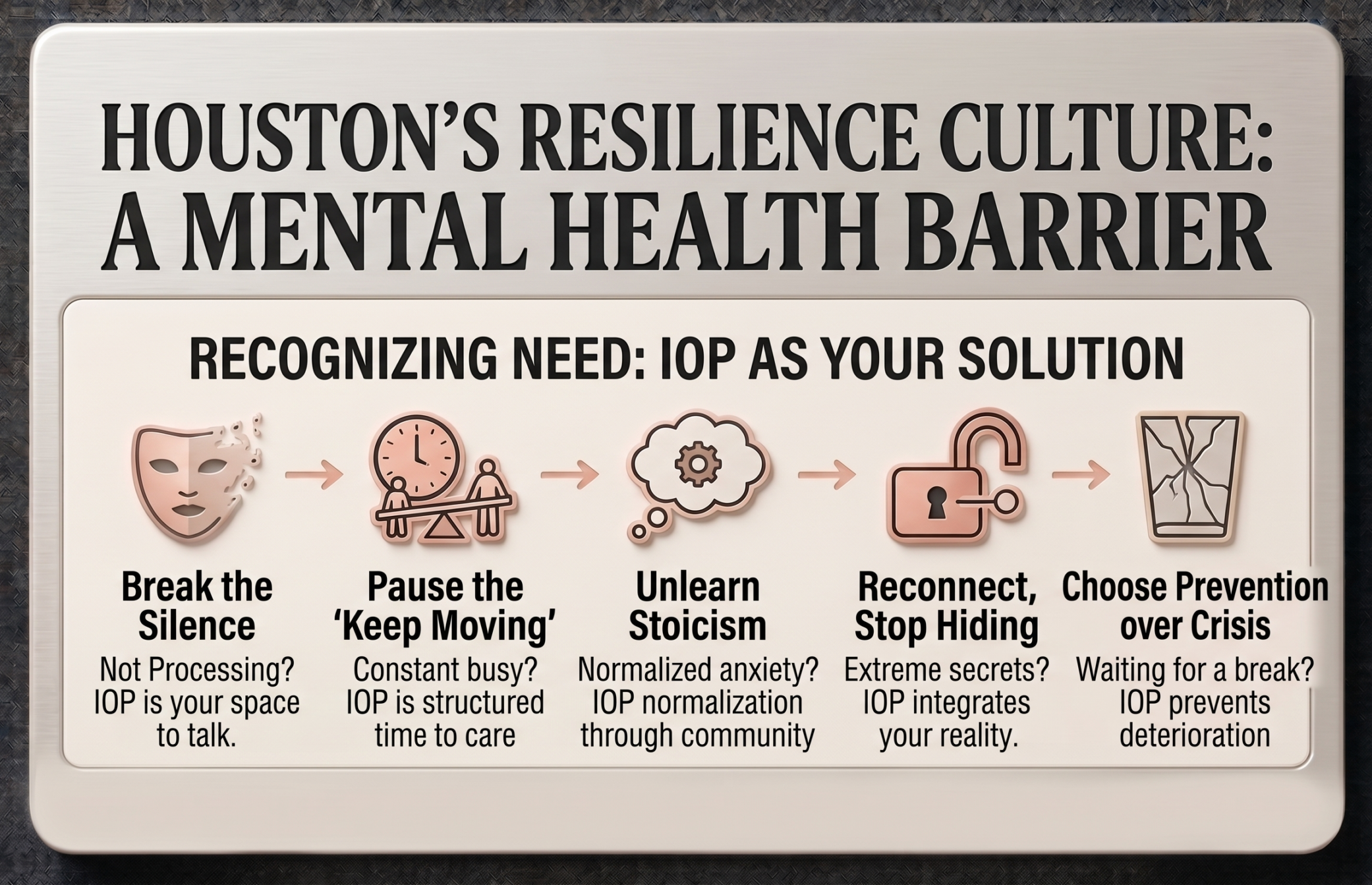
One of the underappreciated features of IOP is its group component. Houston, for all its density, is a city where people can feel remarkably isolated. The geographic sprawl makes a sustained community difficult. Cultural divisions are real. Professional cultures reward stoicism.
In an IOP setting, people sit with others navigating genuinely similar experiences. The normalization that comes from recognizing your experience isn’t unique or shameful is often a more powerful therapeutic moment than any specific technique. Group therapy at its best creates a form of community that many adults in Houston, in any large city, genuinely lack.
Houston Public Media has noted the growing recognition among younger adults in the city that mental health treatment is not a weakness but self-investment. That cultural shift creates the conditions in which IOP can actually work, where someone walks through the door not because crisis forced their hand, but because they understand that structured care is what their situation requires.
Signs That Weekly Therapy May Not Be Enough
The clinical literature is consistent about the indicators that someone has moved beyond what traditional outpatient therapy can adequately address:
- Symptoms that have been present for more than a year without significant improvement
- Mental health measurably affects occupational functioning, relationships, and physical health
- Multiple prior therapy experiences without lasting benefit
- Increasing reliance on substances or behavioral avoidance to manage symptoms
- Any history of psychiatric hospitalization, suggesting a pattern that benefits from higher-intensity care
Lucent’s piece on signs therapy is not enough expands on this in practical, accessible terms. For those stepping down from inpatient treatment, PHP vs. IOP after inpatient care addresses the level-of-care decision specifically.
The Practical Case for IOP in Houston
For someone in the Houston metro, the practical case for IOP is direct: it provides the clinical density needed to create real progress in situations where less intensive care has been inadequate without requiring hospitalization, without requiring someone to leave their career, and in a schedule that fits a working adult’s life.
For a city that has proven it can handle hard things, IOP in Houston, TX represents a structured way to do the hard work of getting better on a schedule that doesn’t require putting life on hold.
Reviewed by Chris Hudson, LPC
Founder & Executive Director – Lucent Recovery and Wellness, Austin, TX (2020–Present)
Leads clinical programs and develops innovative therapeutic approaches integrating experiential and creative therapies.
Board Member – Reklaimed, Austin, TX
Supports recovery-focused nonprofit initiatives fostering community and creative skill-building.
Clinical Leadership Roles – South Meadows Recovery, Inc.
Held leadership positions overseeing program development, clinical operations, and organizational management.
EDUCATION & CREDENTIALS
- M.A., Clinical Mental Health Counseling – Seminary of the Southwest (2021)
- B.A., Studio Art – Lewis & Clark College (2004)
- Licensed Professional Counselor (LPC), Texas
- Licensed Chemical Dependency Counselor (LCDC), Texas