Why Dallas Residents Are Traveling to Austin for Mental Health Treatment
Why Dallas Residents Are Traveling to Austin for Mental Health Treatment
Authored by the Clinical Team at Lucent Recovery and Wellness
Reviewed by Chris Hudson, MA, LPC, LCDC
Texas has a mental health problem. Not in the sense that Texans are uniquely struggling, but in the sense that when they do struggle, finding real help is harder here than almost anywhere else in the country.
Mental Health America’s 2025 State of Mental Health in America report, released in October 2025, ranked Texas among the lowest states in the nation across 17 measures of mental health prevalence and access to care. Nearly 20% of Texas adults living with a mental illness are uninsured, a rate nearly six times higher than states like Vermont. In Texas, more than four in ten people with frequent mental distress reported in 2023 that they could not afford to see a doctor.
These aren’t abstract statistics. For Dallas residents who’ve spent months waiting on a therapist’s availability, calling insurance lines, or sitting in emergency departments because there was nowhere else to go, this is lived experience.
At Lucent Recovery and Wellness, we see this reality directly. A growing number of our clients at our Austin-based Intensive Outpatient Program are making the trip from Dallas and the broader North Texas area specifically because the kind of care they need isn’t available to them locally.
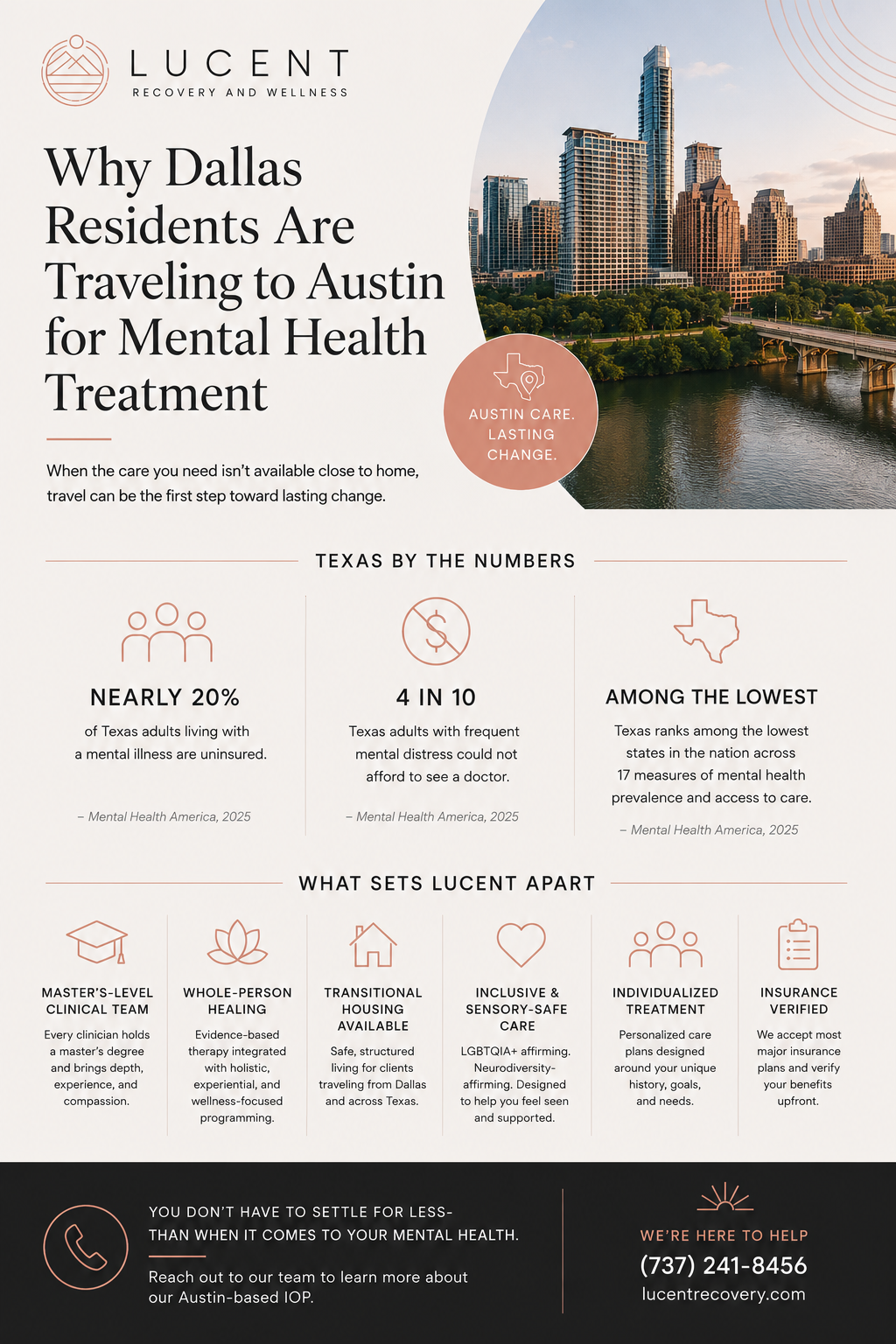
What Dallas Actually Has vs. What People Actually Need
Dallas has mental health resources. Large hospital systems offer psychiatric stabilization. Franchise outpatient chains provide group therapy on structured timelines. Employee Assistance Programs offer a few free sessions before the meter runs out. These services exist, and for people in acute crisis, they serve a critical function.
But there’s a large and underserved population of adults in Dallas who don’t fit neatly into those models. People who are functional enough that they don’t need a hospital, but struggling enough that a weekly 50-minute session isn’t moving the needle. Professionals managing anxiety and burnout alongside demanding careers. Adults with unresolved trauma that’s started showing up as relationship problems, mood instability, or substance use. Neurodiverse individuals who’ve never had treatment designed with their specific needs in mind.
For these people, the middle ground is often where the gap lives. Intensive Outpatient Programs that can meet that need do exist in the DFW area. But the availability of truly personalized, clinician-led care within a boutique model is limited.
The Case for Leaving Town to Get Better
There’s something to be said for geographic distance in mental health treatment. A growing body of clinical observation and patient-reported experience suggests that stepping away from familiar environments, especially when those environments are tied to stress, triggers, or unhealthy patterns, can support deeper therapeutic work.
When a Dallas professional comes to Austin for four to twelve weeks of intensive outpatient care, they’re not running away from their life. They’re creating intentional space to focus on it.
Our clients who travel from Dallas often describe the experience as clarifying. Without the daily pulls of their usual routines, they can actually show up to therapy. They can do the homework. They can sleep. They can participate in the holistic parts of our program, including outdoor experiences, fitness, and mindfulness, that genuinely support what’s happening in clinical sessions.
For those who need a place to stay during treatment, our transitional housing in Austin provides a structured, supportive environment that makes the whole experience sustainable.
What Master’s-Level Care Actually Means
One of the questions we hear most often from Dallas clients is some version of: “Why does it feel like I’ve been in therapy for years and nothing has actually changed?”
The answer is often about fit and depth. Not all therapy is equal, and not all clinicians are trained the same way. At Lucent, every member of our clinical team holds a master’s degree in a mental health discipline. This isn’t a checkbox. It’s a standard we hold because the clients we serve, many of whom have tried multiple therapists and multiple approaches before finding us, deserve clinicians who bring both clinical depth and genuine investment to each therapeutic relationship.
We use evidence-based modalities including Cognitive Behavioral Therapy, Dialectical Behavior Therapy, Internal Family Systems, and trauma-focused approaches adapted to each person’s history and needs. We pair those clinical frameworks with holistic and experiential programming, because we know that lasting recovery involves the whole person, not just their diagnosis.
We’re also LGBTQIA+ affirming and sensory-safe, which matters enormously for clients who’ve felt unseen or misunderstood in more conventional treatment settings.
The Insurance Piece
We won’t pretend the financial piece is simple. Texas’s high uninsured rate is a real barrier for many people, and we acknowledge that. Lucent accepts most major insurance plans, and our admissions team will work directly with you to verify coverage before you commit to anything.
For those who are insured, the gap between needing care and affording care is often smaller than people expect. Reaching out for a consultation costs nothing, and we’d rather spend time walking you through the options than have you delay care because you assumed it was out of reach.
The Bigger Picture
Texas doesn’t have to be ranked near the bottom in mental health access forever. But changing that ranking requires more than policy, it requires Texans to know what options exist, and to believe they’re worth pursuing.
For Dallas residents ready to invest in their mental health in a serious way, the answer might be closer than you think, just a few hours down I-35.
Reach out to our team at Lucent Recovery to learn more about our Dallas IOP program and find out if we’re the right fit for you.
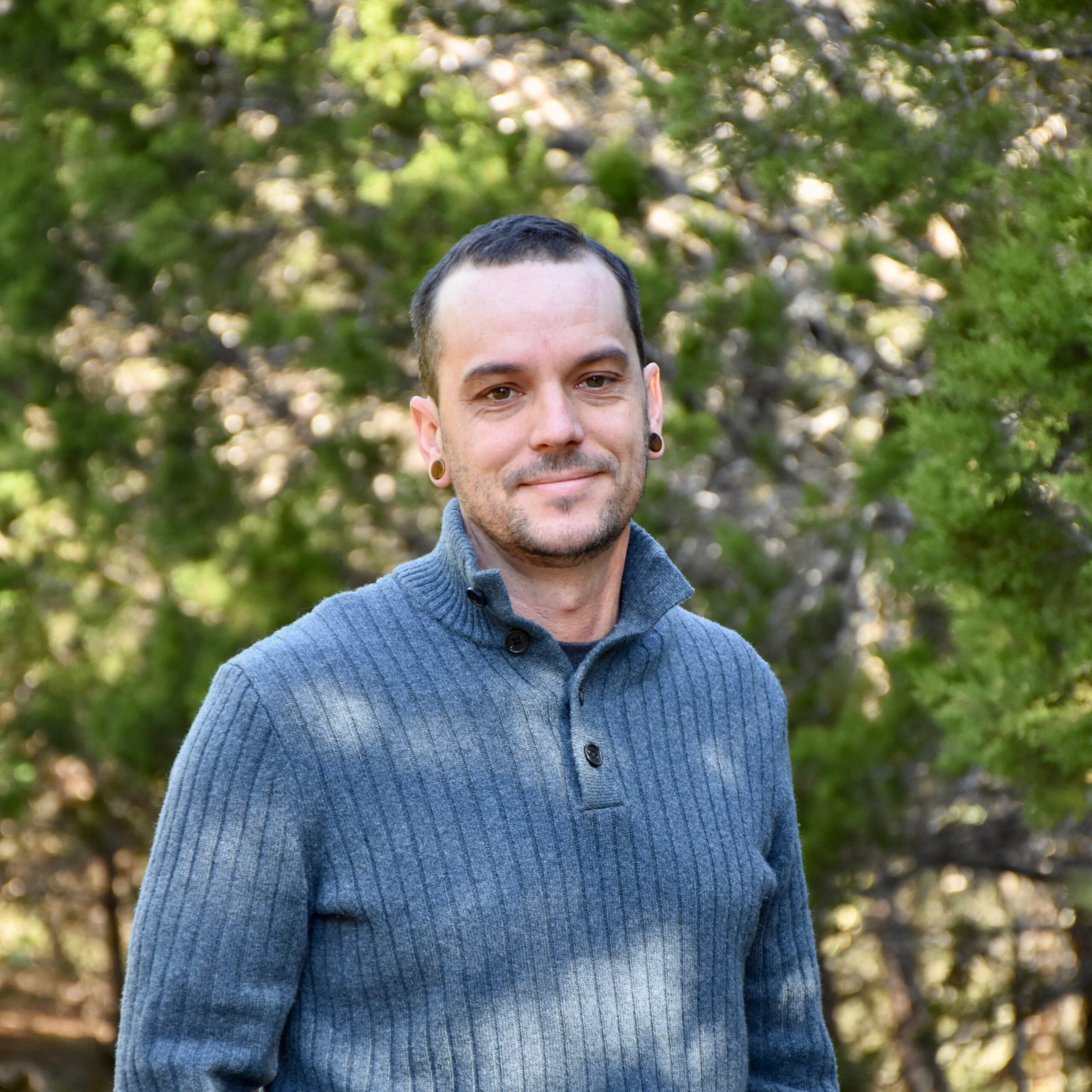
Reviewed by Chris Hudson, LPC
Founder & Executive Director – Lucent Recovery and Wellness, Austin, TX (2020–Present)
Leads clinical programs and develops innovative therapeutic approaches integrating experiential and creative therapies.
Board Member – Reklaimed, Austin, TX
Supports recovery-focused nonprofit initiatives fostering community and creative skill-building.
Clinical Leadership Roles – South Meadows Recovery, Inc.
Held leadership positions overseeing program development, clinical operations, and organizational management.
EDUCATION & CREDENTIALS
- M.A., Clinical Mental Health Counseling – Seminary of the Southwest (2021)
- B.A., Studio Art – Lewis & Clark College (2004)
- Licensed Professional Counselor (LPC), Texas
- Licensed Chemical Dependency Counselor (LCDC), Texas