What to Actually Look for in a Mental Health IOP (A Guide for Dallas Adults)
What to Actually Look for in a Mental Health IOP (A Guide for Dallas Adults)
Authored by the Clinical Team at Lucent Recovery and Wellness
Reviewed by Chris Hudson, MA, LPC, LCDC
Searching for an Intensive Outpatient Program when you’re already struggling is one of the harder things a person can be asked to do. You’re not at your best, you probably don’t know exactly what you’re looking for, and the internet returns a wall of options that all sound nearly identical.
If you’re in Dallas or the DFW area and trying to find the right level of care, this is meant to help. We’re going to walk through what actually matters when evaluating an IOP, and what questions to ask before you commit to any program, including ours.
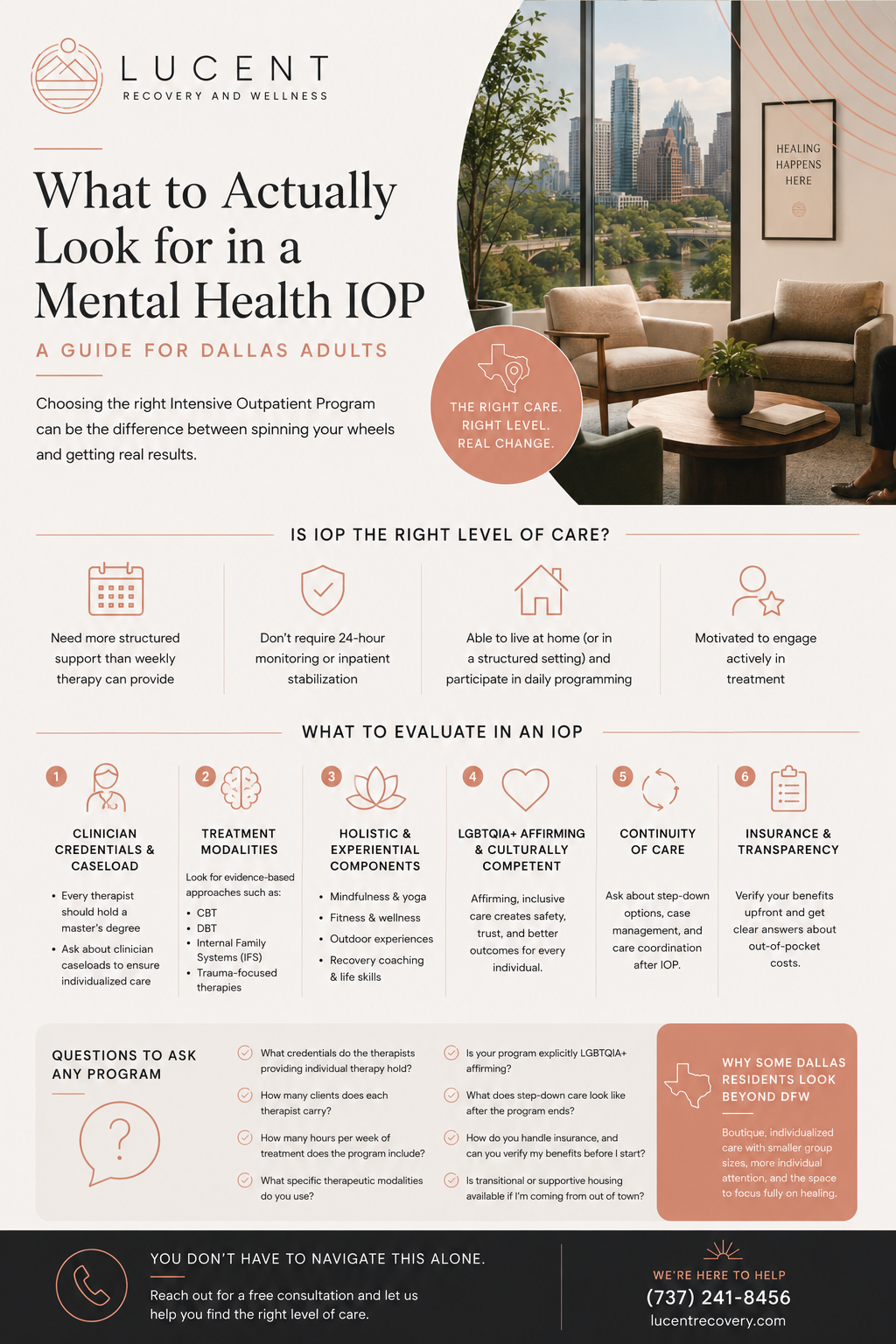
First: Is IOP the Right Level of Care?
This is worth getting clear on before anything else. An Intensive Outpatient Program is designed for adults who:
- Need more structured support than weekly individual therapy can provide
- Don’t require 24-hour monitoring or inpatient stabilization
- Are able to live at home (or in a structured housing setting) and participate in daily programming
- Are motivated to engage actively in treatment
If you’re in crisis or in immediate danger to yourself or others, an inpatient program or emergency evaluation is the appropriate first step. If you’re managing a mental health condition that’s meaningfully affecting your quality of life, your relationships, or your ability to function, and you’ve been working with a therapist without enough traction, IOP is often exactly the right fit.
What to Actually Evaluate
1. Clinician Credentials and Caseload
Not all IOP programs are staffed the same way. Ask specifically: who will be providing my individual therapy? What are their credentials? How many clients does each clinician carry?
The credential piece matters more than marketing language. A program that says it’s “clinician-led” may have one master’s-level therapist supervising a team of bachelor’s-level staff. At Lucent, every therapist holds a master’s degree in a mental health discipline, and individual therapy relationships are central to the program, not supplemental.
Caseload matters too. If a clinician is managing 40 clients, the individualization they can offer is limited by simple math.
2. Treatment Modalities
What therapeutic approaches does the program actually use? Look for specific named modalities, not just general language like “evidence-based treatment.”
Evidence-based approaches commonly used in effective mental health IOP programs include:
- Cognitive Behavioral Therapy (CBT): Restructures unhelpful thought patterns that drive anxiety, depression, and avoidance
- Dialectical Behavior Therapy (DBT): Builds emotional regulation, distress tolerance, and interpersonal skills
- Trauma-focused therapies: Including EMDR, somatic approaches, and Internal Family Systems (IFS)
- Mindfulness-based approaches: Support nervous system regulation and self-awareness
According to SAMHSA’s Treatment Improvement Protocols, group therapy within an IOP framework is most effective when it’s delivered alongside individual therapy, not as a substitute for it. If a program you’re evaluating is primarily group sessions with minimal individual time, ask how that decision is made and how your specific needs are addressed.
At our IOP serving Dallas residents, we use CBT, DBT, IFS, and trauma-focused techniques, matched to each client’s clinical presentation. We also offer individual counseling as part of the program.
3. Holistic and Experiential Components
The most effective programs don’t treat the mind in isolation. Recovery involves the body, the nervous system, and the way a person engages with the world around them.
Ask programs what they offer beyond group and individual therapy. Do they include yoga or mindfulness practice? What about physical fitness or outdoor programming? Is there coaching for daily life skills, employment, or executive functioning?
At Lucent, we include health and fitness programming, outdoor experiential activities including mountain biking, and individualized recovery coaching as part of our standard IOP experience. These aren’t add-ons. They’re integral to the kind of whole-person healing we’re trying to support.
4. LGBTQIA+ Affirmation and Cultural Competence
Mental health treatment is only effective if you feel safe enough to be honest. For LGBTQIA+ clients, that often requires finding a program where affirmation is explicit and practiced, not just implied.
Ask directly: is this program explicitly LGBTQIA+ affirming? Is the clinical staff trained in identity-affirming care? Are group sessions sensitive to the specific experiences of queer, trans, and gender-diverse clients?
We’re proud that Lucent is a genuinely affirming space, and we designed our environment and our clinical culture to reflect that.
5. Continuity of Care
What happens when the program ends? This is a question too few people ask during the evaluation process, and it often determines whether treatment gains hold.
A strong IOP should offer a clear step-down plan, whether that’s a move to a Partial Hospitalization Program for clients who need more support before stepping down, or transition into individual therapy, coaching, and community connection for those who are ready.
At Lucent, we think about the full continuum from the beginning. Case management and care coordination are part of what we provide, and clients who complete IOP with us don’t just graduate into a void.
6. Insurance and Financial Transparency
Get specific before you start. Ask the program to verify your insurance benefits directly with your provider, and ask them to explain your expected out-of-pocket costs in plain language before your first session.
Lucent accepts most major insurance plans, and our team handles the insurance verification process with you. We want you to have complete clarity on the financial picture so it doesn’t become a source of anxiety during treatment.
Questions to Ask Any Program
Here’s a short list you can bring to any IOP evaluation call:
- What credentials do the therapists providing individual therapy hold?
- How many clients does each therapist carry?
- How many hours per week of treatment does the program include?
- What specific therapeutic modalities do you use?
- Is your program explicitly LGBTQIA+ affirming?
- What does step-down care look like after the program ends?
- How do you handle insurance, and can you verify my benefits before I start?
- Is transitional or supportive housing available if I’m coming from out of the area?
Why Some Dallas Residents Look Beyond DFW
Dallas has IOP options. What it sometimes lacks is the boutique, individualized care that certain adults specifically need. Large hospital-based programs and multi-site franchise networks are built for volume. They do good work, but their model has real constraints around personalization.
Some of our clients from Dallas have tried programs closer to home and found that the group sizes were too large, the individual therapy time was too limited, or the clinical focus didn’t match their actual needs. Others simply wanted the experience of stepping away from their environment for a period and entering treatment with full attention and intention.
Whatever brings someone from Dallas to our Austin program, we’re glad they found us. And we’re glad to help anyone in the evaluation process figure out whether we’re the right fit.
Contact us for a free consultation, or learn more about what clients can expect when they join our program.
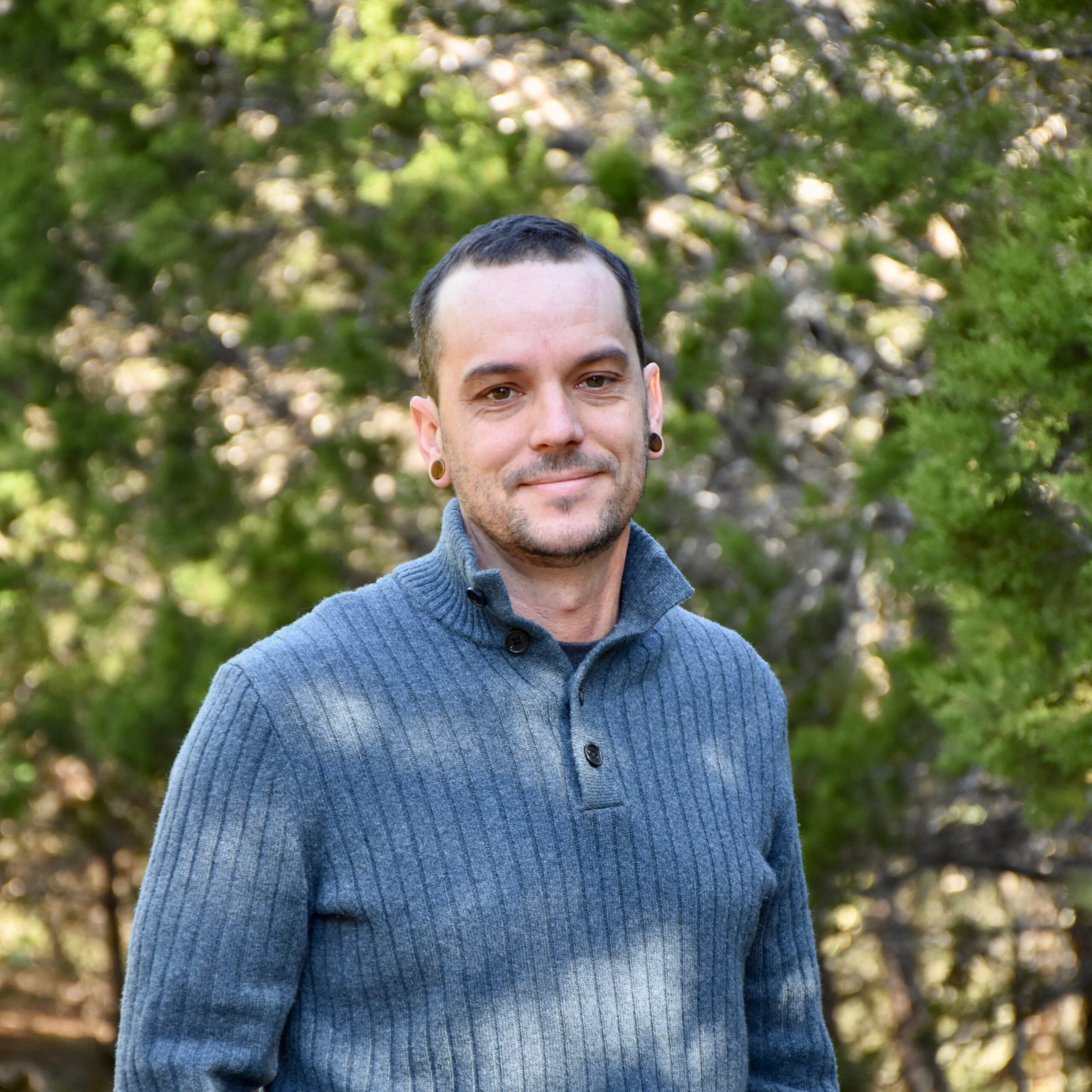
Reviewed by Chris Hudson, LPC
Founder & Executive Director – Lucent Recovery and Wellness, Austin, TX (2020–Present)
Leads clinical programs and develops innovative therapeutic approaches integrating experiential and creative therapies.
Board Member – Reklaimed, Austin, TX
Supports recovery-focused nonprofit initiatives fostering community and creative skill-building.
Clinical Leadership Roles – South Meadows Recovery, Inc.
Held leadership positions overseeing program development, clinical operations, and organizational management.
EDUCATION & CREDENTIALS
- M.A., Clinical Mental Health Counseling – Seminary of the Southwest (2021)
- B.A., Studio Art – Lewis & Clark College (2004)
- Licensed Professional Counselor (LPC), Texas
- Licensed Chemical Dependency Counselor (LCDC), Texas