High-Functioning Anxiety and Depression Are Real. Dallas Professionals Deserve Real Treatment.
High-Functioning Anxiety and Depression Are Real. Dallas Professionals Deserve Real Treatment
Authored by the Clinical Team at Lucent Recovery and Wellness
Reviewed by Chris Hudson, MA, LPC, LCDC
There’s a particular kind of suffering that doesn’t look like suffering from the outside. The person experiencing it wakes up, goes to work, performs, meets their deadlines, shows up for their family. They might even be well-regarded as especially driven or capable. But underneath the surface, something is wrong in a way that’s getting harder to ignore.
High-functioning anxiety and high-functioning depression are not clinical diagnoses in the formal sense. They’re descriptive terms for a presentation that mental health clinicians see regularly: individuals who meet the criteria for an anxiety disorder or depressive disorder, but whose functioning hasn’t collapsed enough yet to make the problem visible to the people around them, or sometimes even to themselves.
In a city like Dallas, where professional culture rewards performance and stoicism, this presentation is especially common. And the treatment gap for this population is significant.
What High-Functioning Actually Looks Like
The National Institute of Mental Health reports that approximately 21% of U.S. adults experienced any mental illness in the past year, and only about half of those individuals received treatment. The gap is even more pronounced among high-functioning adults, who often have the resources to access care but the most difficulty believing they actually need it.
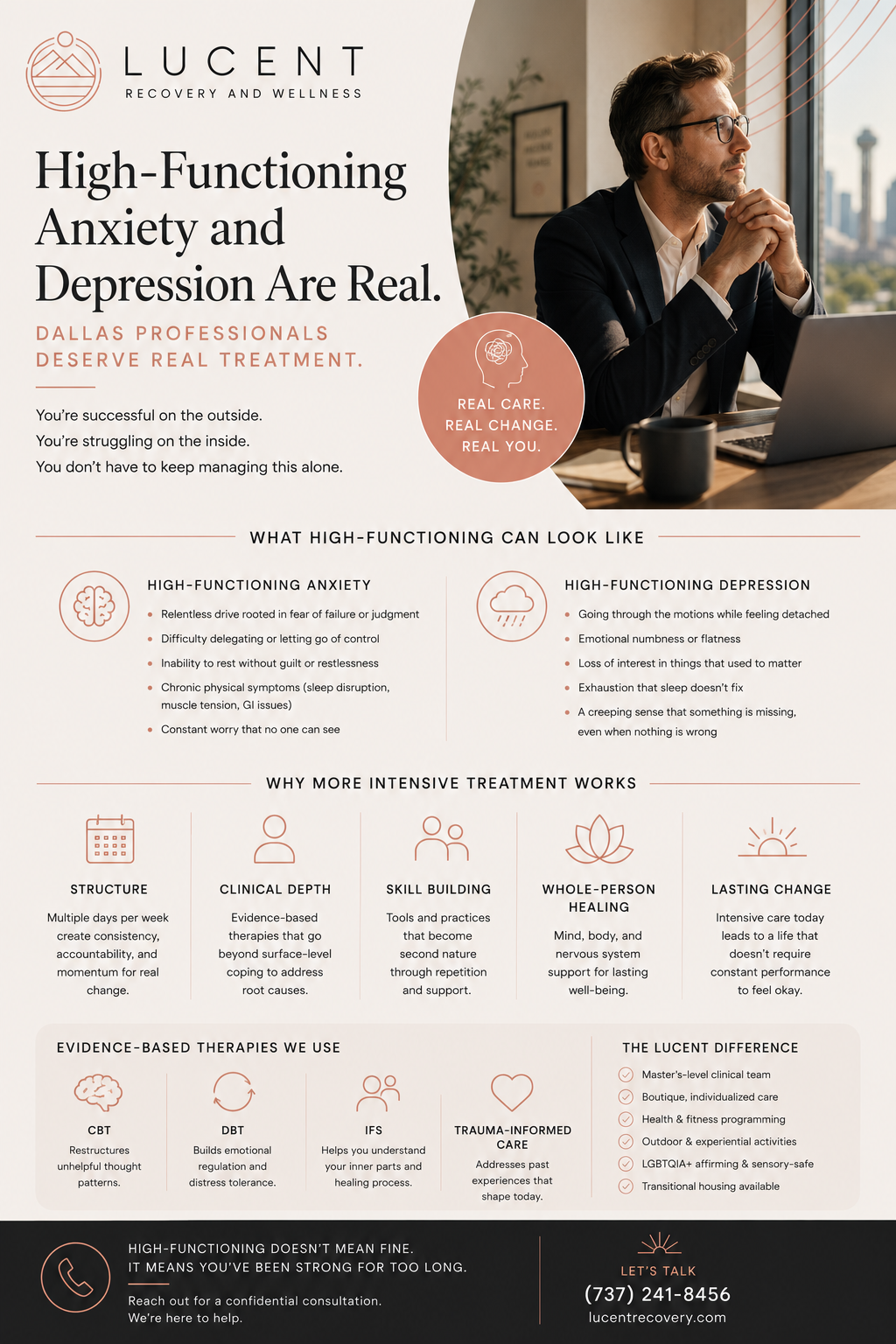
High-functioning anxiety might look like:
- A relentless drive to achieve that’s actually rooted in fear of failure or judgment
- Difficulty delegating or letting go of control
- An inability to rest without guilt or restlessness
- Chronic physical symptoms including sleep disruption, muscle tension, or GI issues
- An inner experience of near-constant worry that nobody around you can see
High-functioning depression can look like:
- Going through the motions of a successful life while feeling strangely detached from it
- Emotional numbness or flatness that shows up as being “fine” in public but hollow in private
- Loss of genuine interest or pleasure in things that used to matter
- Exhaustion that sleep doesn’t fix
- A creeping sense that something is missing, even when nothing on paper is wrong
SAMHSA’s 2024 National Survey on Drug Use and Health, published in September 2025, found that adults with any mental illness continue to face significant barriers to treatment, including not recognizing the need for care, cost concerns, and stigma. For high-functioning adults, that first barrier, not recognizing the need, is often the biggest.
Why the Standard Response Falls Short
Many high-functioning professionals in Dallas who do seek help start with individual therapy once a week. That’s a reasonable first step, and for some people, it’s enough.
But for others, weekly therapy doesn’t create enough structure or intensity to actually move the needle. Life fills in around the session. The insights gained on Tuesday get crowded out by Wednesday. The skills being built don’t have enough repetition to become second nature. And the person comes back the following week feeling like they’ve made no progress.
This is often the point at which someone becomes a candidate for a more intensive level of care, specifically an Intensive Outpatient Program.
An IOP isn’t a step down from “real life.” It’s a structured, multi-day-per-week treatment program that provides the clinical intensity needed to create genuine and lasting change, while still allowing you to maintain your professional and personal responsibilities. You’re not disappearing from your life. You’re taking it seriously enough to give your mental health the attention it actually requires.
At Lucent Recovery and Wellness, our Mental Health IOP serving Dallas adults was built with this population in mind. We work with professionals, executives, entrepreneurs, and high-achievers who know something is wrong and are ready to actually do something about it.
What Treatment Looks Like at This Level
For high-functioning adults with anxiety or depression, effective treatment typically involves several interconnected components.
Cognitive Behavioral Therapy (CBT) helps identify the thought patterns and behavioral loops that sustain anxiety and depression. For high-functioning individuals, these patterns are often sophisticated and deeply ingrained. The perfectionism that drives achievement is often the same pattern driving the anxiety. CBT creates the space to examine those patterns honestly.
Dialectical Behavior Therapy (DBT) builds practical skills for emotional regulation and distress tolerance. For high-functioning adults who’ve spent years managing distress by pushing through it, learning to actually feel and regulate emotions is often genuinely new.
Internal Family Systems (IFS) offers a framework for understanding the internal experience behind the high-functioning presentation, including the “parts” that drive productivity, manage appearances, and protect against vulnerability. Many of our clients find IFS specifically clarifying.
Trauma-informed approaches matter even when the presenting concern isn’t explicitly trauma. Many high-functioning anxiety and depression presentations have roots in earlier experiences that shaped the person’s relationship with performance, safety, and approval.
At Lucent, we also integrate individual coaching, health and fitness programming, and experiential activities that support the clinical work happening in individual and group therapy. Recovery for this population isn’t just about symptom reduction. It’s about building a life that doesn’t require constant performance to feel okay.
Discretion, Quality, and What High-Functioning Professionals Actually Need
One of the things we hear from Dallas clients who’ve sought care elsewhere is that they felt like a small part of a large system. Group sessions with 15 people. Individual therapy every other week. Clinical staff who were clearly managing large caseloads and didn’t have the bandwidth to know them well.
This matters. A treatment environment where you feel truly known and where the care is genuinely individualized produces better outcomes than one where you’re moving through a standardized protocol.
We’re a clinician-owned, boutique program. Our clinical team is master’s-level. Our case management and care coordination are part of the program, not afterthoughts. And for Dallas clients who want to be fully immersed in treatment without the logistical burden of commuting, our transitional housing in Austin makes that possible.
We also take privacy seriously. Many of the professionals and executives who come through our program have careers or reputations they’re thoughtful about protecting. We understand that, and our care is designed accordingly.
The Question Worth Asking
If you’re a Dallas professional who has quietly wondered whether what you’re experiencing is serious enough to warrant real treatment, here’s the honest answer: if it’s affecting your quality of life, your relationships, or your ability to experience genuine joy or connection, it’s serious enough.
High-functioning doesn’t mean fine. It means you’ve learned to keep going even when you shouldn’t have to.
You don’t have to keep managing this on your own. There’s a level of care designed for exactly where you are, and we’d welcome the chance to talk about whether it’s right for you.
Contact Lucent Recovery for a confidential consultation. You can also learn more about what families can expect when a loved one enters our program.

Reviewed by Chris Hudson, LPC
Founder & Executive Director – Lucent Recovery and Wellness, Austin, TX (2020–Present)
Leads clinical programs and develops innovative therapeutic approaches integrating experiential and creative therapies.
Board Member – Reklaimed, Austin, TX
Supports recovery-focused nonprofit initiatives fostering community and creative skill-building.
Clinical Leadership Roles – South Meadows Recovery, Inc.
Held leadership positions overseeing program development, clinical operations, and organizational management.
EDUCATION & CREDENTIALS
- M.A., Clinical Mental Health Counseling – Seminary of the Southwest (2021)
- B.A., Studio Art – Lewis & Clark College (2004)
- Licensed Professional Counselor (LPC), Texas
- Licensed Chemical Dependency Counselor (LCDC), Texas