Military City, Mental Health Gaps: What San Antonio’s Toughest Residents Aren’t Getting
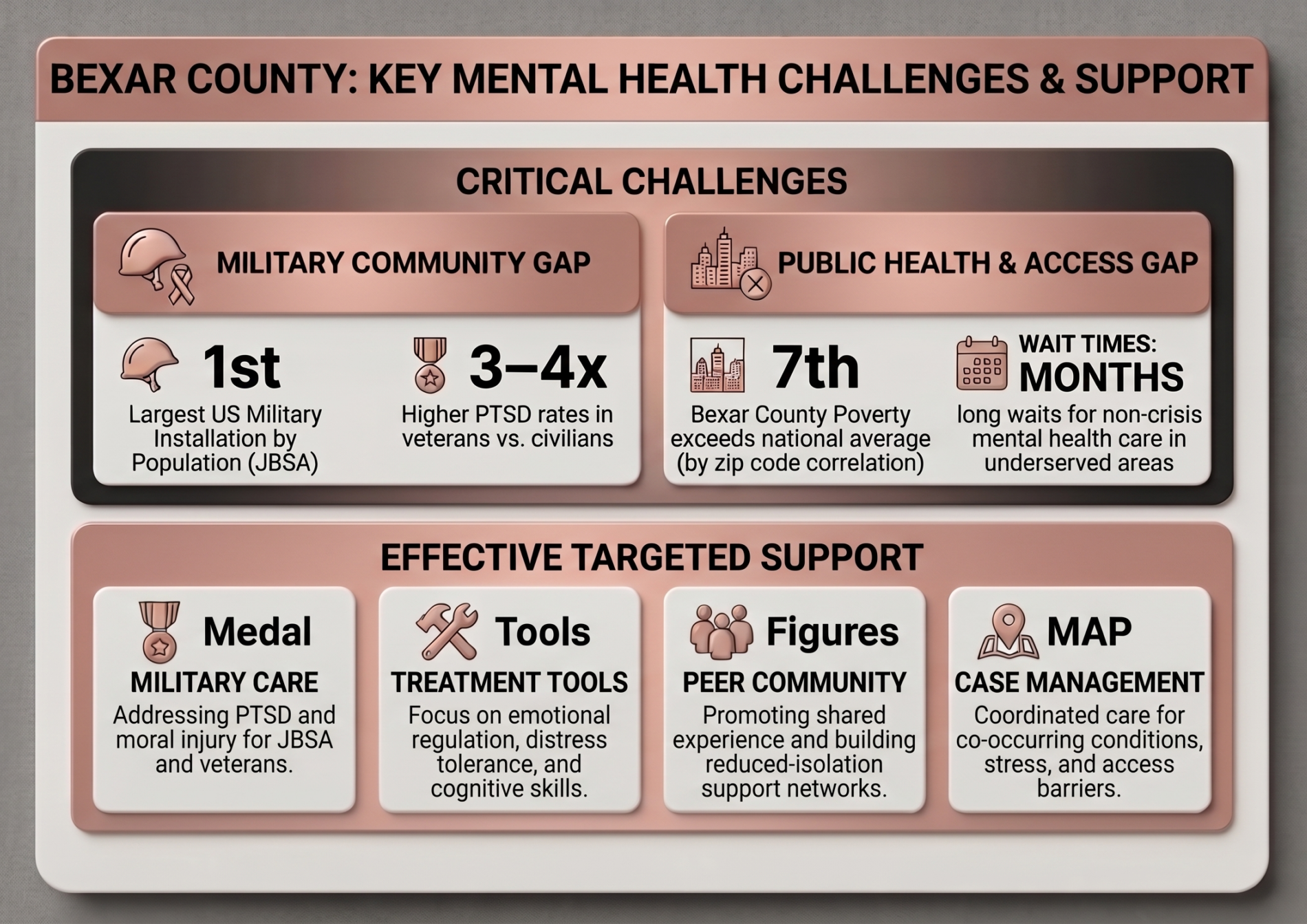
San Antonio carries a title it wears with real pride: Military City, USA. Joint Base San Antonio is the largest military installation in the country by population. Hundreds of thousands of active-duty personnel, veterans, and military family members call Bexar County home. That military identity runs deep in the culture, in the work ethic, the sense of service, and the way the city understands strength.
It also runs deep in the mental health gap. For all that San Antonio does right by its military and veteran population, the mental health system has never fully kept pace with the specific, complex, and often hidden needs of a city where resilience is an identity before it’s a coping strategy.
The growth of IOP in San Antonio, TX, is, in part, a direct response to that gap.
The Military Mental Health Reality in San Antonio
The research on military mental health is well-established. Veterans experience PTSD at rates significantly higher than the civilian population. Active-duty service members face specific stressors, deployment cycles, high-threat environments, hierarchical cultures that discourage help-seeking, and that create predictable mental health vulnerabilities. Military spouses and children carry their own distinct challenges: repeated relocation, extended parental absence, financial instability, and the chronic anxiety of a loved one being in danger.
The San Antonio Express-News has covered the mental health burden on the local military and veteran community in depth, including the gap between VA service capacity and actual demand. VA mental health services in San Antonio have improved in recent years, but access remains imperfect, particularly for veterans who don’t qualify for full VA benefits, or who prefer civilian treatment settings for reasons of privacy, continuity, or clinical speciality.
That gap creates a specific and real need. IOP in San Antonio, TX, that understands military culture, takes trauma seriously, engages with moral injury, and doesn’t require someone to minimize their service experience, serves a population with legitimate, complex needs and limited civilian options.
Beyond the Military: San Antonio’s Broader Mental Health Landscape
San Antonio’s mental health challenges extend well beyond its military population. Bexar County has one of the highest poverty rates among major Texas counties. Economic stress is a primary driver of anxiety, depression, and trauma and Bexar County’s working-poor and working-class population carries a disproportionate share of both the stress and the access barriers.
The San Antonio Report has documented the ongoing shortage of mental health providers in underserved San Antonio neighborhoods, where residents can face months-long waits for basic outpatient services. The combination of high need and restricted access is, clinically, a formula for conditions that worsen over time until they reach crisis.
San Antonio’s proximity to the US-Mexico border adds another dimension. Immigration-related stress, family separation, and the psychological weight of navigating uncertain legal status affect significant numbers of Bexar County residents. These are not challenges that weekly therapy alone can adequately address.
What IOP Provides That the San Antonio System Struggles to Offer
Bexar County’s public mental health infrastructure, anchored by the Center for Health Care Services, provides critical but chronically overburdened services. KSAT has reported on ongoing capacity challenges in the county’s behavioral health system, including extended wait times for non-crisis care.
In that context, IOP in San Antonio, TX, offers something specific: a structured middle level of care that goes well beyond what a weekly therapy appointment provides, without requiring the disruption of inpatient or residential treatment.
For active-duty personnel navigating the complexity of seeking care outside the military system. For veterans who’ve cycled through VA services without finding the right fit. For military spouses who’ve been managing their own mental health quietly for years. For Bexar County residents who’ve reached a point where the weight of accumulated stress requires more than episodic therapy, IOP provides a coherent, structured option.
The Cultural Dimension of Help-Seeking in San Antonio
San Antonio’s culture, shaped by deep Catholic traditions, strong family loyalty, and military pride, creates a specific relationship with vulnerability. Strength is a core value. Needing help can feel, to many, like personal failure.
This dynamic shows up in delayed treatment-seeking across the board. It’s not unique to San Antonio; it’s a feature of communities with strong collective identity. But it’s worth naming because it shapes who gets to IOP and when.
The IOP model itself reframes this: it’s not pathology-focused therapy. It’s a structured, skills-based program that builds concrete capacity for emotional regulation, communication skills, distress tolerance, and stress management. For someone who would struggle with the idea of “going to therapy,” framing IOP as a place where you develop tools changes the conversation.
Lucent’s piece on the importance of mental health services and who fits an IOP program addresses this reframe directly.
The IOP–San Antonio Alignment
Several characteristics of IOP align particularly well with the San Antonio context:
- Structured scheduling allows people to maintain employment and family responsibilities
- Group components create community in a city where a strong community is a genuine cultural value
- Evidence-based modalities, trauma-informed CBT, DBT, and EMDR, directly address the trauma profiles common in military and economically strained populations
- The step-down model aligns with the clinical reality that many San Antonio residents reach IOP after a crisis rather than before one
For a city defined by service and sacrifice, IOP in San Antonio, TX, represents support that honors the identity of the people it serves, structured, purposeful, and built to produce real results.
Reviewed by Chris Hudson, LPC
Founder & Executive Director – Lucent Recovery and Wellness, Austin, TX (2020–Present)
Leads clinical programs and develops innovative therapeutic approaches integrating experiential and creative therapies.
Board Member – Reklaimed, Austin, TX
Supports recovery-focused nonprofit initiatives fostering community and creative skill-building.
Clinical Leadership Roles – South Meadows Recovery, Inc.
Held leadership positions overseeing program development, clinical operations, and organizational management.
EDUCATION & CREDENTIALS
- M.A., Clinical Mental Health Counseling – Seminary of the Southwest (2021)
- B.A., Studio Art – Lewis & Clark College (2004)
- Licensed Professional Counselor (LPC), Texas
- Licensed Chemical Dependency Counselor (LCDC), Texas