The First 24 Hours of IOP: A Step-by-Step Timeline of Your Recovery Journey
Transitioning into an Intensive Outpatient Program (IOP) marks a significant shift in your recovery. For many, it is the first time they are balancing high-level clinical support with the responsibilities of daily life, such as work, school, or family. While residential care or a Partial Hospitalization Program provides a fully controlled environment, IOP is about integration. It is the bridge that leads you back to a full, independent life while keeping your safety net intact.
Because IOP is less time-intensive than other programs, the first 24 hours are less about settling in and more about strategic application. We ensure your first day provides the specific tools you need to remain stable while you are away from the facility. Here is what your first 24 hours will look like in our Austin program.
Understanding the IOP Philosophy: Why the First Day is Different
IOP is designed for the individual who has achieved a level of stability but still requires the structure of a clinical team. The primary goal of the first 24 hours is to establish a routine that protects your recovery during the hours you are not at the clinic. This is often the most vulnerable time for someone in early sobriety. By the end of your first day, the goal is to feel empowered rather than overwhelmed by your new schedule.
Many people arrive at their first day wondering if they can truly handle the freedom that comes with outpatient care. The first day is specifically structured to answer that question with a resounding yes. It is a period of intense observation, planning, and peer connection that sets the foundation for everything that comes after.
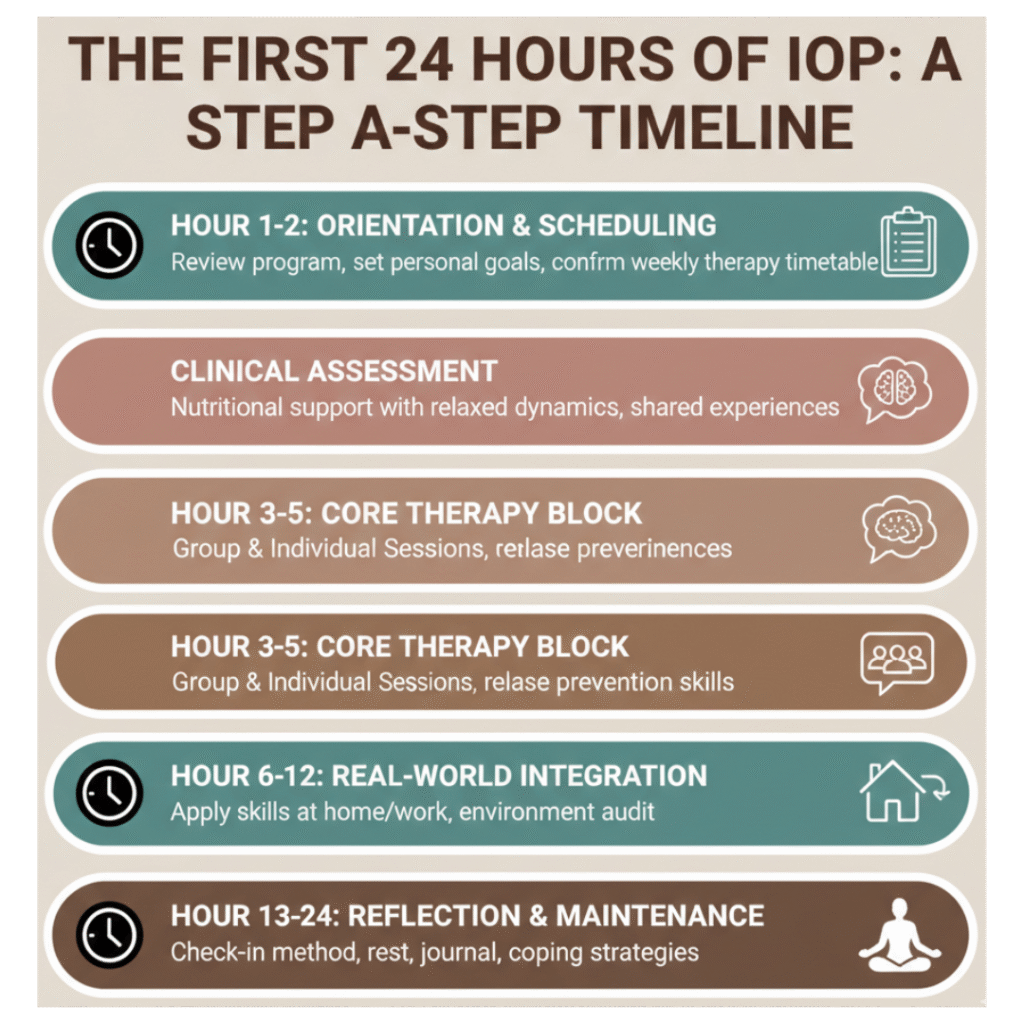
Hour 1 to Hour 2: The Focused Orientation and Goal Setting
Your first day of IOP usually begins with a structured orientation. Unlike the long intake process of a residential program, this session is fast-paced and focused on logistics. You will head straight into a meeting with an admissions coordinator or a case manager to finalize your treatment agreement.
During this hour, we review your specific schedule. Because IOP is flexible, we confirm which days and times you will be on-site. We also discuss your support map. This includes identifying the people in your life who are currently helping your recovery and those who might be a risk. You will meet your primary IOP counselor, who will be your point of contact as you navigate the challenges of being out in the world more frequently.
This orientation also covers the ground rules of the community. You will learn about our expectations for attendance, the importance of a drug-free environment, and how we handle emergencies after hours. This hour is meant to provide a sense of security. You are not just being released back into your life; you are being given a blueprint for how to live it successfully.

Hour 3 to Hour 5: The Core Therapy Block and Peer Connection
In IOP, the therapy blocks are concentrated and purposeful. You will immediately join a group session. These sessions are highly interactive and focus heavily on relapse prevention and social skill building.
Groups in IOP are designed for real-time problem solving. You will discuss the stressors you faced that morning before you arrived. You will receive feedback from peers who are also navigating the balance of recovery and daily responsibility. This block is intense because it is meant to give you a boost of support that carries you through the next several days. This is where you realize that your struggle with work-life balance or family dynamics is shared by others.
Peer connection is the heartbeat of the IOP experience. In a residential setting, you are surrounded by people 24 hours a day. In IOP, the few hours you spend together each day must be high-impact. You will learn how to listen, how to offer support, and how to ask for help when you feel a craving or a trigger starting to build. This sense of community is what prevents the isolation that often leads to setbacks.

Hour 6 to Hour 12: The Real-World Application Phase
Once your session ends, your time at the facility is over for the day, but your first 24 hours continue. This is the most critical part of an Intensive Outpatient Program.
As you drive home or head to your place of work, you will likely feel a mix of relief and vulnerability. This is the application phase. You are now tasked with taking the boundary-setting skills or breathing techniques you just learned and applying them to your environment immediately.
Your first evening at home after starting IOP is about environment auditing. You will look at your surroundings through the lens of your new recovery goals. You might realize that certain rooms or habits are triggers. This phase of the first 24 hours is about making small, physical adjustments to ensure your home remains a sanctuary. We encourage clients to use this time to set up a dedicated quiet space for reflection or meditation. This helps create a mental boundary between the stress of the day and the safety of your recovery journey.
Hour 13 to Hour 24: Reflection and Recovery Maintenance
The final half of your first day in IOP happens during your normal routine. Whether you are waking up for work the next morning or taking care of family, the goal is consistent awareness.
You will practice using the check-in method we taught you during your first session. This involves pausing three times throughout the day to assess your stress levels. Are you hungry, angry, lonely, or tired? By the time you reach the 24-hour mark, you have successfully integrated a high level of clinical care into your normal life. You have proven that you can be in the world without being of the world in a way that compromises your sobriety or mental health.
This period is also about physical recovery. Many people find that they need extra sleep during the first few days of IOP as their brain adjusts to the new social and emotional demands. Honoring your body’s need for rest is a key part of the maintenance phase. By the time you return for your second day, you will have a list of real-world experiences to discuss with your therapist.
Tips for a Successful First 24 Hours in IOP
To get the most out of your first day, we recommend a few specific strategies:
-
Clear Your Calendar: If possible, do not schedule high-stress meetings or difficult family conversations on your very first day of IOP. Give your brain space to process the therapy sessions.
-
Be Honest in Group: The faster you are honest about your current cravings or fears, the faster the group can help you build a defense against them.
-
Keep Your Journal Close: The transition from the clinic to home often brings up fleeting thoughts that are important to discuss in your next session. Write them down as they happen.
-
Hydrate and Nourish: Mental work is physical work. Ensure you are eating regular, balanced meals during your first 24 hours to keep your mood stable and your energy high.
Why the First 24 Hours Matter for Long-Term Success
The first day sets the tone for your entire journey. It is the proof of concept for your recovery. It shows you that you do not need to be in a locked facility to stay healthy. You have the power to make good choices while living your life. This realization is the most powerful tool you will gain during your time in an Intensive Outpatient Program.
Our team understands the unique stressors that come with living in a fast-paced environment. We do not just give you a seat in a room; we give you a roadmap for your life. If you are ready to see how an IOP can fit into your busy life, we are here to help you navigate the first 24 hours and every day that follows.
Reviewed by Chris Hudson, LPC, LCDC
Reviewed by Chris Hudson, LPC, LCDC
Founder & Executive Director – Lucent Recovery and Wellness, Austin, TX (2020–Present)
Leads clinical programs and develops innovative therapeutic approaches integrating experiential and creative therapies.
Board Member – Reklaimed, Austin, TX
Supports recovery-focused nonprofit initiatives fostering community and creative skill-building.
Clinical Leadership Roles – South Meadows Recovery, Inc.
Held leadership positions overseeing program development, clinical operations, and organizational management.
EDUCATION & CREDENTIALS
- M.A., Clinical Mental Health Counseling – Seminary of the Southwest (2021)
- B.A., Studio Art – Lewis & Clark College (2004)
- Licensed Professional Counselor (LPC), Texas
- Licensed Chemical Dependency Counselor (LCDC), Texas