IOP vs PHP: Comparing Treatment Intensity, Structure, and Clinical Support
Authored by the Clinical Team at Lucent Recovery and Wellness
Reviewed by Chris Hudson, MA, LPC, LCDC
When comparing an Intensive Outpatient Program (IOP) and a Partial Hospitalization Program (PHP), many people are trying to determine the right level of care for their current stage of mental health recovery. Some arrive at this decision after recognizing they may need a higher level of care than weekly therapy can provide. Others are transitioning from inpatient or residential treatment and are looking for structured support within the recovery process.
In discussions of PHP vs IOP, the main difference is not about which program is better. It is about how much daily therapeutic immersion, structured programming, and clinical coordination are necessary based on an individual’s needs and personal circumstances.
The primary differences between IOP and PHP fall into three categories:
-
The amount of daily therapeutic immersion
-
The density and consistency of program structure
-
The frequency and pace of clinical coordination
In simple terms, IOP provides structured outpatient support several days per week, while PHP delivers a full therapeutic day model with more intensive therapy, medical monitoring, and coordinated psychiatric care.
Understanding these distinctions can help clarify which level of structured outpatient care aligns with current stabilization needs.
On This Page
Where IOP and PHP Fit Within the Continuum of Care
Mental health treatment exists on a continuum. Levels of care are designed to increase or decrease structure depending on how stable someone feels and how safely progress holds between sessions.
A simplified continuum often looks like this:
-
Inpatient or residential treatment (24-hour medical supervision)
-
Partial Hospitalization Program (highly structured environment during the day, home in the evenings)
-
Intensive Outpatient Program (multiple therapy days per week with less daily immersion)
-
Weekly outpatient therapy
Inpatient and residential settings provide the highest level of intensive care, including round-the-clock monitoring. A Partial Hospitalization Program reduces that level of containment while still offering consistent daily structure. An Intensive Outpatient Program further decreases daily intensity while maintaining coordinated therapeutic services.
PHP frequently serves as a step-down level of care after inpatient hospitalization or residential treatment, supporting consolidation toward long-term recovery. It can also function as a step-up level when IOP or weekly therapy does not provide enough stabilization.
IOP commonly supports individuals who need more than weekly therapy but do not require full-day therapeutic immersion.
PHP often functions as a step-down level of care after inpatient or residential treatment, while IOP commonly follows PHP or serves individuals who need structured support without full-day programming.
Treatment Intensity How Much Daily Immersion Is Needed?
Weekly Time Commitment
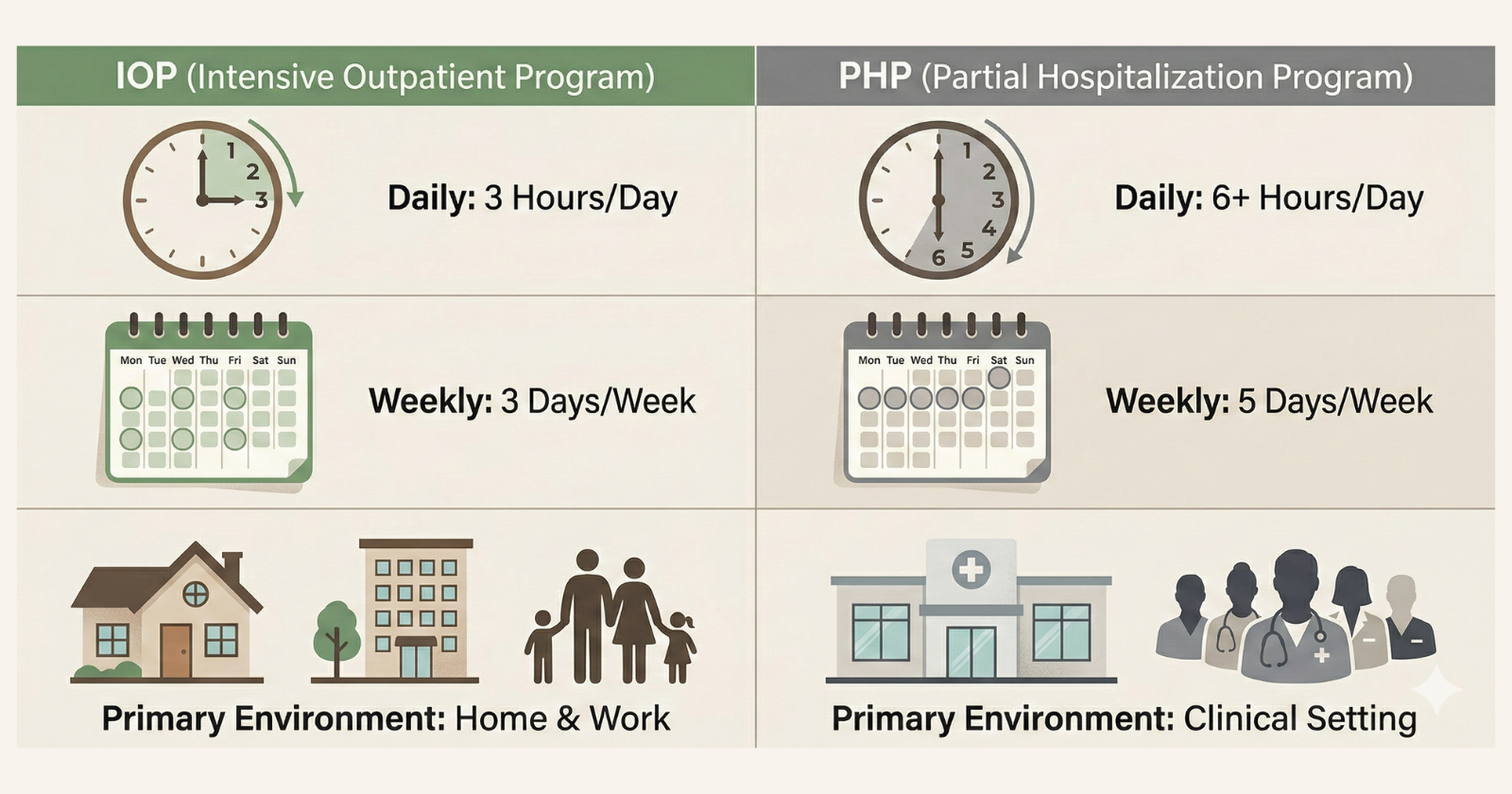
Intensive Outpatient Programs (IOP programs) typically meet several days per week for a few hours per day. This structure provides repeated therapeutic contact while still leaving substantial time for work, school, or family responsibilities.
Partial Hospitalization Programs (PHP programs) usually meet five days per week for approximately six hours per day. This resembles a full therapeutic day model and offers a greater concentration of therapeutic engagement within each week.
However, treatment intensity is not defined by hours alone.
Level of Daily Monitoring and Support
IOP provides structured support across the week, with time between sessions to practice skills independently. This works well when symptoms are present but relatively stable between program days.
PHP offers closer daily monitoring and more frequent medical oversight. This provides intensive support when emotional shifts, medication responses, behavioral patterns, and changes in physical health require shorter gaps between interventions. When regulation feels fragile, mood shifts are rapid, or severe symptoms fluctuate unpredictably, this higher level of daily structure can strengthen stabilization.
In practical terms:
-
IOP supports progress alongside daily life demands.
-
PHP provides a more immersive therapeutic environment and intensive therapy when stability requires closer daily reinforcement.
The higher the frequency of monitoring and therapeutic immersion, the greater the containment and stabilization support provided within the week.
Program Structure How Consistently Are Skills Reinforced?
Skill Repetition and Consolidation
In IOP, therapeutic skills are introduced and practiced multiple times per week to support ongoing skill-building. Participants often return to treatment after testing strategies in real-world settings and adjusting daily routines accordingly.
In PHP, skills are reinforced within structured daily routines. Because there is less time between learning, practice, and review, individuals receive more immediate feedback within consistent therapeutic programming.
The distinction is not simply about what therapies are offered, but how frequently they are practiced and reinforced.
Therapeutic Immersion and Group Structure
IOP typically includes structured group therapy sessions and individual counseling within each treatment week. These sessions provide repetition, accountability, and peer feedback.
PHP involves a more immersive daily schedule that may include multiple group sessions across the therapeutic day. Evidence-based modalities such as dialectical behavior therapy and cognitive behavioral therapy are often delivered in longer, integrated blocks within this structured framework.
When daily routines are significantly disrupted by mood instability or emotional dysregulation, the consistency of a full therapeutic day can help reestablish rhythm and reinforce recovery goals more predictably.
Learn more about how differences in structure within the same level of care affect treatment stability.
Clinical Support How Integrated Is the Care Team?
Both IOP and PHP include access to psychiatric evaluation, psychiatric care, and medication management.
In PHP, daily therapeutic contact allows clinicians and medical staff to observe patterns more frequently. Communication between therapists, psychiatric providers, and case managers becomes more frequent within a coordinated treatment plan.
Structured programs often include case management services as part of comprehensive treatment. Closer coordination can reduce delays in adjusting care plans and strengthen continuity with medical professionals.
Some individuals benefit from additional environmental stability and a strengthened support system, particularly when stepping down from inpatient or residential treatment. Transitional housing options may complement PHP-level structure by providing a more supportive environment when home environments contribute to instability. This gradual reduction in structure helps consolidate gains while increasing independence and maintaining ongoing support.
When IOP Is Often Appropriate
An Intensive Outpatient Program is often appropriate when:
-
Symptoms are present but relatively stable between treatment days
-
Emotional regulation improves and holds for multiple days at a time
-
Work, school, caregiving, or family responsibilities remain manageable
-
Coping strategies are intermittently accessible and can be practiced independently
-
There is no need for daily monitoring to maintain stability
IOP supports individuals who need more structure than weekly therapy but do not require a full therapeutic day model.
When PHP Is Often Appropriate
PHP may be appropriate in two common situations.
When Daily Structure Is Needed for Stabilization
PHP is often considered when emotional instability, co-occurring conditions, or addiction recovery needs require more structured daily reinforcement:
-
Mood shifts are rapid or unpredictable
-
Emotional regulation deteriorates quickly between program days
-
IOP-level structure has not been sufficient to consolidate progress
-
Coping strategies are understood but not consistently accessible during distress
When Transitioning From Inpatient or Residential Care
PHP frequently serves as a step-down level of care after inpatient hospitalization or residential treatment. It provides daily immersion and intensive therapy while reducing inpatient containment.
When Clinicians Recommend Stepping Up From IOP to PHP
A step-up may be recommended when:
-
Symptoms repeatedly destabilize between IOP sessions
-
Emotional crises increase in frequency
-
Progress plateaus and does not consolidate
-
Avoidance or impulsive coping escalates
-
The pace of symptom fluctuation requires closer monitoring
Adjusting levels of care reflects a change in stabilization needs, not a failure.
When PHP Is Not Necessary
PHP may not be necessary when:
-
Symptoms are stable for multiple days between IOP sessions
-
Daily functional demands are manageable
-
Coping strategies are accessible independently
-
No higher level of medical oversight is required
Frequently Asked Questions
How many hours a week is IOP? — IOP usually runs for 9–15 hours per week, spread across multiple days.
How many hours a week is PHP? — PHP typically runs 20–30 hours per week in a full-day structured environment.
Can PHP be stepped down to IOP? — Yes. PHP is often followed by IOP as symptoms stabilize and daily intensity is no longer required.
Is IOP enough after inpatient? — Sometimes. It depends on symptom severity, daily stability, and the level of support available outside of therapy.
How is the level of care determined? — The appropriate level depends on how consistently emotional stability holds between treatment days and how much daily structure is needed to maintain progress. Learn more about how clinicians determine the appropriate level of care.
Reviewed by Chris Hudson, LPC, LCDC
Founder & Executive Director – Lucent Recovery and Wellness, Austin, TX (2020–Present)
Leads clinical programs and develops innovative therapeutic approaches integrating experiential and creative therapies.
Board Member – Reklaimed, Austin, TX
Supports recovery-focused nonprofit initiatives fostering community and creative skill-building.
Clinical Leadership Roles – South Meadows Recovery, Inc.
Held leadership positions overseeing program development, clinical operations, and organizational management.
EDUCATION & CREDENTIALS
- M.A., Clinical Mental Health Counseling – Seminary of the Southwest (2021)
- B.A., Studio Art – Lewis & Clark College (2004)
- Licensed Professional Counselor (LPC), Texas
- Licensed Chemical Dependency Counselor (LCDC), Texas