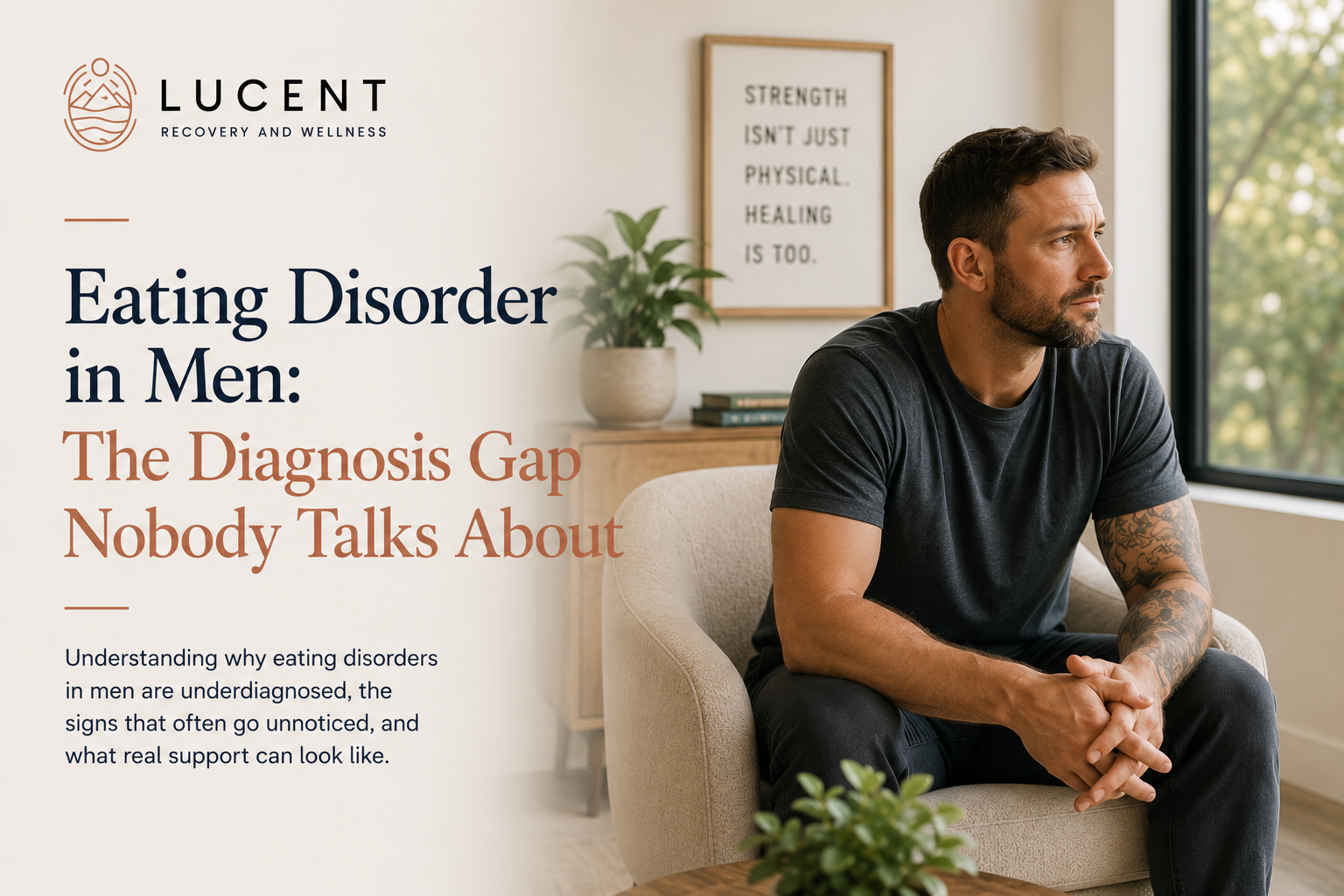
Eating Disorders in Men: The Diagnosis Gap Nobody Talks About
Authored by the Clinical Team at Lucent Recovery and Wellness
Reviewed by Chris Hudson, MA, LPC, LCDC
When men talk to us about food and their bodies, they rarely use the phrase eating disorder. They talk about discipline. About cutting. About being strict in the off-season, or dialling in their macros, or needing to get their body fat down before a trip. The vocabulary is athletic and the framing is achievement. It takes a while before anyone says the quiet part, which is that it stopped being a choice some time ago.
Eating disorders in men and boys are underdiagnosed, and the reasons are not mysterious. The stereotype says these are conditions that affect teenage girls. Men internalise that, families internalise it, and so do a good number of clinicians. The result is a population that gets identified late, treated less, and studied less.
This article covers what the research shows, why male presentations often look different, and what to do if any of it sounds like you or someone you love.
What the research shows
Start with the population data, because it sets a floor. The National Institute of Mental Health reports lifetime prevalence among adolescents aged 13 to 18 at 2.7 percent overall, broken out as 3.8 percent of girls and 1.5 percent of boys. Among adults, anorexia nervosa lifetime prevalence is 0.9 percent in women and 0.3 percent in men. Those figures come from national diagnostic interviews, and by that measure eating disorders are meaningfully more common in women and girls.
That is not the whole picture, and here is where it gets more interesting.
A 2025 study by Kyle Ganson and colleagues at the University of Toronto, published in Eating Behaviors, screened boys and men across the United States and Canada and found that 21.3 percent met criteria for a probable eating disorder, with bulimia nervosa the most common probable diagnosis and anorexia nervosa the least. Among the subgroups, roughly 20 percent of men aged 18 to 24 and 18 percent of those aged 25 to 29 met criteria. Gay and bisexual men had approximately twice the odds compared with heterosexual men. Higher BMI was associated with greater odds, rising about 18 percent for each one-point increase.
We want to be careful with that number, because it is easy to misuse. Twenty-one percent is dramatically higher than NIMH’s population estimates, and the two are not measuring the same thing. Ganson’s study used screening instruments in a non-representative online sample, which identifies probable cases rather than confirming clinical diagnoses. Screening deliberately casts a wide net and will always produce higher figures than diagnostic interviews. Anyone telling you one in five men has an eating disorder is overstating what this research found.
What the study does establish is more useful than a headline. Male eating disorder symptoms are common enough in these samples to be a genuine clinical concern, they skew toward bulimic and binge-type presentations rather than the anorexia stereotype, and the risk is unevenly distributed in ways that a thinness-focused screen would miss entirely.
Alongside that, a 2023 review by Tiffany Brown and Pamela Keel in the Annual Review of Clinical Psychology documents how eating disorder research and clinical care have historically focused on girls and women, which reinforced the idea that these are a female problem. And a 2025 commentary by Hans Hoek in the International Journal of Eating Disorders notes that while recognition among males has improved, they remain underrepresented both in clinical settings and in research.
Underrepresented in research is not a minor footnote. It means that when a man does present, the evidence base a clinician draws on was largely built without him in it.
Why male presentations get missed
The goal is often not thinness
This is the single biggest reason screening fails. A meaningful share of men with disordered eating are not trying to be smaller. They are trying to be leaner, more muscular, more defined. The behaviours can be just as rigid and just as consuming, but they point in a different direction, so a clinician asking about fear of weight gain may hear a confident no and stop there.
The behaviour reads as virtue
Weighing food, training twice a day, eliminating entire food groups, and structuring social life around a regimen all attract praise in a way that other symptoms do not. Someone whose life has narrowed considerably gets told they have willpower. That feedback makes the pattern harder to question, not easier.
Exercise is the vector
For many men the compensatory behaviour is training rather than anything that looks like a classic eating disorder symptom. It is socially sanctioned, easy to explain, and almost never flagged.
Nobody asks
Men are less likely to be screened, and less likely to raise it themselves. Naming it means claiming a condition culturally coded as feminine, which is a real barrier and not a trivial one.
It arrives dressed as something else
Men often present for anxiety, low mood, insomnia, irritability, injuries that will not heal, or relationship strain. Those are the presenting problems. The eating comes up later, if at all.
The conditions underneath
That last point is where our work usually sits.
NIMH’s comorbidity data shows eating disorders overwhelmingly travel with other psychiatric conditions. More than half of adults with anorexia nervosa, nearly 95 percent of those with bulimia nervosa, and roughly 79 percent of those with binge eating disorder met criteria for at least one other core disorder, with anxiety disorders the most common across all three.
For the men we see, the entry point is almost always one of those other conditions. Someone comes in because the anxiety will not switch off, or because the low mood has taken their motivation, or because something they have carried for years has become unmanageable. The rigid relationship with food and training surfaces later, once there is enough trust for it to be mentioned without shame attached.
Asking a man to give up a coping behaviour without treating the distress it was managing rarely holds, particularly when the behaviour is also the main thing holding his self-esteem together.
How we work
Lucent is a clinician-owned outpatient mental health practice in Austin. We treat anxiety, depression, trauma, obsessive patterns, and substance use through our intensive outpatient program, our partial hospitalization program, and mental health counseling, with master’s level case management handling the practical side.
For many of the men we see, group work is the turning point. Shame does not survive contact with other people who recognise it, and a room of men who have quietly organised their lives around food and training tends to do something that individual sessions alone do not.
We will also say plainly that we do not treat compulsive exercise as a fitness problem to be optimised. If training has become the mechanism, that is a clinical matter, and the answer is not a better program.
If you are already working with a physician or another provider, we coordinate with them rather than asking you to start over.
If you are worried about a man in your life
The instinct is usually to comment on the behaviour. Try not to lead there.
Comments about food, weight, appearance, or physique tend to reinforce the framework the disorder already runs on, even when they come from love and even when they are complimentary. Praising someone’s discipline or noticing how lean they are looking can land as encouragement to continue.
What tends to help more is naming what you have noticed about their life rather than their body. That they seem more anxious. That they have stopped coming to things. That meals out have become difficult. That the training schedule has taken over. Those observations are harder to argue with and they do not put anyone on trial.
Then let it be a conversation rather than a confrontation, and expect it to take more than one attempt. Our What to Expect for Families page covers what involvement looks like in practice.
Frequently asked questions
Can men have anorexia? Yes. It is less common than in women, with NIMH putting adult lifetime prevalence at 0.3 percent in men against 0.9 percent in women, but less common is not rare, and men with anorexia are often identified later and at greater medical severity because nobody was looking.
Is muscle dysmorphia an eating disorder? Muscle dysmorphia is classified as a specifier of body dysmorphic disorder rather than an eating disorder, but the two frequently overlap and the eating behaviours involved can be seriously disordered. It is worth assessing either way.
What if I am not underweight and my bloodwork is normal? Neither rules anything out. Most people with eating disorders are not medically underweight, and bulimic and binge-type presentations, which appear to be the more common male pattern in the screening research, are not characterised by low weight at all.
Where is the line between being disciplined about training and having a problem? There is no single threshold, but useful questions are how much mental space it occupies, what happens emotionally when the routine is disrupted, and whether it has cost you relationships, work, or sleep. If the honest answer to the last one is yes, the label matters less than the conversation.
Are eating disorders in gay and bisexual men more common? The Ganson study found roughly twice the odds compared with heterosexual men. That is one screening study, so treat it as a signal rather than a settled figure, but it is consistent with the broader literature on minority stress.
Do I have to call it an eating disorder to get help? No. You do not need a diagnosis or the right vocabulary to have an assessment. Plenty of the men we see never use the term.
What we would want you to take from this
The research picture is genuinely mixed, and we would rather show you that than tidy it up. Population surveys put male eating disorders in the low single digits. Screening studies in specific samples put symptoms far higher. Both are true measurements of different things, and the honest summary is that we do not know the real figure as precisely as we would like, largely because men have been left out of this research for decades.
What is not ambiguous is the direction of the error. Men get identified late, or not at all, because the screening tools, the stereotype, and the cultural script all point away from them.
If food, your body, or your training has taken up more of your life than you want it to, that is reason enough to talk to someone. You do not need to be in crisis and you do not need to be certain.
Reach out
Our team is glad to talk through where you are, with no pressure and no assumptions. If you have been looking for eating disorder treatment in Austin, TX and are not sure where to start, an assessment is the place to begin.
For eating disorder support and referrals, the National Alliance for Eating Disorders runs a free helpline staffed by licensed therapists at 1-866-662-1235, Monday through Friday, 9:00 a.m. to 7:00 p.m. Eastern. If you or someone you love is in crisis, the 988 Suicide and Crisis Lifeline is available 24 hours a day by call or text at 988.
You can contact our team or call 512-588-3899.
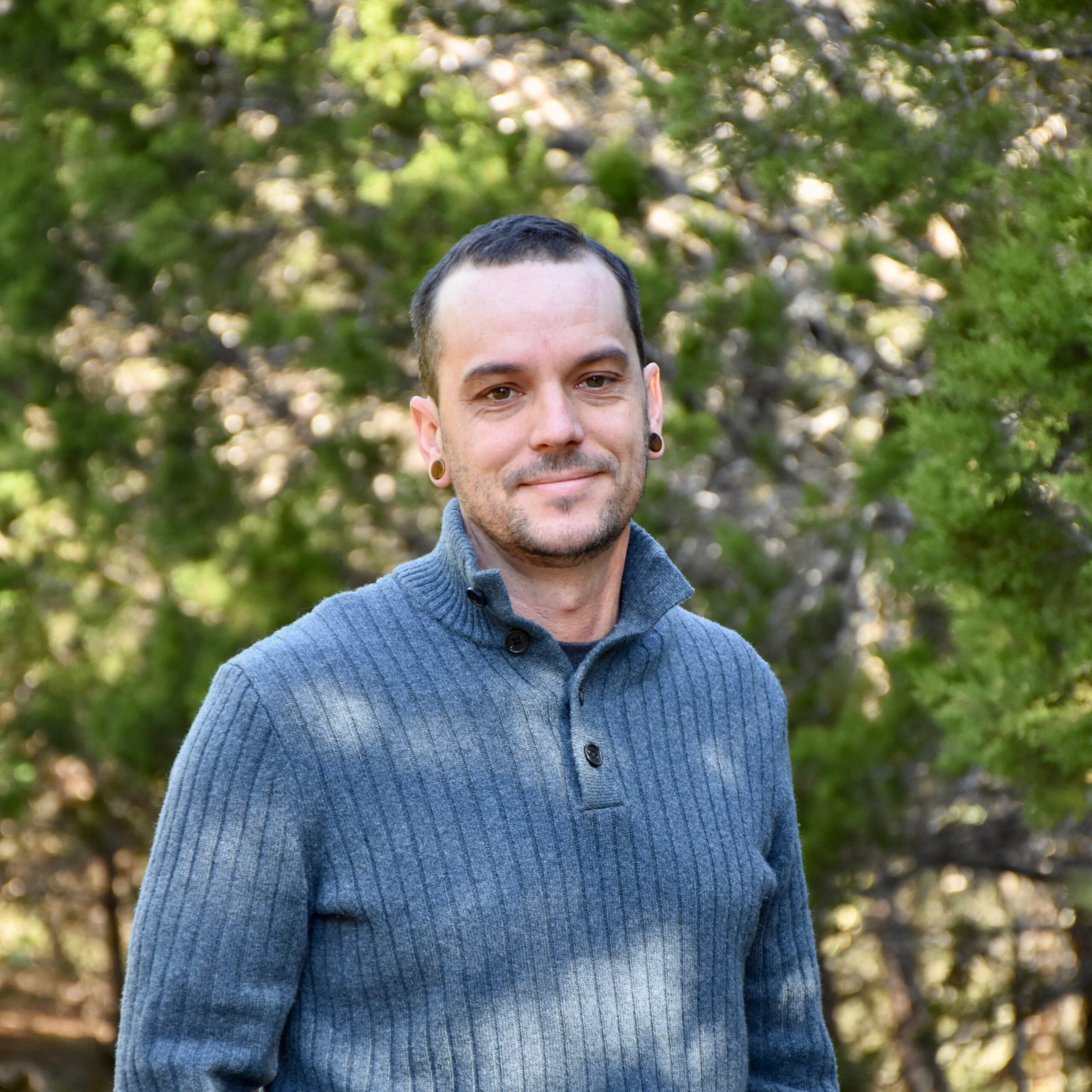
Reviewed by Chris Hudson, LPC
Founder & Executive Director – Lucent Recovery and Wellness, Austin, TX (2020–Present)
Leads clinical programs and develops innovative therapeutic approaches integrating experiential and creative therapies.
Board Member – Reklaimed, Austin, TX
Supports recovery-focused nonprofit initiatives fostering community and creative skill-building.
Clinical Leadership Roles – South Meadows Recovery, Inc.
Held leadership positions overseeing program development, clinical operations, and organizational management.
EDUCATION & CREDENTIALS
- M.A., Clinical Mental Health Counseling – Seminary of the Southwest (2021)
- B.A., Studio Art – Lewis & Clark College (2004)
- Licensed Professional Counselor (LPC), Texas
- Licensed Chemical Dependency Counselor (LCDC), Texas